



Property Taxes: 2026 Homeowner Tax Guide
Fact Checked
FileTax.com content is reviewed for accuracy, timeliness, and completeness. It undergoes a structured editorial review process involving writers and expert reviewers.
More on our editorial standards Meet our editorial team Todd MonahanTax Content Specialist
 Lea Uradu, JDTax Content Reviewer
Your Takeaways:
- Property taxes are based on assessed value, not market price.
- You can deduct them if you itemize, but SALT limits apply.
- Local exemptions can reduce what you owe.
- Taxes are prorated when you buy or sell a home.
- Renters pay property taxes indirectly through rent.
Property taxes are a local tax that funds community services like schools and roads. This guide breaks down how property taxes are calculated, what tax deductions and exemptions are available, how they impact renters, and what to expect when you buy or sell a home.
Welcome to the world of homeownership, where you might feel like you’re riding a rollercoaster of highs and lows. The joys of owning your own space come with plenty of financial responsibilities, and one of the most common ones you’ll hear about is property taxes.
Property taxes are best thought of as the contribution you make to the community you live in. They pay for the schools your kids might attend, the roads you drive on, and even the parks where you walk your dog.
What you pay doesn’t disappear into a black hole, but instead, might come back to you in the form of a tax deduction, which can lower the overall tax bill you get in the mail.
Nevertheless, the tax deductions surrounding these kinds of taxes can be murky. With what seems like endless rules, forms, and deadlines to decode, we’re here to make it a bit simpler. In this guide, we’ll explain how property taxes are calculated, what you can deduct, and how exemptions can save you money.
Homeowner Tax Tips: What to Know Before You File
What Are Property Taxes?
Definition: A property tax is a tax levied by local governments on the value of real estate. These taxes are a primary source of funding for local services such as public schools, police, fire departments, and infrastructure.
A property tax is a local tax based on your home’s assessed value. It’s collected to fund schools, roads, and other public services.
Unlike your income tax, which is a federal tax, your property tax rate is determined by your local government, such as your county or city. The funds generated serve as the lifeblood of your community, helping to pay for everything from the fire department to the local library.
The tax assessment process is a two-part affair. First, a local official, generally a tax assessor, will determine the value of your home by visiting your property address. This value is known as the “assessed value,” and it might not be the same as your home’s market value (which is what your home might sell for).
Next, your local taxing authority applies a tax rate, often called a “mill rate,” to this value. For reference, one mill is equal to one-tenth of a cent ($0.001), or $1 for every $1,000 of assessed value.
These tax rates vary significantly based on your location, as local governments determine the rates based on regional needs and budgets. An urban area with a high population and extensive public services may have a rate of 2.5%, for example, while a rural area with fewer services might levy rates as low as 0.8%.
Payment Options for Your Tax Bill
You’ll typically receive a tax bill once or twice a year from the taxing authority, but the payment options and due dates (as well as required postmarked dates) vary by location. Some jurisdictions might require a single annual payment due in November, while others might split it into two semiannual payments, perhaps one in August and another in January.
If you have a mortgage, your taxes are often paid through an escrow account, meaning a portion of your monthly mortgage payment is set aside to cover your taxes. Your lender pays the bill on your behalf when it's due.
It’s also important to note that local exemptions, such as a homestead or senior freeze, can reduce the taxable portion of your property’s value. While they vary based on where you live, these programs are designed to provide relief to certain homeowners.
How Property Taxes Are Calculated
If you’re feeling some anxiety over what you might owe, rest assured that the amount you’ll be charged with paying isn’t some mystery number pulled out of a hat. Instead, it’s based on a basic formula that you can calculate as long as you know your home’s assessed value and your local mill rate.
The formula is as follows: Assessed Value × Mill Rate = Tax Amount.
Again, the assessed value is the value your local assessor places on your home, strictly for tax purposes. To arrive at this figure, assessors typically select recent sales or comparable properties, as well as other factors. In some areas, the assessed value is calculated as a certain percentage of the home’s fair market value.
The mill rate is the rate set by your local government based on its budget needs, and, like your assessed value, it can change. If a town needs more money to fund a new school or repair roads, the mill rate might go up.
Example: If your home has an assessed value of $350,000 and your local tax rate is 1.25% (or 12.5 mills), then you’d multiply $350,000 x 0.0125 to get the amount of $4,375. This $4,375 is the amount you owe. |
|---|
In addition to the general tax rate, your bill might also include special assessments or levies for specific projects, like a new sewer system or community park. These are voted on by the community and added to your bill. If you’re interested in getting a detailed breakdown of your area’s specific property tax laws, contact your local assessor’s or tax collector’s office or website.
How Property Taxes are Determined
Factor | How It's Determined |
|---|---|
Assessed Value | Determined by a local property assessment based on market data and property features. |
Mill Rate | Set by the local government (city, county, school district) to meet budget requirements. |
Exemptions | Applied to the assessed value, reducing the taxable amount based on eligibility. |
Special Levies | Voted on by residents to fund specific community projects, adding to the total bill. |
Final Tax Bill | The result of the adjusted assessed value multiplied by the total tax rate. |
Can You Deduct Property Taxes on Your Federal Return?
While you’re obligated to pay the full amount due for your property taxes each year, you may be able to deduct the state and local taxes (SALT) you pay.
However, there’s a catch, and it’s a big one: the SALT deduction is capped at $40,000 per household per year ($20,000 if you’re married filing separately). The deduction limit drops to $10,000 for those earning $600,000 or more.
This cap applies to the combined total of your property taxes, state and local income taxes, or sales taxes.
If you’d like to claim this deduction, you must itemize your deductions on Schedule A (Form 1040) instead of taking the standard deduction. This may not always make the best financial sense; whether itemizing is the right move for you depends on your total deductible expenses. If your itemized deductions, including the SALT deduction, mortgage interest, and charitable contributions, add up to more than the standard deduction, go ahead and itemize. Otherwise, you may want to pass.
Standard vs. Itemized Deductions
Deduction Type | 2026 Standard Deduction (Projected) | Who It's For |
|---|---|---|
Standard Deduction | $32,200 (Married Filing Jointly) | Taxpayers who don't have enough deductions to make itemizing worthwhile. It’s the simpler, more common option. |
Itemized Deductions | Varies | Taxpayers whose total eligible expenses (SALT, mortgage interest, etc.) exceed the standard deduction amount. This includes the property tax deduction. |
As you go about this process, make sure you have a clear idea of what you can and cannot deduct.
You can deduct state and local real estate taxes you paid during the year. However, you cannot deduct things like charges for services to your specific property, like trash collection, sewer fees, or assessments for building new sidewalks in your neighborhood. Homeowners association (HOA) dues are also not deductible in this way. All of these details are outlined completely in the official Schedule A instructions.
State and Local Property Tax Exemptions
Beyond the federal deduction, you might also be able to lower your property tax bill directly through exemptions offered by your state or local government. These exemptions work by reducing your home’s assessed value, thereby lowering the amount of tax you owe.
Some of the most common exemptions include:
- Homestead Exemption: This is one of the most common exemptions, helping to reduce the taxable value of your primary residence. You can’t claim it on a vacation home or rental property.
- Agricultural Exemption: Property owners who use their land for agricultural purposes such as farming, ranching, or timber production may qualify for an agricultural exemption. This reduces the taxable value of the land based on its productivity rather than its market value, often resulting in significant property tax savings.
- Senior Citizen Exemption: Many states offer property tax relief for older homeowners, often based on age and income limits. Some places offer a "senior freeze," which locks in the assessed value of your home so it doesn't increase.
- Disabled Veteran Exemption: Veterans with a service-connected disability may be eligible for a significant reduction or even a full exemption from property taxes.
- Disability Exemption: Homeowners with qualifying disabilities may also be eligible for a reduction in their property's assessed value.
Example: Your home is assessed at $200,000. You qualify for a $25,000 homestead exemption. This reduces your home's taxable value to $175,000. If your tax rate is 1%, you would pay $1,750 instead of $2,000, saving you $250. |
|---|
Some states also offer “circuit breaker” programs, which provide a tax credit when property taxes exceed a certain percentage of a homeowner’s income. To find out what exemptions and relief programs are available, visit your state’s Department of Revenue website or contact your local tax assessor’s office. You can also find more information in IRS Publication 530, Tax Information for Homeowners.
State-Level Property Tax Exemptions
State | Common Exemption |
|---|---|
Offers a general homestead exemption of $100,000 for school taxes (Texas has no state property tax). | |
Provides a base homestead exemption of up to $50,000. | |
Offers a $6,500 homestead credit to reduce property tax liability. |
How Property Taxes Affect Renters
If you’re a renter, you probably think these taxes don’t apply to you. After all, you don’t receive a tax bill from the county. So you’re in the clear, right?
Sort of. Technically, you’re contributing to those taxes, too. Landlords are business owners, and property tax is a cost of doing business, just like maintenance or utilities. They typically factor property tax expenses into the rent they charge, meaning renters indirectly share the burden of these taxes through their monthly payments.
Example: Your landlord’s annual property tax bill is $36,000 for a 10-unit apartment building, that amounts to about $3,600 per unit per year. If your rent is $1,500 per month, about $300 of that could be going toward property taxes, amounting to $3,600 each year. |
|---|
Recognizing this, some states go so far as to offer property tax relief for renters, usually in the form of a tax credit or refund. These programs are designed to help offset the portion of rent that covers property taxes.
Again, if you’re not sure if this applies to you, contact your state’s Department of Revenue before you file your taxes.
Property Tax Changes When You Buy or Sell a Home
Planning on buying or selling a home? You’re adding another layer of complexity to the property tax onion. Since you’ll likely only own the home for part of the year, the taxes for the year are split, or “prorated,” between the buyer and the seller. This transaction is usually handled at closing.
This is because the property tax year and the calendar year aren’t likely to align perfectly (remember, these taxes are normally paid in the fall, or perhaps twice a year, rather than neatly at the close of December or start of January).
The closing statement, often a HUD-1 or similar document, will lay out how the taxes should be divided. If the seller has already paid the full year's taxes, the buyer will credit the seller for the portion of the year they will own the home. If the taxes haven't been paid yet, the seller will credit the buyer for the portion of the year they owned the home, and the buyer will be responsible for paying the full bill when it comes due.
Example: If your property taxes are $4,000 and you sell your home exactly halfway through the year, you’ll be responsible for 50% of the taxes, or $2,000. The buyer is responsible for the other $2,000. |
|---|
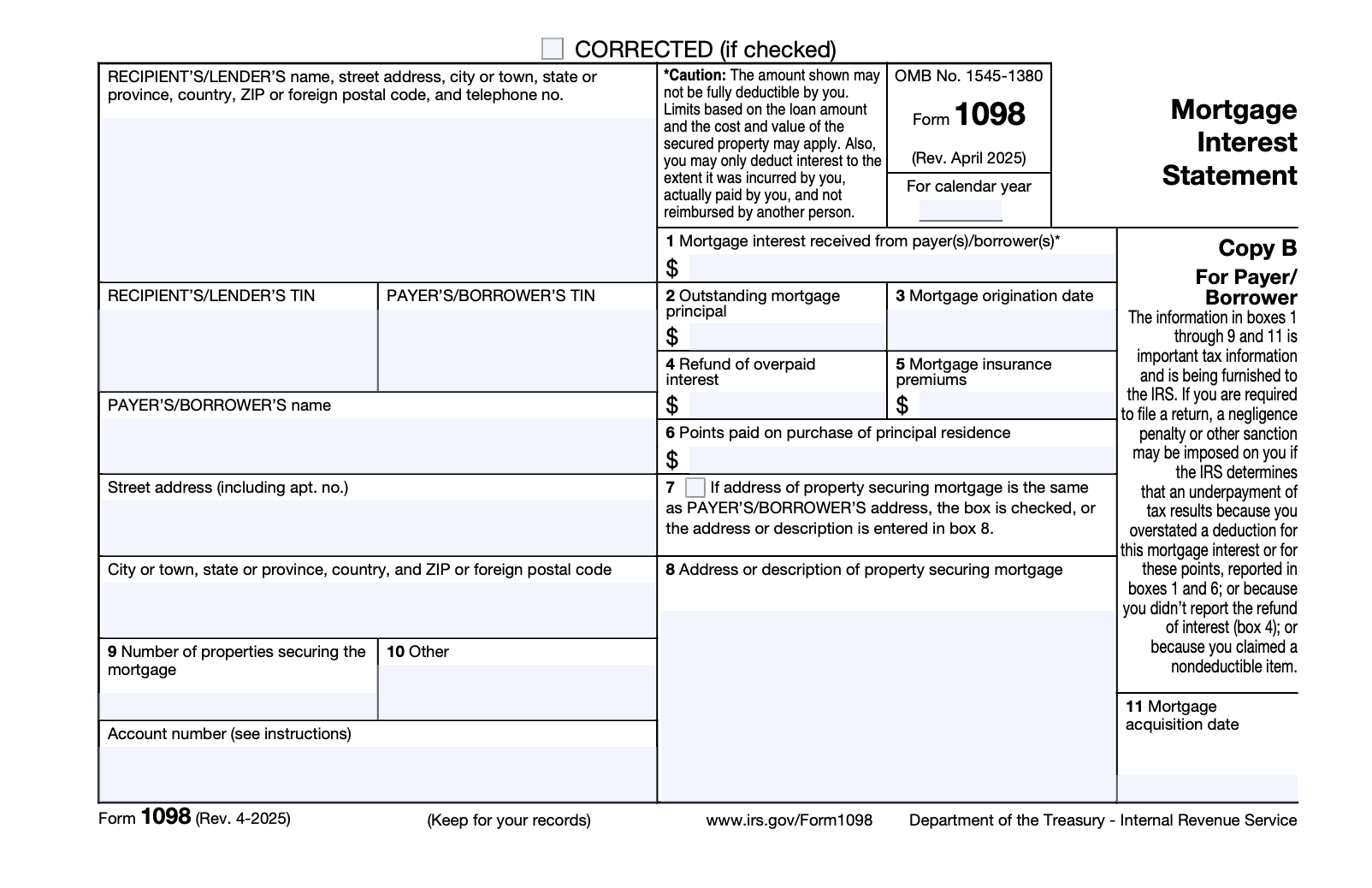
After you buy a home, if you have a mortgage with an escrow account, your lender will collect property tax payments with your monthly mortgage payment and pay the tax bill for you. At the end of the year, your lender will send you Form 1098, the Mortgage Interest Statement. This form will show you the amount of mortgage interest you paid, and it often includes the amount of property taxes paid from your escrow account. This is the figure you'll use when filing your taxes.
It’s also worth mentioning that a home sale has additional (and sometimes complex) implications for capital gains and the home sale exclusion. These are important tax topics to discuss with a professional.
Business Property Taxes and Rental Deductions
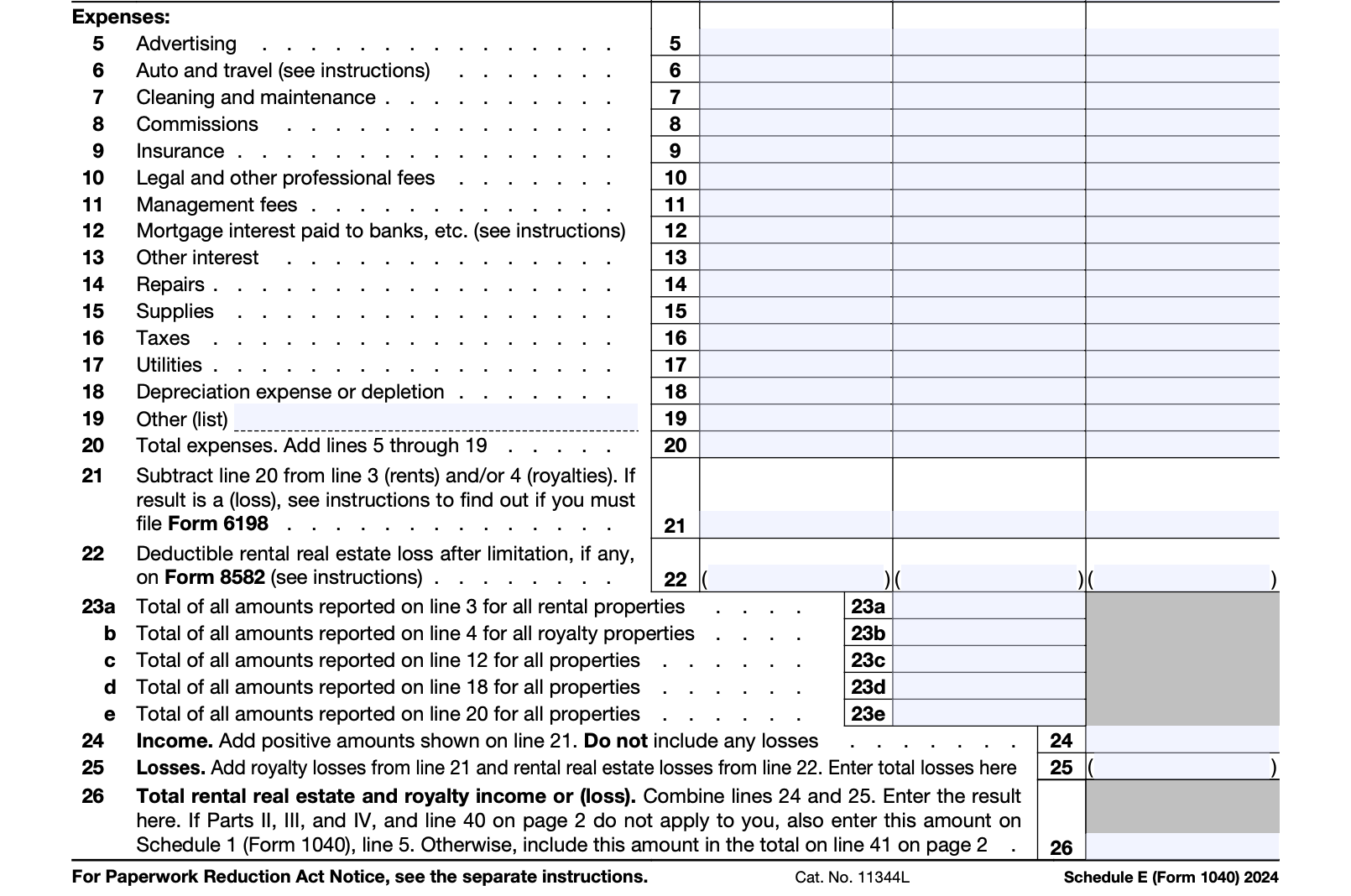
For a rental home, you’ll deduct property taxes as a rental expense on Schedule E (Form 1040). These taxes are deducted from your rental income, reducing the amount of profit you're taxed on. Unlike the SALT cap for personal residences, there is no limit on the amount of property tax you can deduct for a rental property.
If you own a property used for your business, such as an office or storefront, the taxes are deductible as a business expense. These are typically claimed on your business tax return, for example, on Form 4562 for depreciation. These deductions are considered an ordinary and necessary cost of running a business.
So what’s the TL;DR? Essentially, if your home is a personal residence, property taxes are an itemized deduction. If it’s a rental or business property, it’s a business expense deducted directly against income, which often results in a more significant tax benefit.
SALT Deduction Updates (2025–2026)
From the moment it was introduced in 2017, the $10,000 cap on the SALT deduction has been a contentious topic.
The SALT deduction has been around just about as long as federal income tax itself, dating back to the Revenue Act of 1913. For decades, it allowed homeowners to deduct unlimited amounts of property taxes, state income taxes, and, in many cases, sales taxes. That all changed in 2017 with the Tax Cuts and Jobs Act, which imposed a hard cap.
Starting in tax year 2018, the maximum combined deduction for state and local taxes has been $10,000 per tax return ($5,000 for married filing separately). It was originally set to run through the end of 2025.
Over the years, this limit sparked multiple legislative attempts to change it. In 2021, the U.S. House briefly passed a version that would have raised the SALT cap to $80,000 through 2030, a move that would have sharply benefited high-income households. However, the change never made it through the Senate, and the bill stalled.
The One Big Beautiful Bill Act, signed into law in 2025, increased the SALT cap to $40,000 for individuals earning less than $500,000 in 2025 ($40,400 in 2026), with the cap scheduled to revert to $10,000 after five years. If you make $500,000 or more, the $10,000 cap still applies.
Congress continues to debate whether to permanently raise, lower, or eliminate the cap; no unlimited deduction is currently in effect.
Year(s) | SALT Deduction Rule |
|---|---|
Pre-2018 | Unlimited deduction for all state and local taxes, including property, income, and sales taxes. |
2018–2021 | Deduction capped at $10,000 ($5,000 MFS) due to the Tax Cuts and Jobs Act of 2017. |
2022–2024 (proposed but not enacted) | The House-passed Build Back Better Act would have increased the cap to $80,000 through 2030, but the bill did not pass the Senate. |
2025 | One Big Beautiful Bill Act raises the cap to $40,000 for individuals with income under $500,000; $10,000 cap continues for others. Cap is scheduled to revert after 5 years. |
Post-2029 | Unless new legislation is passed, the cap is set to return to $10,000. Unlimited deduction has not been restored. |
So, if you’re filing taxes in 2025, review whether you qualify for the $40,000 cap or if the $10,000 limit still applies in your situation. You’ll need to itemize on Schedule A of Form 1040 to claim any SALT (including property tax) deductions.
Always double-check the IRS website for the most current updates and further information, as the rules tend to change with shifting politics.
Key IRS Forms and References
Form / Publication | Purpose | Link |
|---|---|---|
Publication 530 | Tax Information for Homeowners | |
Publication 523 | Selling Your Home | |
Publication 936 | Home Mortgage Interest Deduction | |
Schedule A (Form 1040) | Itemized Deductions | |
Form 1098 | Mortgage Interest Statement |
File Your Taxes With Confidence
Property taxes are unavoidable (though, we’ll admit, sometimes unpleasant!) part of being a homeowner and a good citizen of your community.
While they do exist as a significant expense, understanding how they work and why can help you manage them more effectively.
Don’t let confusing laws or missed credits trip you up. Take charge and create your own affordable path to homeownership.
FileTax.com makes sure your property taxes work for you, not against you, automatically applying every deduction, SALT credit, and renter relief you qualify for.
Ready to stop overpaying and start saving? Let’s make your next tax bill your smartest move yet.
💡 File your taxes with confidence. FileTax automatically applies property tax deductions, SALT credits, and renter relief programs when you file online.
Frequently Asked Questions
Property taxes are local taxes on real estate paid by property owners. These funds support community services like schools and police. If you own a home, you pay them directly. If you rent, you pay them indirectly through your rent.


