




How Long Do Divorce Settlement Payments Last?
Fact Checked
FileTax.com content is reviewed for accuracy, timeliness, and completeness. It undergoes a structured editorial review process involving writers and expert reviewers.
More on our editorial standards Meet our editorial team Andrew WalshCPA, CFP CTFA & Tax Content Specialist
 Lea Uradu, JDTax Content Reviewer
Your Takeaways:
- The IRS does not set how long divorce settlement payments last—courts and settlement agreements do.
- Divorce settlements can be paid as a lump sum or through ongoing payments, depending on the agreement.
- Lump-sum settlements are usually not taxable and avoid recurring tax issues.
- Ongoing payments can affect your taxes each year, especially if they’re structured as alimony.
- Child support payments are never taxable or deductible, regardless of how long they last.
Divorce settlement payments can be structured as lump-sum or ongoing. The IRS doesn’t set a timeline for divorce settlement payments—courts and settlement agreements do. However, the tax treatment of these payments varies: lump sums typically avoid recurring tax issues, while ongoing payments like alimony or child support can impact your annual filings.
Divorce Settlement Payment Structures: Lump Sum vs Ongoing
When the dust settles after a divorce, one of the biggest financial questions is: how long do I have to pay my divorce settlement? The answer depends less on the IRS and more on the settlement agreement and court order you and your former spouse sign.
Divorce settlements generally fall into two categories:
- Lump-sum payment – A one-time transfer of assets, money, or property to the receiving spouse. This often includes the transfer of marital property or retirement accounts.
- Ongoing payments – Monthly or annual amounts spread over a period of years. This could include structured buyouts, spousal support, or agreements tied to shared property sales.
The IRS doesn’t dictate how long settlement payments must last. Instead, the duration depends on your settlement agreement and court order.
For a full breakdown of payment structures, see our guide on Divorce Settlements & Taxability.
It’s also important to distinguish settlements from alimony and child support, since those payments follow different tax rules. We’ll cover those distinctions below.
Tax Treatment of Divorce Settlement Payments
Taxes are where things get tricky. While the IRS doesn’t decide how long a settlement lasts, it does determine how payments are treated for tax purposes.
- Lump sum payments are usually not taxable to the receiving spouse and not deductible by the payer. Instead, they’re considered part of dividing marital property.
- Ongoing payments can have ongoing tax implications, since the tax year you pay or receive matters. If payments are structured as alimony, the tax treatment depends on whether your divorce was finalized before or after 2019. See our Alimony & Child Support Tax Rules for details.
- Child support payments are never deductible for the paying spouse or taxable to the custodial parent.
This is why a tax advisor is worth their weight in gold—structuring your payments incorrectly could cost thousands in unnecessary taxes.

Property Transfers and Retirement Accounts in Divorce
Dividing assets during divorce goes far beyond splitting the furniture. For tax purposes, property transfers and retirement accounts need extra attention.
- Marital property, like a primary residence, investments, or business interests, may be transferred under the divorce decree. While these transfers aren’t immediately taxable, the cost basis carries over. That means the receiving spouse could face capital gains taxes later when selling.
- Retirement accounts require a Qualified Domestic Relations Order (QDRO) for division. Without one, early withdrawals could be treated as taxable income plus penalties.
- Group assets (like joint stock portfolios) may be split, but keeping records of cost basis and transfer dates is essential for avoiding tax headaches in future tax years.
When handled correctly, asset transfers are generally tax-free at the time of divorce. When handled poorly, they can trigger costly tax problems years later.
Alimony and Child Support vs. Settlements
It’s easy to confuse divorce settlement payments with alimony payments or child support—but the tax rules are very different.
- Alimony payments (for divorces finalized before 2019, and not updated after December 31, 2018): deductible for the paying spouse, taxable as ordinary income for the receiving spouse.
- Alimony payments (for divorces after 2018): no longer deductible or taxable.
- Child support payments: never deductible or taxable, regardless of the divorce year.
If your separation agreement doesn’t clearly define which payments are settlement, alimony, or child support, you could run into IRS scrutiny. A clear court order or divorce decree keeps each payment type cleanly separated for tax purposes.
For more details, check out our guide on Alimony & Child Support Tax Rules.
Also, remember the child tax credit: only the custodial parent (where the child spends the majority of nights) can claim it—unless the custodial parent signs IRS Form 8332 releasing the claim to the noncustodial parent.
Post-Divorce Tax Considerations
The financial relationship with your ex doesn’t stop once the ink dries. Every tax year after divorce brings new considerations:
- Filing status: If your marriage ends by December 31, you’re no longer “married filing jointly.” Depending on whether you qualify with a dependent child, you’ll likely file as Single or Head of Household.
- Tax withholding: Don’t forget to update your W-4 with your employer. You may owe taxes if you don’t adjust because your withholding assumed a Married Filing Jointly household.
- Child-related credits: Custody arrangements determine whether one spouse qualifies for the child tax credit or other credits.
- Retirement accounts and Social Security Administration updates: Ensure your beneficiary designations and records reflect your new status.
- If divorced, you’re jointly and individually responsible for any tax, interest, and penalties due on a joint return for a tax year ending BEFORE the divorce. This applies even if your divorce decree states that your former spouse is responsible for the amounts due on previously filed joint returns.
Think of this as tax “spring cleaning” after divorce—it keeps your finances aligned with your new reality.
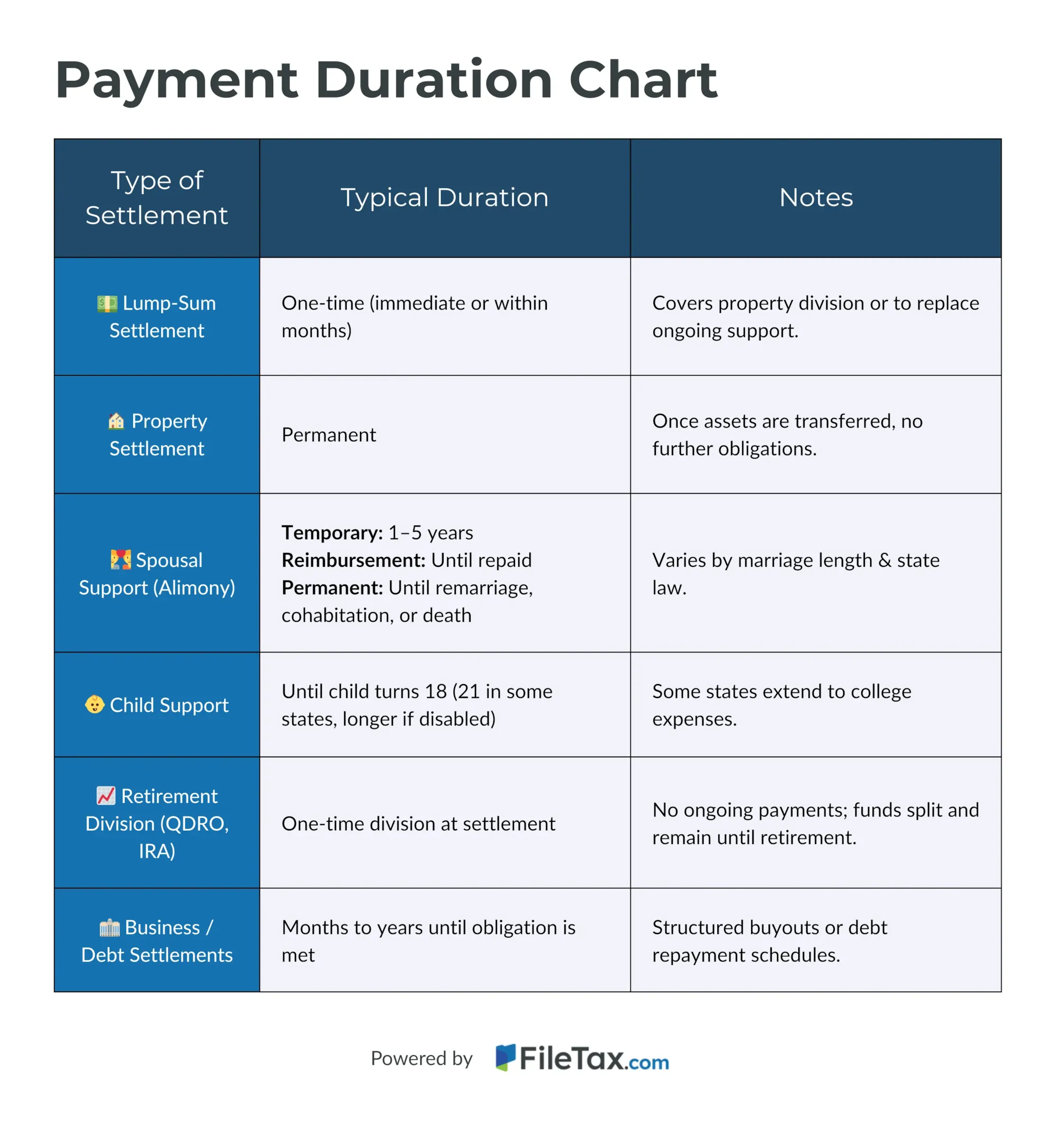
How Long Do Divorce Settlements Last?
So, let’s reevaluate: how long do divorce settlement obligations typically last?
There’s no single answer, but here are the most common scenarios:
- Lump sum payment: Paid once, often within a set deadline from the divorce decree.
- Installment settlements: Spread over a fixed number of years (e.g., 5–10 years), often tied to asset buyouts.
- Spousal support/alimony: The duration depends on state law and court orders. It may last a set number of years, until the receiving spouse remarries or until a certain event occurs.
- Child support: Ends when the child reaches the age of majority (18 or 21 in most states) or graduates from high school.
For tax purposes, the key thing to remember is that the IRS only cares about what type of payment you’re making, not how long it lasts. Whether you pay for one year or twenty, the tax consequences depend on whether the payment is considered a property transfer, alimony, or child support.
When to Seek Professional Help
Divorce can feel overwhelming—you’re dividing assets, restructuring your household, and worrying about money. That’s why getting professional advice is critical.
- A tax advisor can review your settlement agreement to make sure payments are structured to minimize tax liability.
- A family law attorney can ensure the divorce decree and settlement agreement are drafted clearly for tax purposes.
- The IRS has resources like Publication 504, which explains the tax consequences of divorce, from property transfers to dependency claims.
Think of professionals as your financial GPS: they’ll keep you from taking wrong turns that cost you money.
Key Takeaways on Divorce Settlement Duration and Taxes
When it comes to divorce settlements, the real question isn’t just how long divorce settlement payments last—it’s how they’re structured and taxed. A lump sum may be simpler, but ongoing payments can provide financial balance. Either way, understanding the tax implications is essential for both spouses.
👉 Want clarity at a glance? Download our Divorce Settlement Payment Duration Chart to see the timelines for lump sums, alimony, and child support side by side.
Frequently Asked Questions
It depends on the agreement. Lump sums are one-time, while ongoing payments may last for years.


