




Alimony and Child Support: How Taxes Work After Divorce
Fact Checked
FileTax.com content is reviewed for accuracy, timeliness, and completeness. It undergoes a structured editorial review process involving writers and expert reviewers.
More on our editorial standards Meet our editorial team Andrew WalshCPA, CFP CTFA & Tax Content Specialist
 Lea Uradu, JDTax Content Reviewer
Your Takeaways:
- Child support is always tax-free: It’s never deductible for the payer and never taxable for the recipient—no matter when the divorce happened.
- Labels matter more than intent: If payments are tied to a child (or reduced when a child hits a milestone), the IRS treats them as child support—even if you call them alimony.
- Pre-2019 agreements still matter: Older divorce agreements may still follow the old alimony tax rules unless a modification explicitly opts into the new law.
- Reporting mistakes are costly: Misreporting alimony or child support can trigger IRS penalties or missed deductions, so clarity in your divorce decree is critical.
Under current tax law, alimony is only deductible/taxable for divorce or separation agreements finalized before 2019. Child support is never taxable and never deductible. Knowing the tax treatment of support payments can prevent costly mistakes after divorce.
Why Support Payments and Taxes Matter
Divorce doesn’t just split a household — it reshapes finances, responsibilities, and taxes. If you’re navigating a divorce or separation agreement, you’ll quickly discover that support payments come with very different tax consequences. For a full overview of related issues, see our Divorce and Taxes Guide.
Here’s the short version: alimony tax rules changed in 2019, while child support taxes never apply at all. The IRS draws a sharp line between alimony and child support, and that difference can mean thousands of dollars on your tax return.
This guide breaks down:
- What counts as alimony vs child support.
- How the Tax Cuts and Jobs Act (TCJA) reshaped tax treatment.
- Common mistakes and planning strategies.
- What every payer, spouse, and recipient spouse should know before tax season.
👉 Related Read: Learn how support fits into broader divorce settlements and taxability.
What Counts as Alimony?
Alimony (sometimes called spousal support or separate maintenance payments) is financial assistance one spouse pays the other after divorce or legal separation. But not every payment to a former spouse qualifies as “alimony” for tax purposes.
IRS Definition of Alimony
For a payment to qualify as alimony under IRS rules, it must meet all of the following conditions:
- Paid in cash (or cash equivalent): Checks, money orders, or electronic transfers qualify. Property transfers do not.
- Made under a divorce or separation instrument: This includes a divorce decree, separate maintenance decree, or written separation agreement.
- Not designated as non-alimony: The divorce or separation agreement cannot label it as “non-alimony.”
- Separate households: The spouses cannot be members of the same household when the payment is made.
- Ends at the recipient’s death: The obligation must terminate when the receiving spouse dies.
What Doesn’t Count as Alimony
Not all payments between former spouses qualify as alimony for tax purposes. The IRS specifically excludes the following:
- Child support payments: Any amount tied to a child’s needs, or reduced when a child reaches a milestone (e.g., turning 18), is never alimony.
- Voluntary payments: Money given without a court order, divorce decree, or written separation agreement doesn’t qualify.
- Use of property instead of cash: Allowing your ex to live in your house rent-free or drive your car isn’t alimony.
- Payments for jointly owned property: Mortgage, tax, or insurance payments on property you both own don’t count unless your decree specifically designates them as alimony.
- Community Property: Payments that are the spouse's part of community property income.
Understanding these distinctions is step one in applying alimony tax rules correctly.
Source: IRS, Topic no. 452, Alimony and separate maintenance
Alimony Tax Rules Under the Tax Cuts and Jobs Act
Here’s where things get tricky—the Tax Cuts and Jobs Act changed everything.
Pre-2019 Divorce or Separation Agreements
- Payer spouse: Can deduct alimony payments from taxable income.
- Recipient spouse: Must report alimony as taxable income.
- Applies to: divorce decrees, separation agreements, or modifications finalized on or before December 31, 2018.
Post-2018 Divorce or Separation Agreements
- No deduction, no income inclusion.
- The paying spouse cannot deduct alimony, and the receiving spouse does not report it as income.
- Applies to: all agreements executed after December 31, 2018.
Related: Learn more about your financial obligations when divorce is filed.
Modifications and Exceptions
- If a pre-2019 agreement is modified, old rules still apply unless the modification expressly states that the new tax law applies.
- This creates an important planning opportunity when renegotiating terms.

Child Support Taxes: Simple Rules You Need to Know
Compared to alimony, the tax treatment of child support is refreshingly simple: child support is never taxable and never deductible.
Key Rules to Remember
- Paying spouse: You can’t deduct child support payments from your taxable income.
- Receiving spouse: You don’t report child support as income.
- IRS position: Child support is considered money for the child’s benefit, not taxable income to the parent who receives it.
Common Misconceptions
Divorced parents often get tripped up by these myths:
- “I can deduct it because I’m paying every month.” Nope — that only applied to alimony (and only under pre-2019 rules). Child support has never been deductible.
- “I should report it as income.” Wrong again — reporting child support as income could inflate your tax liability unnecessarily.
- “It depends on my state.” While state family law determines how much child support you pay, the IRS tax rule is universal: no deduction, no income inclusion.
Example Scenario
Let’s say your divorce decree requires you to pay $1,500/month:
- $900 is labeled as alimony.
- $600 is labeled as child support.
Result:
- Only the alimony portion may have tax consequences (depending on whether your agreement was finalized before 2019).
- The child support portion has zero impact on either parent’s tax return.
👉 Related read: See how support payments connect to claiming children after divorce.
Custody and Tax Filing Tie-In
While child support itself isn’t taxable, custody arrangements do affect who claims the child as a dependent. Normally, the custodial parent gets the claim, but a noncustodial parent can take it if the custodial parent signs Form 8332. This matters for tax credits like:
- Child Tax Credit
- Earned Income Tax Credit (EITC)
- Dependent Care Credit
Alimony vs Child Support Tax: Key Differences
Think of alimony as a spousal financial bridge and child support as a parental duty. The IRS only taxes the spousal bridge (and only for older agreements).
Payment Type | Deductible by Payer? | Taxable to Recipient? | Notes |
|---|---|---|---|
Alimony (pre-2019) | ✅ Yes | ✅ Yes | Must meet IRS criteria |
Alimony (post-2018) | ❌ No | ❌ No | TCJA eliminated the deduction |
Child Support | ❌ No | ❌ No | Always tax-free |
👉 Source: IRS Publication 504: Divorced or Separated Individuals
👉 Related Read: Compare with divorce settlement payments.
Reporting and Compliance
Correct reporting prevents IRS penalties and ensures deductions (when allowed).
Payer Spouse (Pre-2019 Agreements Only)
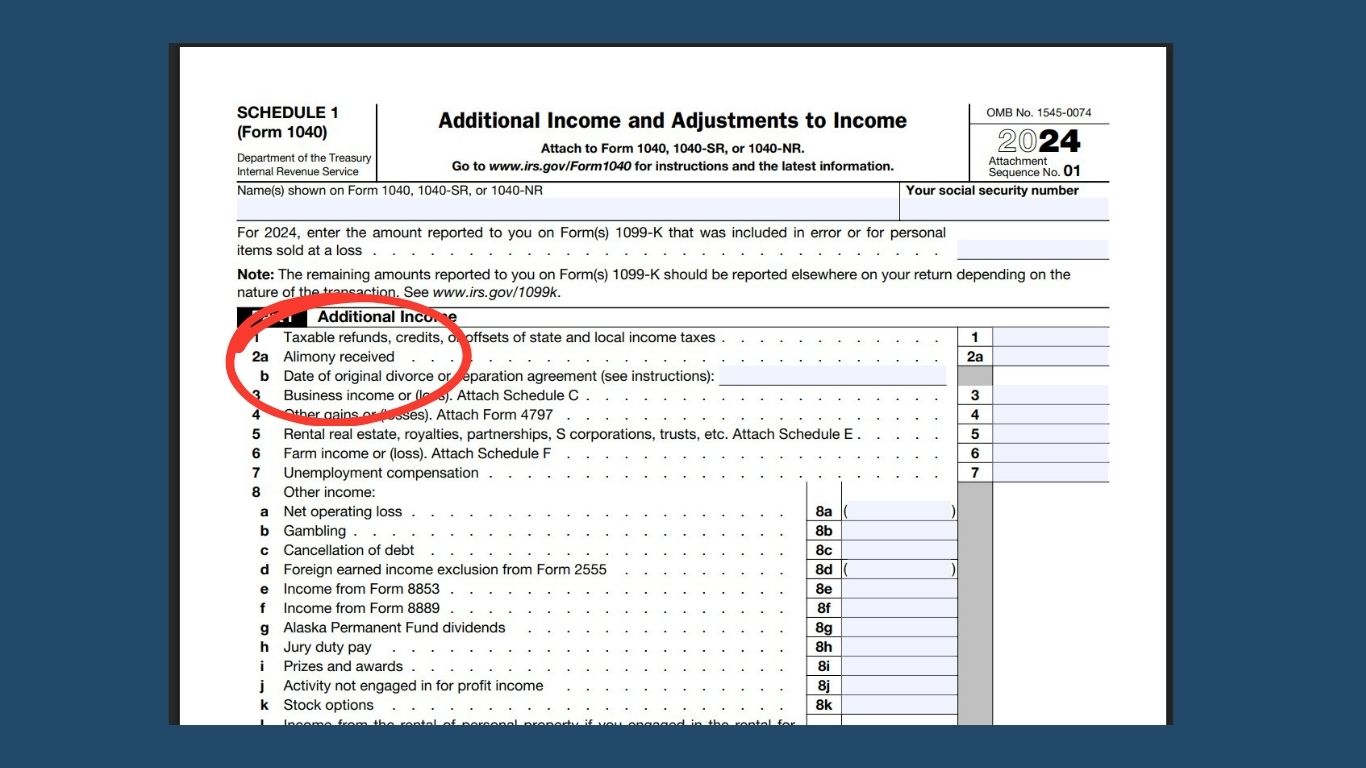
- Report alimony on Form 1040, Schedule 1 (line 18a).
- Provide the recipient’s Social Security number or ITIN.
- Failure to provide may trigger a $50 penalty.
Recipient Spouse (Pre-2019 Agreements Only)
- Report alimony as “Other Income” on Schedule 1 (line 2a).
- Include all taxable alimony received, whether monthly or lump sum.
Child Support Reporting
- No reporting required. Do not include on a tax return.
Tax Planning Tips After Divorce
Taxes shouldn’t be an afterthought when negotiating a divorce settlement. Here are ways to plan smarter:
- Clarify terms: Clearly label payments as “alimony” or “child support” in your divorce decree. Ambiguity risks IRS reclassification.
- Time your agreement: If you finalized before 2019, know whether the old alimony deduction rules apply.
- Mind modifications: A post-2019 modification can erase the deduction unless the decree explicitly says otherwise.
- State tax laws vary: Some states follow IRS rules; others treat alimony differently. Check your local tax law.
- Think lump sum vs ongoing: Ongoing payments may have different tax treatment than a lump sum. For more context, see our guide on how long divorce settlement payments last.
- Coordinate with custody: Alimony and dependency claims are separate but connected issues.
👉 Internal link: Read more on claiming children after divorce.
Final Thoughts
Alimony and child support may seem similar in everyday life, but for the IRS, they’re worlds apart. Alimony tax rules changed dramatically with the Tax Cuts and Jobs Act, while child support is always tax-free.
Understanding these differences helps you avoid costly mistakes, negotiate smarter settlements, and file with confidence.
FAQs: Alimony and Child Support Tax Questions
Only if your divorce or separation agreement was finalized on or before December 31, 2018, post-2018 agreements are not taxable to the receiving spouse.


