




How Buying a House Affects Your Taxes in Your First Year
Fact Checked
FileTax.com content is reviewed for accuracy, timeliness, and completeness. It undergoes a structured editorial review process involving writers and expert reviewers.
More on our editorial standards Meet our editorial team Todd MonahanTax Content Specialist
 Lea Uradu, JDTax Content Reviewer
Your Takeaways:
- Buying a home can lower your taxes if you itemize deductions.
- Mortgage interest is deductible on loans up to IRS limits.
- Property taxes are deductible, subject to the SALT cap.
- Points paid at closing may be deductible in the purchase year.
- Energy-efficient upgrades can qualify for valuable tax credits.
Buying a home can provide you with several federal and state tax deductions for things like mortgage interest, property taxes, and even energy upgrades. Learn which expenses qualify under the 2025 SALT rules and how to claim them correctly by using FileTax.com.
Does buying a house help with taxes? Indeed, it does.
Buying a house is one of those massive life milestones that feels equal parts exhilarating and terrifying. You’ve finally signed all the paperwork, secured your down payment, got the keys, and moved every last box into a house that’s actually yours. No more asking a landlord for permission to paint the walls or worrying about rent hikes or other fees.
Now, your monthly payments are going to work for you, building home equity and allowing you to invest in your future, one mortgage payment at a time.
But once the dust settles and you’ve unpacked the last box, another reality settles in. This one may not be so appealing, at least not at first glance.
You’re now a homeowner in the eyes of the IRS, and your tax situation just got a whole lot more interesting.
Whether you’re a first-time buyer, a seasoned home buyer, or even picking up property as a side gig or business investment, how your taxes work is about to change (and in big ways).
For many people, tax season as a renter was simple. Most just took the standard deduction, filed a quick federal tax return, and moved on. You likely didn't think twice about property tax deductions, mortgage interest deduction, or whether you could deduct homeowners' association fees or other costs.
As a homeowner in 2025, though, you could score significant savings, as long as you know what to claim and where to do it. Let’s find out how to get you some money back!
How Homeownership Changes Your Taxes
Buying a home changes how you file taxes, as homeowners can deduct costs that renters cannot. However, this is true only if you itemize, so it pays to know which expenses and fees qualify as tax deductions.
Let’s start by clearing up the big question: does buying a home help on taxes? In short, yes, but it varies based on your situation. When you rent, your housing costs are just that: costs. You can’t deduct rent payments, utilities, or your share of the security deposit from your federal tax return.
Homeowners, on the other hand, can claim deductible expenses like mortgage interest, real estate taxes, and several credits.
Definition: Homeownership tax benefits are deductions and credits available to taxpayers who own and live in their home. They include mortgage interest, property tax deductions, and energy credits that reduce taxable income within SALT limits, as well as certain deductions relating to your main home, even if you work from home or use part of your property for business. |
|---|
The first step for most new home buyers is this: decide whether you’re going to take the standard deduction or itemize. Itemized deductions mean listing each deductible expense (such as mortgage and state and local property taxes, interest paid, and charity) on Schedule A and only make sense if your total beats the standard deduction for your filing status.
So does buying a house help you cross that line? Here’s a quick comparison table:
Tax Benefits for Homeowners vs. Renters
Category | Renters | Homeowners |
|---|---|---|
Housing costs deductible? | No | Yes, if itemized |
Mortgage interest | No | Deductible (Form 1098) |
Property taxes | No | Deductible up to $40,000 SALT cap |
Energy credits | Limited | Available (Form 5695) |
To learn more about the range of tax benefits available, be sure to check out our full guide on the tax benefits of owning a home.
Mortgage Interest Deduction
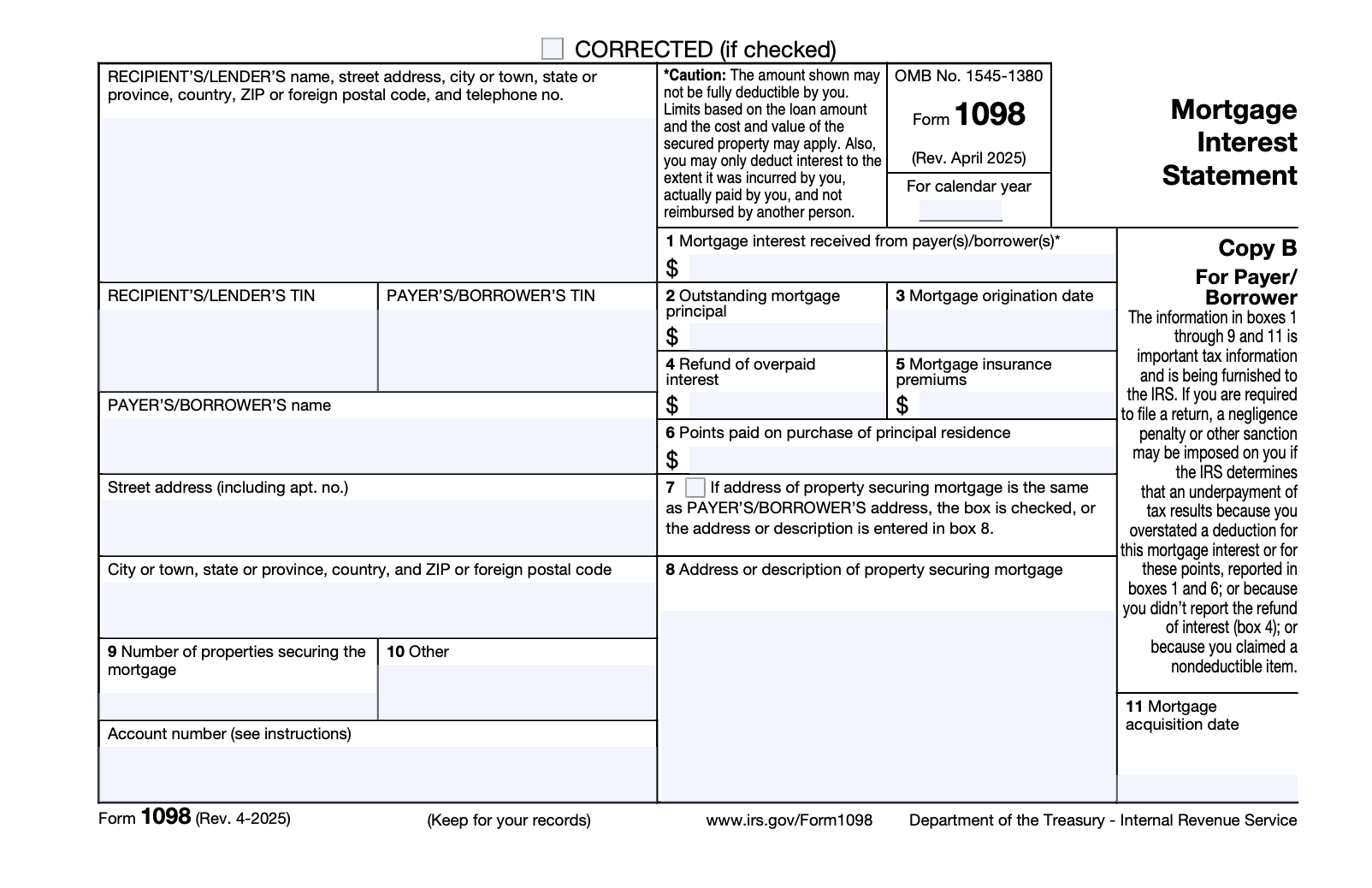
If you itemize, you can deduct the interest on up to $750,000 of mortgage debt ($375,000 if married filing separately) on your main home, and in some cases a second home. This matters most in your first years, when most of each payment is interest, and your lender reports the amount on Form 1098, Box 1. For the full rules, see how the mortgage interest deduction works.
Property Tax Deduction (SALT Cap Reminder)
You can deduct the state and local property taxes you pay, along with state income or sales taxes, up to a combined $40,000 cap ($20,000 if married filing separately). In your first year, check your settlement sheet, since you can only deduct your share of that year's property taxes. See how the property tax deduction and SALT cap work, and our guide to SALT deduction updates for recent changes.
Points Paid at Closing
An often-overlooked line item at tax time is points paid at closing. These are prepaid interest amounts you hand over at closing to lower your mortgage interest rate, and they’re potentially deductible as well.
However, not every dollar paid in closing costs is deductible. For instance, homeowners' association fees, settlement sheet admin charges, and transfer taxes are not deductible each year (though they may be if and when you sell your home).
But prepaid interest (points) paid for buying or building your main home are different. If you paid points directly at close (say, $2,000 on a $200,000 mortgage), they’re generally deductible in the tax year you purchased your house.
Points will also appear on your Form 1098. Look for Box 6 - Points Paid. If you refinanced or the points relate to something other than your primary home, you may need to spread the deduction out over several years.
Homeowner Credits and Other Deductions

Deductions lower your taxable income, while tax credits cut your tax bill directly. Some energy upgrades have their own federal credits, claimed on Form 5695, so check which home energy credits apply and their limits before you count on one. Improvements like a new addition also add to your home's basis, which matters when you sell your house later.
Standard Deduction vs. Itemized Deductions
Now, for the fork in the tax road, do you take the standard deduction or itemize? With so many tax benefits riding on property taxes, mortgage interest, and other deductions, you really need to take the time to crunch the numbers. Here are the 2026 standard deduction amounts:
Filing Status | 2026 Standard Deduction | When to Itemize |
|---|---|---|
Single | $16,100 | If mortgage + taxes + donations > $16,100 |
Married Filing Jointly | $32,200 | If total deductions > $32,200 |
Head of Household | $24,150 | If itemized deductions > that amount |
Typically, if the deductions you’re able to claim (like mortgage interest, state and local taxes, property tax deductions, charitable donations, and so on) add up to more than these amounts, itemizing will save you money.
Example: You and your spouse are filing jointly. If you deduct mortgage interest ($20,000), property taxes ($10,000), and donations ($5,000), your total itemized deductions reach $35,000. That’s $2,800 more than the standard deduction, which offers significant savings that go straight into your pocket. |
|---|
Filing Tips for New Homeowners
The IRS loves paperwork, so you should too (or at least tolerate it for tax season). Here’s what you’ll need:
- Form 1098: Proof of interest paid and points paid, which you’ll need for claiming the mortgage interest deduction.
- Property tax receipts or escrow statements: Verify exactly which local property taxes and real estate taxes you paid during the year (not every payment is shown on Form 1098).
- Form 5695: If you claimed an energy tax credit.
- Closing Disclosure (settlement sheet): Details all payments at purchase, including deductible items.
Double-check whether your lender paid property taxes from your escrow account, as only payments made to the local taxing authority in the tax year in question are deductible. For a full explainer, look at IRS Pub. 530, which covers filing basics for new homebuyers.
Does Buying a Home Help On Taxes? You Bet.
So does buying a house help with taxes? Absolutely. For many Americans, owning a house rather than renting means getting a big boost at tax time. You can access mortgage interest deductions, property tax deductions, and tax credits that lower your taxable income and your tax bill. As long as you plan wisely and do your paperwork, that is.
Don’t let the cost of homeownership or the mountain of forms scare you off. Get organized, hold onto all those important documents, and reach out to your lender or tax adviser if questions come up.
But most importantly: don’t leave money on the table by skipping deductions you’re eligible for.
💡 File your taxes with confidence. FileTax.com automatically applies property tax deductions, SALT credits, and renter relief programs when you file online.
Frequently Asked Questions
It might. Deducting property taxes, mortgage interest, and other costs can push your total deductions higher than the standard deduction. This reduces taxable income and your federal tax bill, sometimes leading to a refund.


