




Property Taxes Explained: How They Work and What You Can Deduct
Fact Checked
FileTax.com content is reviewed for accuracy, timeliness, and completeness. It undergoes a structured editorial review process involving writers and expert reviewers.
More on our editorial standards Meet our editorial team Todd MonahanTax Content Specialist
 Lea Uradu, JDTax Content Reviewer
Your Takeaways:
- Property taxes are local taxes based on your home’s assessed value.
- They fund schools, roads, and essential community services.
- Your tax bill depends on assessed value and local tax rates.
- Property taxes may be deductible if you itemize deductions.
- The SALT cap limits how much you can deduct federally.
Property taxes help fund schools, safety, and public services in your community. If you itemize deductions, you might be able to lower your federal tax bill (up to the SALT cap). This guide breaks down how property taxes are assessed, key deduction rules, and money-saving credits or relief options for both homeowners and renters.
If you own any kind of real estate, you’re probably already at least peripherally familiar with the term “property taxes.” For many, the annual or semi-annual property tax bill is one of the largest expenses associated with homeownership, right after the mortgage payment itself.
While you know you have to pay them, you might be wondering where the money goes, how the amount is determined, and if you can get any of it back.
If you want to be able to manage your finances effectively, you need to have a keen understanding of your property tax liability. These taxes fund essential local services that shape your community, from public schools to emergency medical services.
Perhaps more pertinent: the amount you pay could lead to a valuable deduction on your federal tax return.
What Are Property Taxes?
Definition: Property tax is a recurring local tax based on assessed property value, used to fund essential community services like education and infrastructure.
A local property tax charged on real estate based on its assessed value. Local governments, such as your city or county, collect these taxes to fund vital community services like schools, roads, police and fire departments, and public transportation.
The authority to levy these taxes is granted by the state, but the rates and collection are handled at the local level.
It’s important to distinguish this tax from other real estate-related taxes. For instance, a real estate transfer tax is a one-time tax paid when a property’s title is transferred from one owner to another. A property tax, however, is a recurring expense that property owners pay annually or semi-annually.
The tax applies to what is known as “real property”, which is land and any structures permanently attached to it like a house or a garage. In some jurisdictions, it can also apply to certain types of tangible personal property, like business equipment or vehicles.
How Property Taxes Are Calculated

Some people view their taxes as a bit of a mystery, a surprise that arrives in the mail each year when they receive their bill. However, calculating your taxes involves a relatively straightforward formula, one you can use to plan ahead for your overall tax burden each year.
The components of the formula do vary a bit depending on where you live. In general, however, taxing authorities use the following calculation to determine your bill:
Assessed Value × Local Tax Rate (Mill Rate) = Annual Property Tax
Assessed value is not necessarily the same as your home’s market value (in other words, what it would sell for). A local government assessor determines your property’s assessed value, which might be based on a percentage of the current market value, known as an assessment ratio.
For example, if your home's market value is $400,000 and the local assessment ratio is 80%, its assessed value for tax purposes is $320,000. Assessors typically consider factors like recent sales of comparable properties, market conditions, and any improvements you've made.
The local tax rate is also known as the mill rate, expressed in “mills.” One mill is equal to $1 for every $1,000 of assessed value. Local governments will set the mill rate and any related property tax laws based on their annual budget needs. For example, if a town needs to raise $10 million in property tax revenue and the total assessed value of all property in town is $500 million, the mill rate would be 20 mills ($10M/$500M=0.02, or 20 mills).
It's important to note that your property tax bill may also include special assessments for specific local improvements like new sidewalks, sewers, or streetlights. These charges are typically not deductible as property taxes on your federal return.
When Are Property Taxes Due?
Property tax due dates are set by local taxing authorities and vary by state and even by county. While you should always check with your local tax office for the exact dates, there are a few common billing cycles that dictate how often you will pay property taxes.
Semiannual is the most common model, with the total annual tax split into two installments, one in the fall or spring (in most cases). Others issue a single annual property tax bill.
Example: In states like California, payments are due on November 1 and February 1. Other states, like Texas, issue a single annual property tax bill. These bills are typically sent out in the fall and are due by January 31 of the following year. |
|---|
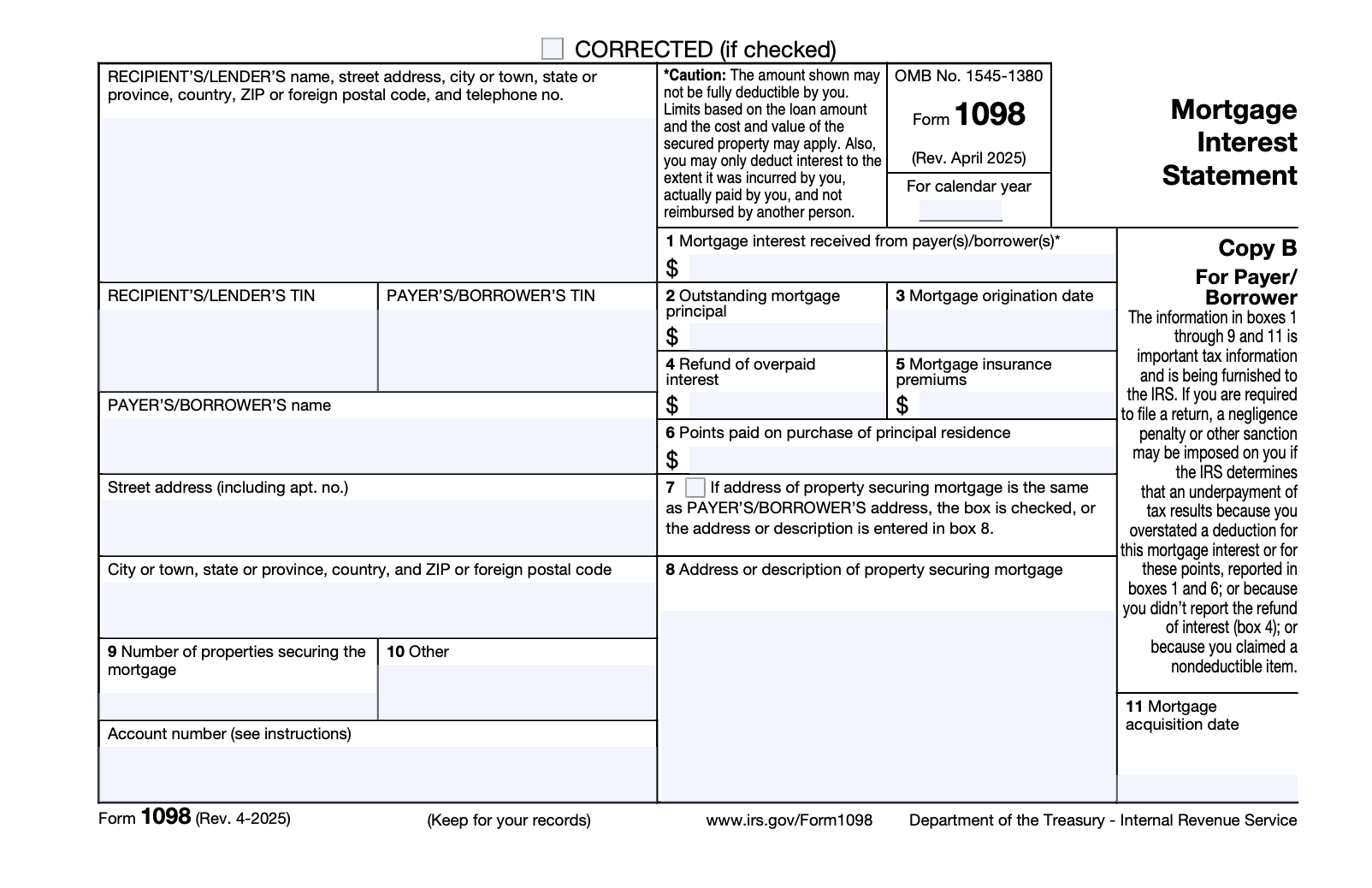
If you have a mortgage, your lender may require you to pay your property taxes through an escrow account (or present it as a voluntary option). With this arrangement, a portion of your estimated annual property tax is added to your monthly mortgage payment. The lender holds these funds in escrow and pays the bill on your behalf when it comes due. You should be able to find the amount of property taxes paid through escrow on Form 1098, which your lender will send you each year.
So, what happens if you miss a payment deadline? It happens, but it can be expensive, as local governments will charge interest and penalties on back taxes. In severe cases of non-payment, they can even place a lien on your property and foreclose on it.
Are Property Taxes Deductible?
Property owners who choose to itemize their deductions by filling out a Schedule A can deduct the property taxes they paid on their federal income tax return. However, it’s subject to limitations.
The Tax Cuts and Jobs Act of 2017 introduced a cap on the State and Local Tax (SALT) deduction. It limits the total amount you can deduct for all state and local taxes combined, including property, income, and sales taxes, to $40,000 per household (or $20,000 if you’re married and filing separately).
Example: In 2024, if you paid $8,000 in real estate taxes and $5,000 in state income taxes during the year, your total state and local taxes paid were $13,000. Due to the SALT cap, you can only deduct $10,000 on your federal return. |
|---|
This cap has a major impact on taxpayers in states that have high property and income taxes. For the latest rules, check out our guide on SALT deduction updates.
To be eligible to deduct property taxes, the tax must be based on the assessed value of your real property. You can only deduct taxes you actually paid during the tax year, regardless of when they were due. The table below clarifies what is and isn’t deductible.
Deductible as Property Tax | Not Deductible as Property Tax |
|---|---|
State and local real estate taxes paid | Homeowners' association (HOA) dues |
Property taxes paid through a mortgage escrow account | Fees for specific services (e.g., trash, water) |
Taxes on your primary residence and other properties you own | Special assessments for local benefits (e.g., sidewalks, sewer lines) |
Foreign real estate taxes paid | Real estate transfer taxes paid at sale |
Remember, even if you rent, you may be eligible for some relief, as certain states offer property tax credits or rebates for renters. Landlords often pass on the cost of property taxes through rent.
Local vs. State Property Tax Rules
While property taxes are a local affair, it’s the state laws that provide the framework. Each state sets its own rules regarding assessment frequency, taxpayer appeal rights, and available exemptions.
Some states require properties to be reassessed annually, while others do so only every few years. It’s important to recognize that frequent assessments in a rising housing market often lead to a higher tax burden.
As such, if you feel that your property’s assessed value is too high compared to its market value or home values of similar properties, you have the right to appeal. This process usually starts with your local assessor’s office and can be escalated to a county or state board, with a successful appeal ultimately lowering your tax bill.
Most states also offer property tax exemptions that reduce the taxable value of your property. Some of the most common include those for seniors, veterans, individuals with disabilities, and primary residences (also known as homestead exemptions). Take the time to learn more about the most common property tax exemptions.
It’s also interesting to pay attention to how property taxes relate to other state taxes; those with no state income tax, like Texas, often have higher-than-average property tax rates to generate the revenue needed for public services. IRS Pub. 530 includes everything you need to know about these rates.
Property Tax Examples by State
To illustrate how much property taxes can vary across state lines, you may find it helpful to view a few examples. The table below shows the average effective tax rate and the estimated annual tax on a home with a market value of $300,000 in three different states.
State | Average Effective Tax Rate | Annual Tax on $300K Home |
|---|---|---|
California | 0.70% | $2,100 |
Texas | 1.36% | $4,080 |
Illinois | 1.83% | $5,490 |
Note: These are statewide averages. Actual tax rates are set locally and can vary significantly by county and city.
Frequently Asked Questions
The property tax system is the primary source of revenue for local governments. They’re used to fund essential community services, including public schools, fire and police departments, libraries, parks, road maintenance, and other services that benefit the entire community.


