




Tax Benefits of Owning a Home in 2026
Fact Checked
FileTax.com content is reviewed for accuracy, timeliness, and completeness. It undergoes a structured editorial review process involving writers and expert reviewers.
More on our editorial standards Meet our editorial team Todd MonahanTax Content Specialist
 Lea Uradu, JDTax Content Reviewer
Your Takeaways:
- Homeownership can reduce your tax bill through deductions and credits.
- Mortgage interest is deductible if you itemize your return.
- Property taxes are deductible, subject to the $40,000 SALT cap.
- Home equity loan interest is deductible if used to improve your home.
- Energy-efficient upgrades can qualify for valuable tax credits.
Homeownership can lower your tax bill by letting you deduct things like mortgage interest, property taxes, and eligible energy-saving upgrades. FileTax makes it simple to find and claim every homeowner deduction as you file your taxes online.
Congratulations, you’re a homeowner! You’ve survived (mostly unscathed) the house-hunting adventure, the mountain of paperwork, and the sheer joy (and terror) of being handed those keys.
Now that you’re settling in, it’s time to think about something a little less exciting than picking out paint colors, but much more important: your taxes. Most homeowners recognize that owning a home comes with some pretty significant financial implications, as well as some perks, and understanding them can save you a bundle when tax season rolls around.
The tax benefits that come with owning a home aren’t just myths once whispered to you by your parents. Instead, they’re real, tangible savings that can make a big difference to your bottom line. We’ll explain what you can claim, how it works, and what you need to do to make sure you get every penny you deserve.
What Are the Main Benefits of Owning a Home?
Homeownership can lower your federal taxes through deductions and credits that are tied to your mortgage, property taxes, and qualified home improvements. In simple terms, the government offers incentives that reduce your taxable income or, even better, directly lower your tax bill. These benefits are essentially the government’s way of encouraging homeownership.
However, it’s important to note that these perks aren’t automatic for everyone. Your ability to claim them often depends on your filing status, your income, and whether you choose to take itemized deductions instead of taking the standard deduction.
Definition: The tax benefits of owning a home are federal deductions and credits that reduce your taxable income or tax owed. They include mortgage interest, property tax deductions (subject to SALT limits), and credits for energy-efficient upgrades. |
|---|
If all this sounds confusing, don't worry; we’ll get into all the details below. For now, just know that buying a house can help with your taxes, and sometimes, in big ways.
If you just bought your first home, also see first-time homebuyer tax credits and programs.
Mortgage Interest Deduction: The Most Common Homeownership Tax Benefits
Perhaps the most well-known tax benefit of homeownership is the mortgage interest deduction. When you take out a mortgage, a large portion of your early payments goes toward interest. The good news is that you can often deduct the interest you pay from your taxable income.
To claim this mortgage deduction, you need to itemize your deductions on Schedule A of your tax return. There are limits, of course. For 2025, you can deduct the interest on up to $750,000 of mortgage debt ($375,000 if you're married filing separately). This applies to the mortgage on your main home and even a second home, as long as the loan is secured by the property.
Example: You have a $400,000 mortgage. Over the year, you paid $20,000 in mortgage interest. If you itemize, you can typically deduct that entire $20,000, which lowers your total taxable income significantly. |
|---|
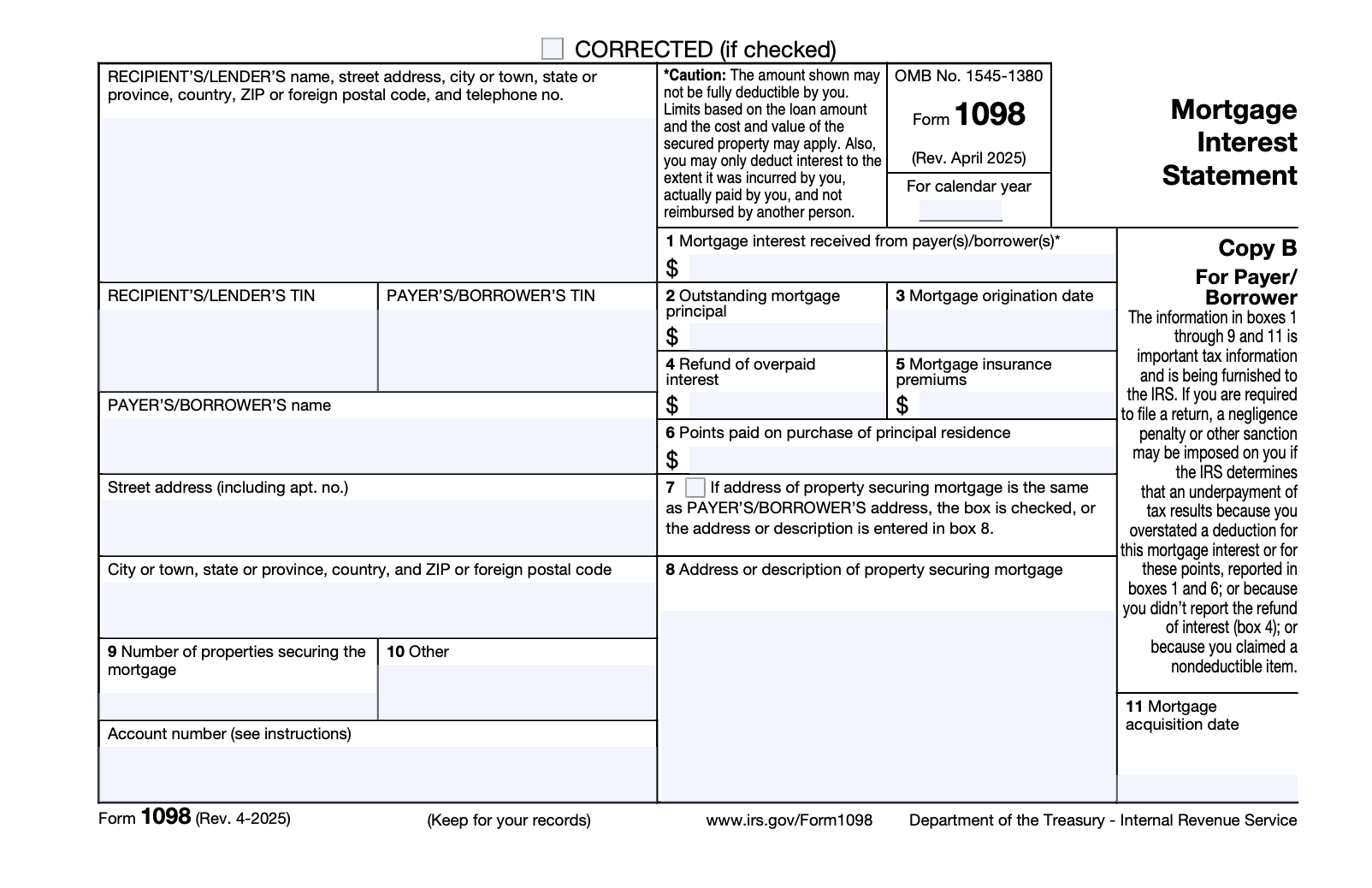
Your lender will send you a document called Form 1098 at the beginning of the year. This form clearly states how much mortgage interest you paid in Box 1, making it easy to report. Keep an eye out for it! For more specifics on what qualifies, Internal Revenue Service (IRS) Publication 936 is your go-to guide.
Property Tax Deduction (SALT Limit)
Another major perk is the ability to deduct the property taxes you pay to your state and local government, which fund schools, roads, and public services. The IRS lets you write them off, but there’s a limit: it’s known as the SALT deduction cap.
The State and Local Tax (SALT) deduction is capped at $40,000 per household per year ($20,000 if married filing separately). This cap includes a combination of property taxes and either state income taxes or state sales taxes.
You can't deduct more than $40,000 in total from these categories. Renters, on the other hand, can’t claim this deduction at all since they don't pay property taxes directly.
Example: You paid $7,000 in property taxes and $8,000 in state income taxes. That’s a total of $15,000, which is well below the $40,000 SALT cap, so you can deduct the full $15,000 on your federal return. If you paid $35,000 in property taxes and $10,000 in state income taxes, you could only deduct $40,000 because that’s the maximum allowed under the SALT cap. You’ll claim this on Schedule A (Form 1040) when you file. You’ll claim this on Schedule A (Form 1040) when you file. |
|---|
Understanding property taxes and their deductible limits is important for any homeowner, so be sure to check out our detailed guide to what they are and what they cover.
Home Equity Loan Interest Deduction
Many homeowners later choose to tap into their home’s equity with a home equity loan or a Home Equity Line of Credit (HELOC). The interest on these loans can also be deductible under specific conditions.
In general, you can only deduct the interest if you use the loan funds to "buy, build, or substantially improve" the home that secures the loan.
Example: If you take out a $50,000 HELOC and use it to build a new deck and renovate your kitchen, the interest you pay on that loan is generally deductible. But if you use that same HELOC to pay off student loans or buy a car, the interest is not deductible. The debt must be tied to improving your home's value. |
|---|
Again, the limits tied to the primary mortgage apply for these tax deductions, as detailed in IRS Pub 936.
- Interest on home equity loans or HELOCs is deductible only if used to buy, build, or substantially improve the property.
Energy-Efficient Home Credits
If you’re looking to make your home more energy-efficient, the government wants to lend a helping hand! There are several valuable tax credits that are available for making qualified green upgrades. Unlike tax deductions, which lower your taxable income, credits reduce your tax bill dollar-for-dollar.
There are two main credits to know about:
- Energy Efficient Home Improvement Credit: Sunsetting at the end of 2025 under the Big Beautiful Bill, this credit is for smaller projects like installing new insulation, energy-efficient windows, or upgrading your furnace. For projects completed by December 31, 2025, you can claim up to $3,200 annually for these improvements.
- Residential Clean Energy Credit: Also due to phase out in 2026 or later, these energy credits are for bigger projects. It offers a credit of 30% of the cost of a new, qualified clean energy property for your home, with no annual limit. This includes systems like solar panels, solar water heaters, geothermal heat pumps, and battery storage.
Example: Installing new, highly-rated windows might get you a credit, while putting solar panels on your roof could lead to a credit worth thousands of dollars. |
|---|
Be sure to check the specific requirements for each upgrade, as not all "green" products qualify. You'll use Form 5695 to claim these home energy tax credits.
Selling Your Home: The Exclusion Benefit
While it might not be anything you’re thinking about now, down the road, you might decide to sell your home. If you’ve made a profit, you might worry about capital gains taxes. Fortunately, homeowners get a massive tax break here, too.
If you meet the requirements, you can exclude a huge chunk of the profit from your income. Single filers can exclude up to $250,000 in capital gains, and married couples filing jointly can exclude up to $500,000.
To qualify, you must pass two tests: the ownership test and the use test. This generally means you must have owned the home and lived in it as your main residence for at least two of the five years leading up to the sale.
Example: You and your spouse bought your home for $400,000 and sold it a few years later for $800,000. Your profit is $400,000. As long as you meet the ownership and use tests, you can exclude that entire $400,000 from your taxable income. You won’t owe a dime in capital gains tax.
This is a huge benefit of homeownership, and IRS Publication 523 offers all the fine print.
When to Itemize vs. Take the Standard Deduction
This is the million-dollar question for many homeowners. You only get the tax benefits of tax deductions like mortgage interest and property taxes if you itemize. To itemize, your total deductible expenses must be greater than the standard deduction for your filing status.
For 2025, the standard deduction amounts and recommendations are as follows:
Filing Status | Standard Deduction (2026) | When to Itemize |
|---|---|---|
Single | $16,100 | If mortgage + taxes + donations exceed $16,100 |
Married Filing Jointly | $32,200 | If combined deductions exceed $32,200 |
Head of Household | $24,150 | If total deductions exceed $24,150 |
If you're single and your combined mortgage interest, SALT deductions (up to the $40,000 cap), and charitable donations add up to more than $16,100, it makes sense to itemize. If they don't, you're better off taking the standard deduction.
The higher standard deductions introduced in recent years mean that fewer people itemize, but for many homeowners, especially those in high-cost areas, itemizing is still the best path. You can learn more about how the SALT deduction cap updates affect this decision here.
Documentation Homeowners Should Keep
At tax time, good record-keeping will be your number one best friend. To make sure you’re claiming everything correctly (and can back it up if needed), keep these documents organized and ready to go:
- Form 1098: Your mortgage interest statement.
- Property Tax Records: Bills from your local government or year-end statements from your mortgage escrow account.
- Closing Disclosure: The document you received when you bought your home. It shows your purchase price and any points you paid as well as closing expenses incurred (which can be useful for reporting during the tax year that the home is sold).
- Receipts for Improvements: Keep records of what you spent on energy-efficient upgrades and any major improvements that add to your home's value.
Note that you may also be able to deduct things like home office expenses under the home office deduction if you’re using your home as a business, too. Keep track of all paperwork to make sure you’re able to tap into any available tax benefits.
Tap Into the Tax Benefits of Homeownership with Property Tax Breaks
By now, you know that owning a home means more than just having a place to rest your head at night. It’s a financial tool that, when wielded wisely, can provide you with impressive tax benefits.
Take advantage of these potential tax benefits and leverage the many tax deductions that are available to you. Home related expenses stack up quickly, but by taking the time to understand these rules, you can feel confident you’re not leaving any money on the table.
💡 File your taxes with confidence. FileTax automatically applies property tax deductions, SALT credits, and renter relief programs when you file online.
Frequently Asked Questions
The most significant tax benefits are deductions for mortgage interest and property taxes (up to $10,000 SALT cap), plus credits for energy-efficient upgrades.


