



Arizona Tax Extension Rules and Filing Deadlines
Get the Extra Time You Need to File Your Arizona State Taxes Without Penalties
Fact Checked
FileTax.com content is reviewed for accuracy, timeliness, and completeness. It undergoes a structured editorial review process involving writers and expert reviewers.
More on our editorial standards Meet our editorial team Andrew WalshCPA, CFP CTFA & Tax Content Specialist
 Lea Uradu, JDTax Content Reviewer
Your Takeaways:
Original due date for filing and payment: April 15, 2026
Extension request due: April 15, 2026
Extended due date: October 15, 2026
Extension length: 6 months
Minimum to pay by April 15: 90 percent of your Arizona tax
Running out of time before the Arizona deadline? Six more months are available, and if you already hold a federal extension you may not have to file anything with the state at all.
Arizona accepts the federal extension outright. What it asks is that you pay, and it attaches a specific threshold to that: 90 percent of your Arizona liability by the original due date.
This page covers the Arizona individual return for an Arizona resident filing Form 140, and for a part-year resident or nonresident filing Form 140PY or Form 140NR. For the federal side of the process, see our guide to filing a tax extension, and for everything else Arizona, see the Arizona state tax guide. For other states, start at the state tax extension hub.
How Does an Arizona Tax Extension Work?
Arizona grants an automatic six-month extension, moving the extended due date to October 15, 2026. Whether you need Form 204 to get there depends on two things: your federal extension, and how you pay.
Your Federal Extension Is Accepted, for Exactly the Period It Covers
The Form 204 instructions put it simply: "Arizona will accept your federal extension for the period covered by the federal extension."
That phrasing carries a detail worth noticing. Arizona matches the federal period rather than granting a fixed six months of its own, so a federal extension running longer than the usual six-month extension carries its longer date into Arizona too.
When You Do Not Need Form 204 at All
Holding a federal extension does not automatically finish the job, but paying the right way can.
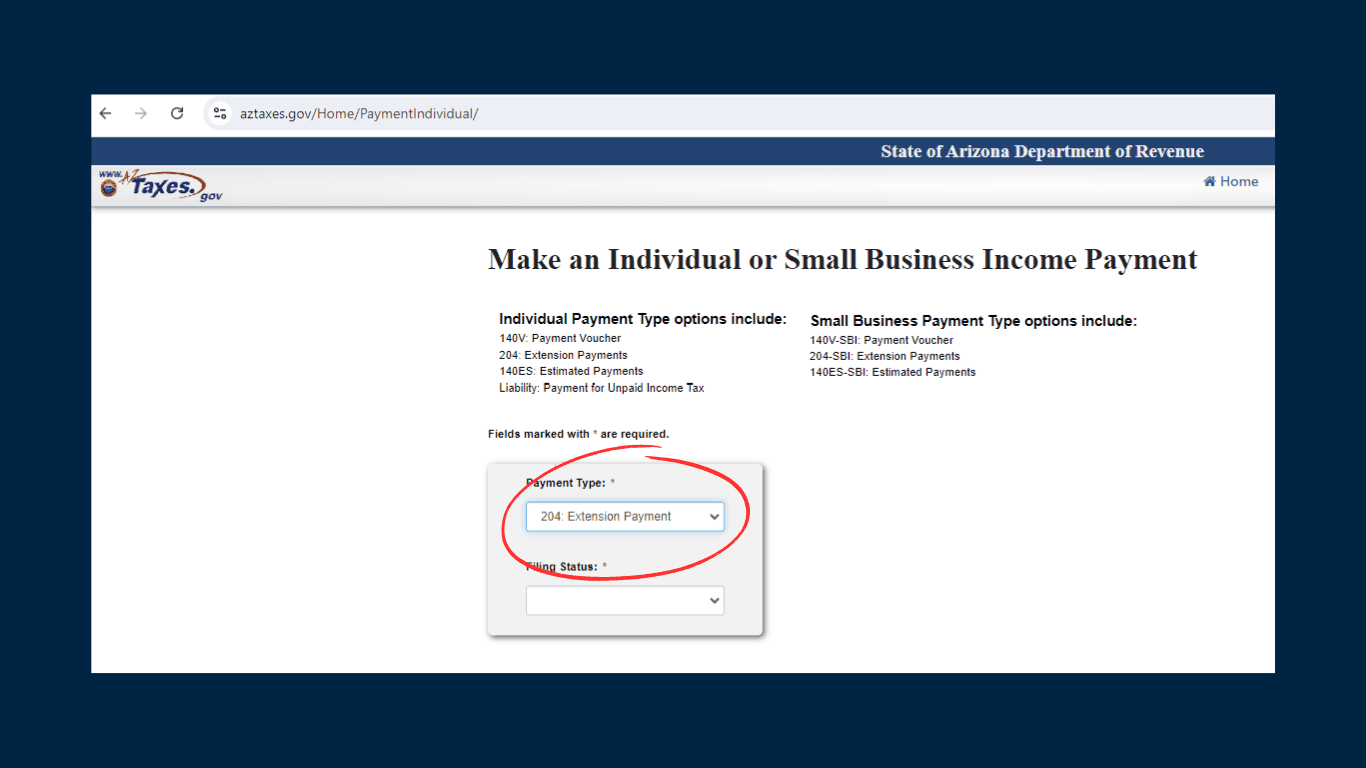
Arizona states that "if you are filing under a federal extension, but making an electronic extension payment or making an extension payment using a credit card, you do not need to mail in Form 204." So an online payment at AZTaxes.gov, made under payment type 204, replaces the paperwork entirely.
Form 204, the Application for Filing Extension, is what you file if you have no federal extension, or if you are filing under one and sending your extension payment by mail.
Either way, the extension request must be postmarked on or before the original due date of the return.

How Do You File an Arizona Tax Extension?
Step 1: Work out your estimated tax due
Gather your income records and confirm your filing status, then work out your Arizona individual income tax for the year. Subtract your Arizona withholding and any estimated payments already made. What remains is your tax balance, and 90 percent of your total liability is the number that matters next.
Step 2: Pay at least 90 percent by April 15, 2026
Arizona is precise about the threshold and the consequence of missing it: "if you do not pay at least 90% (.90) of the income tax liability disclosed by your return by the return's original due date, you will be subject to the extension underpayment penalty."
Note what the 90 percent is measured against. It is the liability your finished return eventually discloses, not the estimate you made in April, so an optimistic estimate does not protect you.
Step 3: Pay online, or mail Form 204
An online payment at AZTaxes.gov is the cleaner route, and with a federal extension it removes the form. Electronic funds transfer and credit card are both accepted.
If you are mailing, the mailing address depends on whether a payment is enclosed:
With payment: Arizona Department of Revenue, PO Box 29085, Phoenix, AZ 85038-9085
Without payment: Arizona Department of Revenue, PO Box 52138, Phoenix, AZ 85072-2138
Keep the payment confirmation either way.
Step 4: File your return by October 15
File the completed Form 140, or Form 140PY or Form 140NR if one of those applies, by October 15, 2026. Short-form filers using Form 140A or Form 140EZ follow the same extended date, as do Form 140PTC and Form 140ET claimants.
Ensure you check Box 82F (Filing Under Extension) on page 1 of Form 140.
How Much Should You Pay With an Extension?
Clear the whole balance if you can. The 90 percent threshold is the floor, not the target.
Say your Arizona income tax comes to $4,000 and your withholding covered $3,400. Ninety percent of $4,000 is $3,600, so you would need at least $200 more by April 15 to stay clear of the extension underpayment penalty. Interest still runs on the remaining $400 from the original due date.
Our penalty and interest calculator can help you estimate what a shortfall would cost.
The Extension Underpayment Penalty Runs in 30-Day Periods, Not Months
Arizona's charge for missing the 90 percent threshold is small per period, and counted differently from a monthly accrual.
It is "½ of 1% (.005) of the income tax not paid for each 30-day period or fraction of a 30-day period", capped at 25 percent of the unpaid income tax.
The 30-day period is the part that trips people. It runs from the original due date in rolling 30-day blocks rather than aligning to calendar months, so paying on the 29th day after April 15 costs one period and paying on the 31st costs two.
Filing Late Costs Nine Times as Much Per Month
The extension exists to avoid this charge, which is why filing on time matters even when the money is short.
Arizona's late file penalty is 4.5 percent of the tax required to be shown on the return for each month or fraction of a month the return is late. Against the extension underpayment penalty's half a percent, that is nine times the monthly rate.
Arizona Uses the Federal Interest Rate
Interest accrues on any late payment from the original due date through to the date you pay, and Arizona does not publish a rate of its own. The Department states plainly that "the Arizona interest rate is the same as the federal rate."
That is convenient for anyone working both returns at once: the figure you looked up for your federal balance is the correct one here.
Arizona Business Tax Extension Basics
Corporations extend on Arizona Form 120EXT and partnerships on Form 165EXT, both separate from the individual Form 204. Federally, a business tax extension runs on Form 7004.
Arizona corporate income tax deadlines vary by entity, so check the form that applies to yours. How Form 7004 works federally is covered on the business extension guide.
Do Military Servicemembers Get More Time to File in Arizona?
Yes, though the relief comes from the federal side rather than from a rule Arizona publishes.
Arizona Has No Separate Combat Zone Extension
Arizona's military tax filing guidance covers how service pay is treated and how residency works. It does not set out a state combat zone extension, a separate deadline, or a suspension of penalties and interest.
The relief still reaches you through the provision above. Arizona accepts your federal extension for the period it covers, and a federal combat zone extension covers a considerably longer period than six months. The federal date becomes the Arizona date without a separate request.
The combat zone tax extension page covers what the federal rules pause and what they leave running.
Common Arizona Extension Mistakes to Avoid
- Mailing Form 204 after paying online. With a federal extension and an electronic or credit card payment, the form is unnecessary.
- Measuring 90 percent against your April estimate. The threshold is 90 percent of the liability your return eventually discloses.
- Counting the penalty in calendar months. It runs in 30-day periods from the original due date.
- Sending the request late. The extension request must be postmarked on or before the original due date.
- Using the wrong PO Box. 29085 with a payment, 52138 without.
- Letting the return slip while chasing the money. Filing late costs 4.5 percent a month against the underpayment penalty's half a percent.
- Looking up an Arizona interest rate. There is not one. Arizona uses the federal rate.
How Arizona Tax Extension Rules Compare to Nearby States
Tax extension rules can vary significantly by state.
If you live, work, or have recently moved between states, you may also want to review:
Filing Your Arizona Extension
Arizona keeps this simple if you take it in order. Work out your Arizona tax, get 90 percent of it paid by April 15, and pay online if you already hold a federal extension so the form never enters the picture. Then file Form 140 by October 15. If you are mailing instead, check which PO Box matches your envelope before it goes out.
File your extension with FileTax.com and we will walk you through the federal side, which is what Arizona accepts on its own terms.
Frequently Asked Questions
Yes. Arizona accepts your federal extension for the period covered by it, so a federal Form 4868 extension carries a matching Arizona extension. Our federal extension accepted page covers how other states handle the same question.


