




Compare IRS Filing Statuses: Single vs HOH vs MFJ vs MFS vs QSS
Fact Checked
FileTax.com content is reviewed for accuracy, timeliness, and completeness. It undergoes a structured editorial review process involving writers and expert reviewers.
More on our editorial standards Meet our editorial team Karen Van ThournoutTax & Financial Content Specialist
 Lea Uradu, JDTax Content Reviewer
Your Takeaways:
- This guide provides a high-level comparison of the five IRS filing statuses. It helps you quickly understand how each status works and directs you to detailed comparison guides when choosing between two specific options.
- Head of Household offers a larger standard deduction and lower tax rates than Single, but requires a qualifying child or relative and paying more than half of the household expenses.
- Married Filing Jointly generally provides the lowest combined tax liability for married couples, with the widest income brackets and access to the most credits.
- Single is the simplest status, but usually comes with fewer tax breaks and higher effective tax rates.
Choosing the correct filing status directly affects your tax liability, refund amount, and credit eligibility. The sections below help you compare each option clearly and objectively.
This page is your comparison hub.
It’s designed to help you quickly choose between tax filing statuses based on your life situation. We’ll give you the highlights here, and link you to deeper “vs.” breakdowns so you can make the smartest move with confidence.
The “best tax filing status” depends on three main factors:
- Your marital status
- Whether you have dependents
- Your income
Let’s break it down.
IRS Filing Status Comparison Table
Here’s your big-picture view. Think of it as the cheat sheet for comparing Single vs. Head of Household vs. Married Filing Jointly vs. Married Filing Separately vs. Qualifying Surviving Spouse.
Important Note: The standard deduction amounts shown below apply to taxpayers under age 65. If you or your spouse are 65 or older by December 31 of the tax year, you qualify for an additional standard deduction. See the breakdown below the table for age-based increases.
Filing Status | Standard Deduction (2026) | Typical Tax Benefits | Eligibility Snapshot | Pros | Cons |
|---|---|---|---|---|---|
$16,100 | Basic deductions; some credits if eligible | Unmarried, no dependents | Simplest filing; fewer forms; easier to benefit from itemizing if you pay mortgage interest and property taxes | Fewer tax benefits; typically higher effective tax rate | |
$24,150 | Child Tax Credit, Earned Income Credit, Dependent Care Credit | Unmarried, qualifying child or relative, paid more than half of household expenses | Larger standard deduction; typically lower effective tax rate; may qualify for additional credits if supporting dependents | Must support dependent; IRS has strict rules about qualifying persons | |
$32,200 | Full range of credits (Child Tax Credit, Education Credits, Earned Income Credit) | Legally married by the end of the tax year. | Lower combined tax liability; higher income thresholds for credits; easier record-keeping | Combining both spouses’ incomes can push the household into a higher tax bracket | |
$16,100 (each) | Sometimes deduct high medical expenses, student loans, or if one spouse wants liability protection | Married, but choose to file a separate return | Protects from spouse’s tax issues; sometimes better for medical expenses or when separated | Lose access to many credits and deductions; both spouses must itemize or both must take the standard deduction; often results in a higher total tax; does not eliminate higher tax bracket issues if incomes are uneven | |
$32,200 (same as joint) | Joint tax benefits continue for 2 years | Spouse died in the prior 2 years, dependent child in the household | You keep a higher standard deduction and lower tax rates | Only lasts 2 years; must have a dependent child |
Additional Standard Deduction for Taxpayers Age 65 or Older
If you or your spouse are age 65 or older by December 31 of the tax year, the IRS allows an additional standard deduction on top of the regular deduction amount.
- Single and Head of Household filers can add an additional $2,000.
- Married Filing Jointly, Married Filing Separately, and Qualifying Surviving Spouse filers can add an additional $1,600 for each qualifying spouse age 65 or older.
Beginning in tax year 2025 and continuing through 2028, eligible taxpayers age 65 or older may also qualify for a temporary additional deduction of up to $6,000 per person under the new federal tax law. Married couples filing jointly may qualify for up to $12,000 if both spouses meet the age requirement.
The temporary $6,000 senior deduction begins phasing out for taxpayers with modified adjusted gross income (MAGI) above:
- $75,000 for Single and Head of Household filers
- $150,000 for Married Filing Jointly filers
This temporary deduction is available whether you take the standard deduction or itemize deductions.
Learn More About Each Filing Status
- Single Filing Status Guide
- Head of Household Filing Status Guide
- Married Filing Jointly Guide
- Married Filing Separately Guide
- Qualifying Surviving Spouse Guide
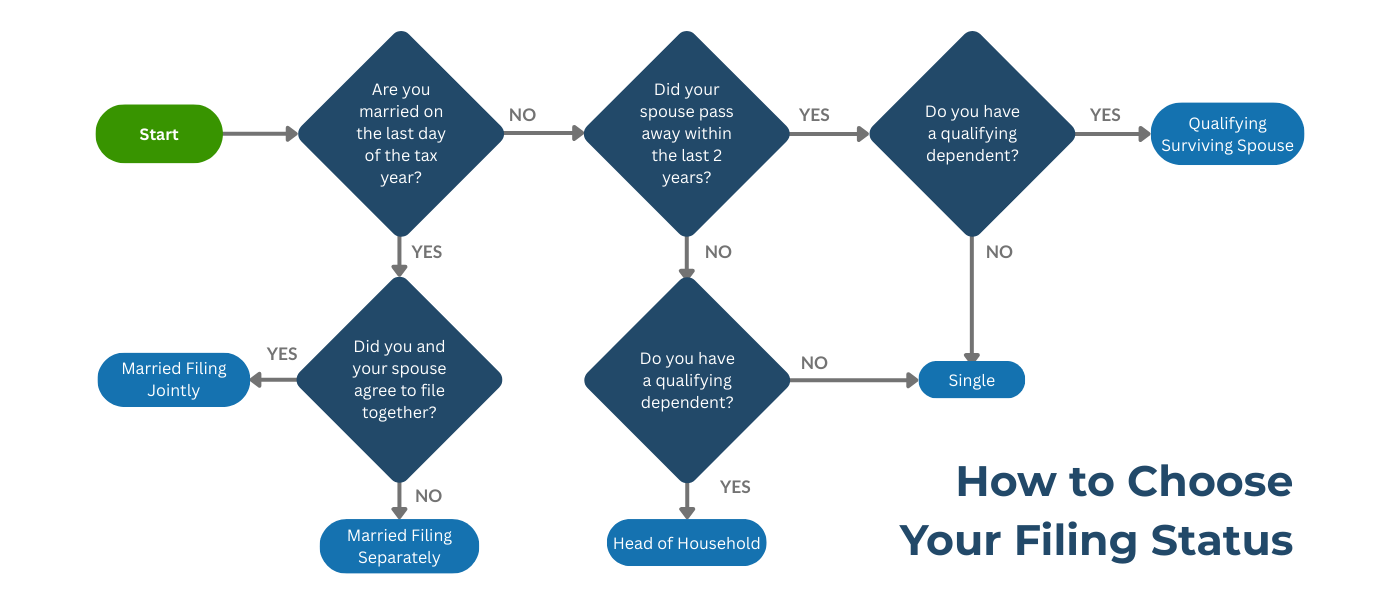
When Each Filing Status Wins (Decision Shortcuts)
Sometimes you just want the highlights. Here’s when filing statuses might make sense for you:
Single Filing Status
- Best if: You’re unmarried at the end of the year and have no qualifying person.
- Why it wins: Simplicity: file, pay, done.
- Notes: Higher tax liability and fewer family-related credits since most Single filers don’t have dependents.
Head of Household
- Best if: You're a single parent or supporting a qualifying child/relative.
- Why it wins: It has a higher standard deduction and generally lower effective tax rates than Single.
- Notes: You must pay more than 50% of the costs, and the dependent generally must live with you for more than half the year (exceptions for parents/temporary absences).
Married Filing Jointly
- Best if: You’re legally married, living together, and agree to file a joint return with your spouse.
- Why it wins: Lowest combined tax liability, higher thresholds for credits, and access to certain credits that aren’t available if filing separately.
- Notes: You’re both fully responsible for the accuracy of the income tax return. If your spouse underreports income, the IRS still comes after you.
Married Filing Separately
- Best if: You want liability protection, or one spouse has large medical expenses or student loans on an income-driven repayment plan.
- Why it wins: Sometimes lowers taxes in cases of student loans, medical expenses, or when divorce is not yet finalized.
- Notes: You lose access to many tax credits, such as education credits and certain dependent-related credits.
Qualifying Surviving Spouse
- Best if: Your spouse died in the last two years and you’re supporting a dependent child.
- Why it wins: Keeps the higher standard deduction and lower tax rates of joint filing during a tough financial time.
- Notes: You must still have a dependent child, and it only applies for two years after your spouse died.
Compare Pages (Detailed Guides)
Want to go deeper before you commit? These side-by-side breakdowns walk you through the fine print — income limits, deductions, credit eligibility, and real-world scenarios.
Looking for the detailed comparison? Dive into these guides below.
- Single vs Head of Household
- Single vs Married Tax Withholding
- MFJ vs MFS
- QSS vs HOH
- Which filing status should I choose?
Sources
Final Takeaway
Your filing status affects your tax brackets, deduction amount, and eligibility for key credits. Reviewing your marital status, dependents, and household support carefully ensures you choose the correct category.
If you're unsure, review the detailed comparison guides above before filing.
Common Questions About Choosing a Filing Status
The IRS considers your marital status on the last day of the year, your qualifying dependents, and whether you paid at least half of the household expenses.


