



Kansas Tax Extension: How to File and Pay on Time
Everything You Need to Know About Filing a Kansas Tax Extension
Fact Checked
FileTax.com content is reviewed for accuracy, timeliness, and completeness. It undergoes a structured editorial review process involving writers and expert reviewers.
More on our editorial standards Meet our editorial team Todd MonahanTax Content Specialist
 Lea Uradu, JDTax Content Reviewer
Your Takeaways:
Original due date (file or pay): April 15, 2026
Extended filing deadline: October 15, 2026
Minimum payment required: 90% of your Kansas tax liability
Running out of time before April 15? You're not alone, and getting more time to file in Kansas is easier than you might think. Filing federal Form 4868 gives Kansas individual taxpayers an automatic six-month extension to file, though it doesn't extend the deadline to pay Kansas tax. This guide walks through the 2026 deadlines, filing steps, payment rules, and requirements for individuals and businesses. Filing in another state too? See our state tax extension hub for every state's rules.
Kansas automatically grants individual taxpayers the same extension when they file federal Form 4868. It does not extend the deadline to pay. If you pay at least 90% of your total Kansas tax liability by April 15, 2026, and pay the remaining balance when you file, you can generally avoid a separate late-payment penalty, though interest still applies to any amount paid after April 15.
The Kansas Department of Revenue directs taxpayers to include a copy of Form 4868 with the completed Kansas return. This process covers income reported through wages, W-2 withholding, 1099s, and self-employment income. An extension does not replace an amended return if you discover an error after filing.
How Does a Kansas Tax Extension Work?
An extension provides more time to prepare an accurate state income tax return, not more time to fund the balance. Kansas individual filers do not need a separate state extension form. File a valid IRS Form 4868 by the original due date, which requests more time to file your federal income tax return, and Kansas automatically grants the same six-month extension for your Kansas return. That's different from working through the federal extension process itself, which Kansas follows rather than duplicates.
Employees, freelancers, and self-employed taxpayers commonly use the additional time to reconcile W-2 and 1099 records or finish estimated tax calculations. Filing circumstances can differ, so taxpayers with residency changes, unusual income, or other special facts may want to consult a licensed tax professional. For a broader look at Kansas filing requirements and residency rules, see our Kansas state tax guide.
Extension to File vs. Time to Pay
The extended filing deadline applies to paperwork. Unpaid Kansas tax still accrues interest starting April 15, 2026, regardless of your extension. Estimate what you owe, pay as much as possible by the original due date, and complete the return by October 15.
Who This Guidance Covers
The individual rules below apply primarily to Kansas residents and other taxpayers filing Form K-40 (Kansas's individual income tax return), including employees, self-employed workers, freelancers, and military personnel filing a Kansas return. Corporations, partnerships, fiduciaries, and other entities should review the Kansas Business Tax Extension Basics section below, since their forms and deadlines differ.
How Do You File a Kansas Tax Extension?
For an individual filer, the central action is submitting federal Form 4868 before April 15, 2026. Retaining the accepted request, payment confirmations, and your final return creates a reliable record if Kansas later asks how or when the extension was completed.
Step 1: Estimate Your Kansas Tax Due
Use current income records, prior-year information, tax withholding, estimated tax payments, tax deductions, tax credits, and your filing status to calculate a reasonable projected balance. If retirement contributions, retirement benefits, or personal exemptions affect your Kansas taxable income, factor those in as well. See "How Much Should You Pay With an Extension?" below for the estimate formula. The estimate does not need to match your final return exactly, but postponing all payment analysis until October can increase your interest cost.
Step 2: File Federal Form 4868 by April 15
Submit Form 4868 by the original due date to request the automatic federal extension that Kansas follows for individual returns. Save your electronic acceptance evidence or a copy of the mailed form, since Kansas instructs individual filers to include the extension documentation with their state return.
Step 3: Pay Your Estimated Kansas Balance
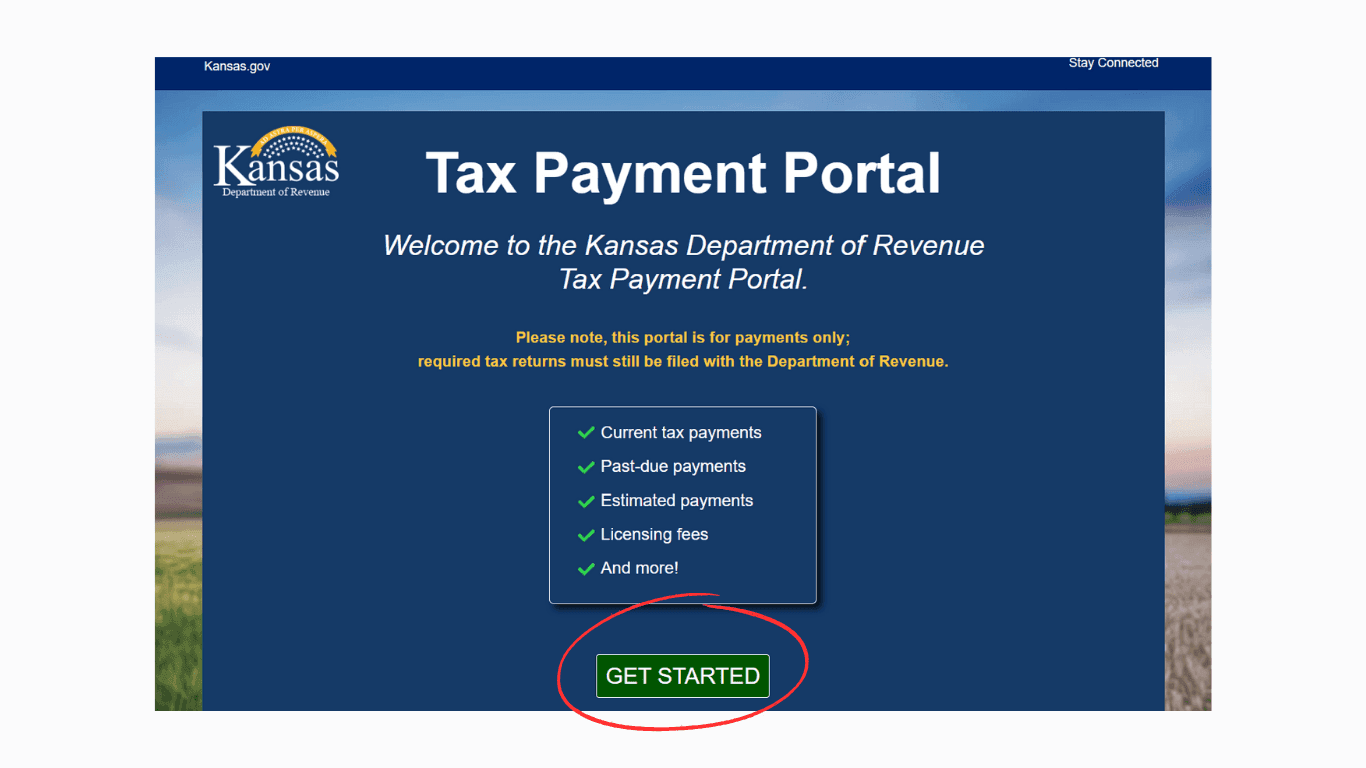
Make an extension payment through the Kansas Department of Revenue's Payment Portal or by mailing Form K-40V, the Kansas Payment Voucher. If mailing the voucher, check the extension-payment box and include it with your check or money order made payable to "Kansas Income Tax." Do not staple or attach the voucher to your payment.
Step 4: File Your Kansas Return by October 15
File Form K-40 by October 15, 2026, and attach a copy of Form 4868 as directed by Kansas guidance. Pay any remaining balance with your completed return, and keep copies of your return, extension, and payment records.
Once you've filed, you can check your refund status through the Kansas Department of Revenue's online refund tool. Normal processing time for a paper return is up to 16 weeks; refund information for prior-year or amended returns isn't available through that same tool.
What Are the Kansas Tax Extension Deadlines for 2026?
The following dates apply to 2025 calendar-year individual returns filed during 2026. Neither date falls on a weekend or legal holiday this year, so no shift applies; if a due date ever does land on a Saturday, Sunday, or legal holiday, Kansas guidance moves it to the next regular business day.
Action | Deadline | What You Need to Do | Why It Matters |
|---|---|---|---|
File Form 4868 | April 15, 2026 | Submit the federal extension request | Establishes your Kansas filing extension automatically |
Make an estimated Kansas extension payment | April 15, 2026 | Pay your projected Kansas balance using Form K-40V or the Payment Portal | Limits unpaid tax and avoids the late-payment penalty |
File Form K-40 | October 15, 2026 | Submit your completed return with a copy of Form 4868 attached | Meets the extended filing deadline |
Pay any remaining balance | October 15, 2026 | Pay the final amount shown on Form K-40 | Resolves the balance, though interest applies from April 15 |
These dates separate two obligations taxpayers often combine mentally: April controls the extension request and estimated payment, while October controls the completed return.
How Much Should You Pay With an Extension?
Kansas Department of Revenue guidance states that paying at least 90% of your tax liability by the original due date, then filing and paying the remainder by the extended due date, avoids the late-payment penalty. Any balance still unpaid after April 15, 2026 accrues interest regardless of whether you met the 90% threshold. For 2026, Kansas sets the interest rate at 8% per year, or approximately 0.67% per month, not compounded.
A practical estimate is your projected Kansas tax liability minus withholding, estimated tax payments, and refundable credits. Taxpayers with variable income, a business sale, residency changes, or other major life events should consider qualified professional help, since a basic projection may omit material items.
The Individual Penalty Rate Is 1% Per Month, Not the Graduated Schedule Some Sources List
The penalty for not paying 90% of your Kansas individual income tax by April 15 is 1% of the unpaid balance for each month or part of a month it remains unpaid, up to a maximum of 24% (Kansas Statutes Annotated, or K.S.A., 79-3228). That's a flat, single-rate penalty, not the graduated 2%/5%/10%/15% schedule you may see cited for Kansas late payments. That graduated schedule is real, but it applies to late withholding tax deposits (K.S.A. 79-32,107), a different tax filed by employers, not individual income tax. Kansas's own penalty-and-interest page lists both schedules on the same page, which is an easy place for the two to get crossed. Use our penalty and interest calculator to see what you'd owe.
For example, on a $10,000 Kansas tax liability, paying only $6,000 (60%) by April 15 misses the $9,000 threshold needed to reach 90%. On the resulting $4,000 shortfall, waiting the full six months until the October 15 extended due date to pay the rest would add roughly $240 in penalty (1% per month for six months) plus interest of roughly $160 (0.67% per month for six months), for about $400 in additional cost on top of the tax itself. Paying closer to the full 90% up front avoids the penalty entirely and limits the cost to interest on whatever small balance remains.
Payment Methods and Form K-40V
Form K-40V, the Kansas Payment Voucher, accompanies a mailed individual income tax payment, including an extension payment. Check the extension-payment box on the voucher when it applies to your situation. The voucher transmits your payment; it does not request more filing time. Form 4868 supports the extension itself.
You can also pay electronically through the Kansas Department of Revenue's Payment Portal or Customer Service Center, by bank debit, or by credit card through the state's third-party service provider, which charges a convenience fee based on your payment amount. Electronic payment gives you a confirmation number immediately and avoids mailing delays. Whichever method you use, keep the confirmation number, cleared-payment evidence, or voucher copy with your tax records.
If you're mailing a payment separately from your return, confirm the current mailing address on the official Form K-40V instructions before sending, since Kansas Department of Revenue mailing addresses can differ depending on whether you're filing with your return or paying separately.
Kansas Business Tax Extension Basics
Business owners should not apply the individual procedure above to a business tax extension without checking the entity-specific instructions. The Kansas Department of Revenue's corporate income guidance confirms that Kansas follows an accepted federal business extension for qualifying corporate filers: if you've applied for the automatic six-month federal extension, Kansas will follow it, and you don't need to file a separate Kansas extension request.
A federal business extension commonly involves IRS Form 7004, but the applicable due date depends on your entity type and tax year. Extra filing time does not postpone the tax payment deadline. Kansas guidance applies the same 90% payment threshold to corporate filers that it applies to individuals: pay at least 90% of the tax due by the original due date to avoid the late-payment penalty.
When to Verify Business-Specific Requirements
C corporations, S corporations, partnerships, fiduciaries, and fiscal-year entities should confirm current Kansas tax regulations, forms, and due dates before filing. A Kansas Subchapter S corporation election follows your federal S corporation status automatically, with an exception for banks, savings and loan associations, and trust companies, which file a privilege tax return instead. Applicable corporations use Form K-120V, the Kansas Corporate Income Tax Payment Voucher, to submit certain payments.
Do Military Servicemembers Get More Time to File in Kansas?
The extension rules above cover most individual filers, but Kansas grants service members more time than the standard six-month extension in specific situations. Under the federal Servicemembers Civil Relief Act, Kansas automatically extends several deadlines 180 days after deactivation: filing returns, paying taxes, filing refund claims, and taking other actions with the department. This applies if any of the following describe your situation:
- You serve in the Armed Forces in a combat zone, or have qualifying service outside a combat zone.
- You serve in a qualified hazardous duty area, or are deployed overseas away from your permanent duty station in support of operations in a qualified hazardous duty area.
- You're deployed outside the United States away from your permanent duty station as part of a contingency operation designated by the Secretary of Defense or triggered by a war or national emergency.
If you qualify and can't file your return, pay tax due, or respond to an existing balance or notice until you return from deployment, complete Form KS-2848, Servicemember Mobilization Notice, and send it along with a copy of your deployment orders to Kansas Department of Revenue, PO Box 750260, Topeka, KS 66675-0260. When you return to normal duty, file the appropriate tax documents and pay any remaining balance to bring your account current; the department's Taxline (785-368-8222) can help with that process.
Common Kansas Extension Mistakes to Avoid
A valid extension works only when you handle both the filing and payment obligations correctly. These errors lead to preventable interest charges, late-payment charges, or an unfiled-return issue:
- Assuming the extension delays payment until October rather than estimating and paying tax by April 15.
- Filing Form 4868 but not retaining evidence that the request was submitted or accepted.
- Forgetting to attach a copy of Form 4868 to the completed Kansas return.
- Missing the October 15 filing deadline after receiving the extra time.
- Treating Form K-40V as an extension request rather than a payment voucher.
- Reusing prior-year interest rates, penalty figures, or deadlines instead of checking current Kansas Department of Revenue guidance. Rates change annually — the 2026 interest rate is 8%, down from 9% in 2025.
A calendar reminder for both deadlines addresses most timing failures. A separate document folder for Form 4868, Form K-40V, payment confirmations, and Form K-40 addresses most recordkeeping failures.
Compare Kansas Tax Extension Rules to Nearby States
If you live or work across state lines, you may also need to understand how other states handle tax extensions:
- Missouri tax extension
- Nebraska state tax extension
- Oklahoma tax extension rules
- Colorado tax extension
Each state has different rules for payment requirements, penalties, and whether they accept the federal extension.
Keep Filing and Payment Deadlines Separate
Accurate estimates, retained confirmations, and timely Form K-40 filing provide the clearest path through the extension process. Filing a federal extension for a business too? Business filers should confirm their entity-specific due date before assuming the individual deadlines apply.
Frequently Asked Questions
Yes, for 2025 calendar-year individual returns, a valid federal extension gives you until October 15, 2026 to file your Kansas return. Your estimated Kansas tax payment is still due April 15, 2026.


