




Can You File Head of Household If You’re Married?
Fact Checked
FileTax.com content is reviewed for accuracy, timeliness, and completeness. It undergoes a structured editorial review process involving writers and expert reviewers.
More on our editorial standards Meet our editorial team Karen Van ThournoutTax & Financial Content Specialist
 Lea Uradu, JDTax Content Reviewer
Your Takeaways:
- Married taxpayers can file as Head of Household only if the IRS considers them “unmarried,” which requires living apart the last six months, filing separately, paying most household costs, and having a qualifying child.
- Legal separation often allows HOH or Single status, while simply living apart without meeting IRS rules does not qualify.
- Only the custodial parent can claim Head of Household — noncustodial parents never qualify, even if they provide support or claim the child as a dependent.
Can you file as Head of Household if married? Yes — but only if the IRS treats you as “considered unmarried.” Read on to see if you qualify.
The IRS Rules Explained (Plain English)
The IRS is strict about filing status, and for good reason. Head of Household filing status comes with valuable tax benefits: a higher standard deduction, access to lower tax brackets, and potential eligibility for tax credits compared to the Single filing status. To file as Head of Household while married, you must meet all of the following conditions:
Considered “Unmarried”
To be considered unmarried, all of the following must apply:
- Lived apart from spouse during the last six months of the tax year (temporary separations, like work travel, don’t count).
- Paid more than half of the household costs.
- Had a qualifying child who lived in the home for more than half of the year.
- File a separate return.
This is the cornerstone test for married taxpayers seeking HOH.
Exception: If your spouse is a nonresident alien and you do not elect to treat them as a U.S. resident for tax purposes, you may be considered unmarried without meeting the six-month separation rule. See IRS Publication 501 for details.
Legal Separation vs. Living Apart
- Legally separated: If you are legally separated or under a separate maintenance decree recognized by state law, the IRS does not consider you married for tax purposes. You may file as Single or Head of Household (if you also meet the HOH tests).
- Living apart without legal paperwork: The IRS still allows HOH filing status if the “considered unmarried” rules apply.
Myths to Bust
There’s a lot of confusion around Head of Household, especially for married taxpayers. To set the record straight, here are the most common myths—and the truth behind each one.
Myth 1: “We live in separate homes, so I qualify.”
Truth: Living apart doesn’t automatically qualify you as Head of Household.
To file HOH, you must have a qualifying child who has lived with you for more than half the year and prove you paid most of the household expenses.
Myth 2: “If my spouse and I don’t file jointly, I can pick HOH.”
Truth: You can’t choose Head of Household as a fallback to married filing separately.
The IRS only allows HOH if you meet strict rules about living apart and supporting a qualifying child.
Myth 3: “Noncustodial parents can claim HOH.”
Truth: Only the custodial parent can qualify.
Even if a noncustodial parent provides support or claims the child as a dependent, they never qualify for Head of Household. The custodial parent — the one the child lives with for more than half the year — may be eligible if they also meet the other HOH rules, like paying more than half the household costs.
Myth 4: “Paying child support guarantees HOH status.”
Truth: Paying child support alone is insufficient to claim Head of Household.
The child must live in your household for more than half the year, and you need to meet the cost test.
Myth 5: “Once you qualify, you always qualify.”
Truth: Head of Household status is determined year by year; it's not automatic from year to year.
You may no longer qualify if your household situation changes, such as your child moving out or you reconciling with your spouse.
Myth 6: “Temporary absences count as living apart.”
Truth: Temporary absences do not count as living apart for IRS purposes.
If your spouse is away for work, school, military service, or medical care but intends to return, the IRS still treats you as living together.

Common Scenarios
Scenario 1: Custodial Parent Living Apart
Here’s a common case: You and your spouse separate mid-year and remain apart for the last six months. Your child lived with you for more than half the year, you paid most of the household expenses, and you file a separate return. You may qualify for the Head of Household filing status in this situation.
Scenario 2: Legally Separated Under a Court Decree
If you’re legally separated or under a separate maintenance decree recognized by your state, the IRS does not consider you married for tax purposes. If your child lives with you and you pay more than half the cost of keeping up your home, you may qualify for the Head of Household filing status.
Scenario 3: The Misconception Case
You and your spouse live apart, but your child lives with your spouse instead of you. In this situation, you can’t claim Head of Household, even if you cover all of your own household costs, because the qualifying child must live with you for more than half the year.
How HOH Compares to Other Filing Statuses
Here’s a quick breakdown of how HOH stacks up against other filing statuses:
Filing Status | Standard Deduction (2026) | Tax Brackets | Typical Use Case |
|---|---|---|---|
Head of Household | $24,150 | Lower tax rates than Single | Single parents or caregivers with dependents |
Married Filing Jointly | $32,200 | Widest brackets, best for dual-income couples | Most married couples |
Married Filing Separately | $16,100 | Higher tax rates, limited credits | Couples who need separate returns |
Single | $16,100 | Higher tax rates than HOH | Individuals without dependents |
Why HOH matters: You may qualify for a higher standard deduction, a lower tax rate, and access to valuable tax credits like the Child Tax Credit or Earned Income Tax Credit.
Think of it this way: Head of Household is a special filing status with extra tax benefits — but only if you meet strict IRS rules. It’s not available to everyone, but meeting the requirements can lower your taxable income and put you in a lower tax bracket.
What To Do Next
Not sure if you qualify? Here’s your next move:
- Read the Head of Household Filing Status Guide for the full breakdown.
- Compare with Married Filing Jointly or Separately to see which makes more sense for your situation.
- Need more time? Learn how to extend with our Tax Extension Guide.
👉 Use our simple flowchart: “Do You Qualify as Head of Household?”
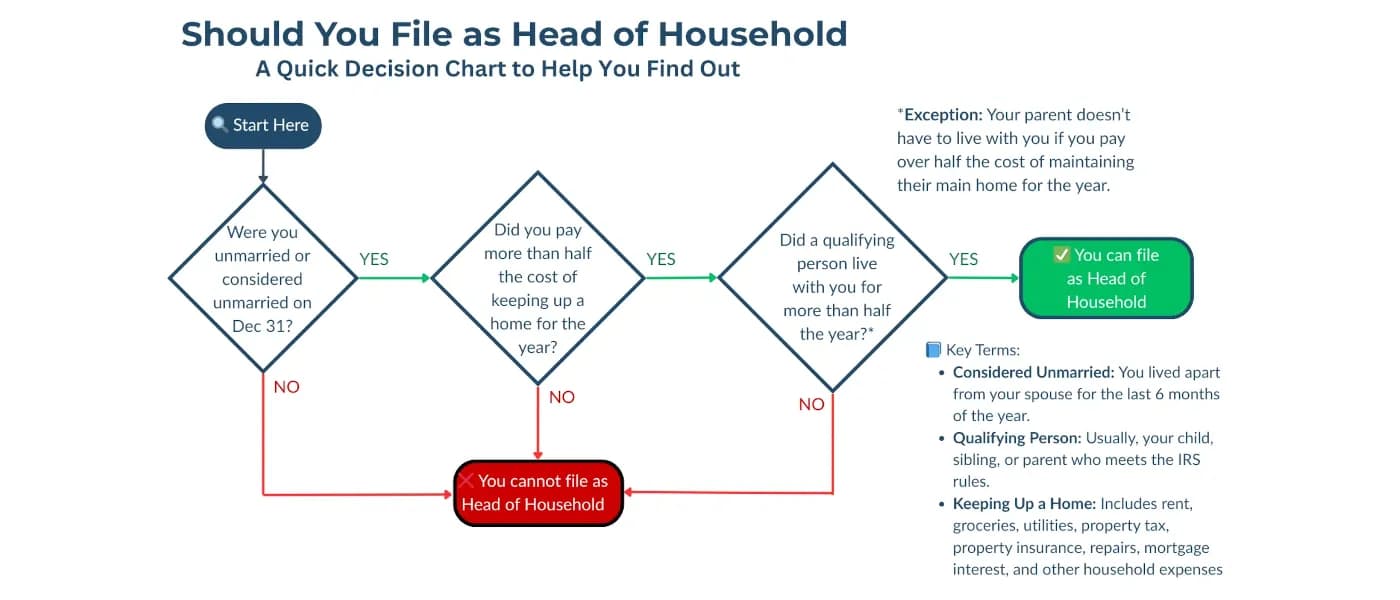
Bottom line: You can file Head of Household while married, but only if you meet strict IRS rules. If you don’t qualify, your options are generally Married Filing Jointly or Married Filing Separately. If you’re legally separated under state law, you may qualify as Single instead. When in doubt, get professional advice.
Frequently Asked Questions
Yes, but only if you’re “considered unmarried” under IRS rules, lived apart the last six months, and supported a qualifying child who lived with you for more than half the year.


