



Head of Household Filing Status
Head of Household filing status can affect your tax rate, standard deduction, eligibility rules, and whether you can claim a qualifying dependent. This hub brings together FileTax.com resources that explain who qualifies, common filing mistakes, and situations where Head of Household status may or may not apply.
Head of Household can be one of the most misunderstood filing statuses because eligibility depends on your marital status, household costs, living arrangements, and whether you have a qualifying dependent. Use the resources below to compare common scenarios, understand the rules, and find the guide that best matches your situation.
Quick Link Resources


Head of Household Filing Status: What This Hub Covers

Head of Household status is generally for unmarried taxpayers who pay more than half the cost of keeping up a home and have a qualifying person. Because the rules can vary based on whether you are married, separated, living with a parent, supporting a child, or sharing a household, this hub organizes the most common Head of Household questions into focused guides.
Use the resources below to learn:
- Who may qualify as Head of Household
- How the Head of Household compares with Single filing status
- Whether married or separated taxpayers may qualify
- What counts as a qualifying dependent
- How shared homes, parents, roommates, or multiple taxpayers can affect eligibility
- What penalties may apply if Head of Household is claimed incorrectly
If you’re unmarried (or considered unmarried), paid more than half of your household expenses, and had a qualifying person live with you for more than half the year, you may qualify for the Head of Household (HOH) filing status. Filing as Head of Household can reduce taxable income compared to Single filing status, which may result in lower federal income tax.
Quick Answer: You generally qualify for Head of Household if you are unmarried (or considered unmarried), paid more than half the cost of keeping up your home, and have a qualifying person such as a child or dependent parent. Single parents, certain separated spouses, and taxpayers supporting a dependent relative may qualify if they meet all IRS requirements.
What Is Head of Household Filing Status?
The Head of Household (HOH) filing status is designed to give tax relief to people supporting dependents while shouldering most household costs. Compared to filing as Single or Married Filing Separately, HOH usually provides some tax advantages:
- A higher standard deduction: For the 2026 tax year, HOH filers receive a $24,150 standard deduction, a significant upgrade from the $16,100 standard deduction for Single filers (based on the Big Beautiful Bill).
- Lower tax brackets: You’ll stretch into higher brackets more slowly, which means keeping more of your income taxed at lower rates.
How Head of Household Status Affects Tax Credits
Head of Household (HOH) status doesn’t create new tax credits or raise income phaseout thresholds compared to filing Single. Most credits phase out based on your adjusted gross income (AGI), and those limits are the same for Single and HOH. The real differences are:
- Child Tax Credit (CTC): The phaseout thresholds are identical for HOH and Single. However, HOH filers typically qualify because they have a dependent child, while a Single filer without dependents cannot.
- Child & Dependent Care Credit: HOH and Single follow the same income rules. The main distinction is that Married Filing Separately (MFS) filers are not eligible, but HOH can claim it.
- Earned Income Credit (EIC): The income ranges are the same for Single and HOH filers. However, HOH filers often qualify at higher incomes because they usually have children, and the credit allows higher income limits for taxpayers with qualifying children.
- Education Credits (AOTC & Lifetime Learning): Phaseout thresholds don’t change between HOH and Single, but again, MFS is excluded.
Bottom line: HOH status doesn’t extend phaseout ranges compared to Single, but it usually goes hand in hand with having dependents, which opens the door to credits like the Child Tax Credit and Earned Income Credit. On top of that, HOH filers benefit from a larger standard deduction and wider tax brackets, which reduce their overall tax bill compared to Single filers at the same income.
✅ Pro Tip: Think of HOH as the IRS’s saying, “We see you, doing it all.” It’s recognition (in tax savings form) for covering most of the bills while caring for someone else.
Who Qualifies for Head of Household? IRS Rules Explained
To claim HOH status, you must meet three IRS tests:
1. Marital Status Test: Unmarried or Considered Unmarried
You must be:
- Unmarried: Single, legally separated, or divorced by December 31 of the tax year.
- Considered unmarried: Married but lived apart from your spouse during the last six months of the year, and you meet all IRS requirements, including filing a separate return, paying more than half the cost of the home, and having a qualifying child who lived with you more than half the year.
Note: Being separated does not qualify you; all IRS tests must be met to be considered unmarried. You must meet IRS rules for “considered unmarried.” Learn more about filing HOH while married
Special case: If your spouse is a nonresident alien, special IRS rules apply. You generally cannot claim Head of Household unless you satisfy the "considered unmarried" requirements and have a qualifying person.
2. Support Test: Paying More Than Half of Household Costs
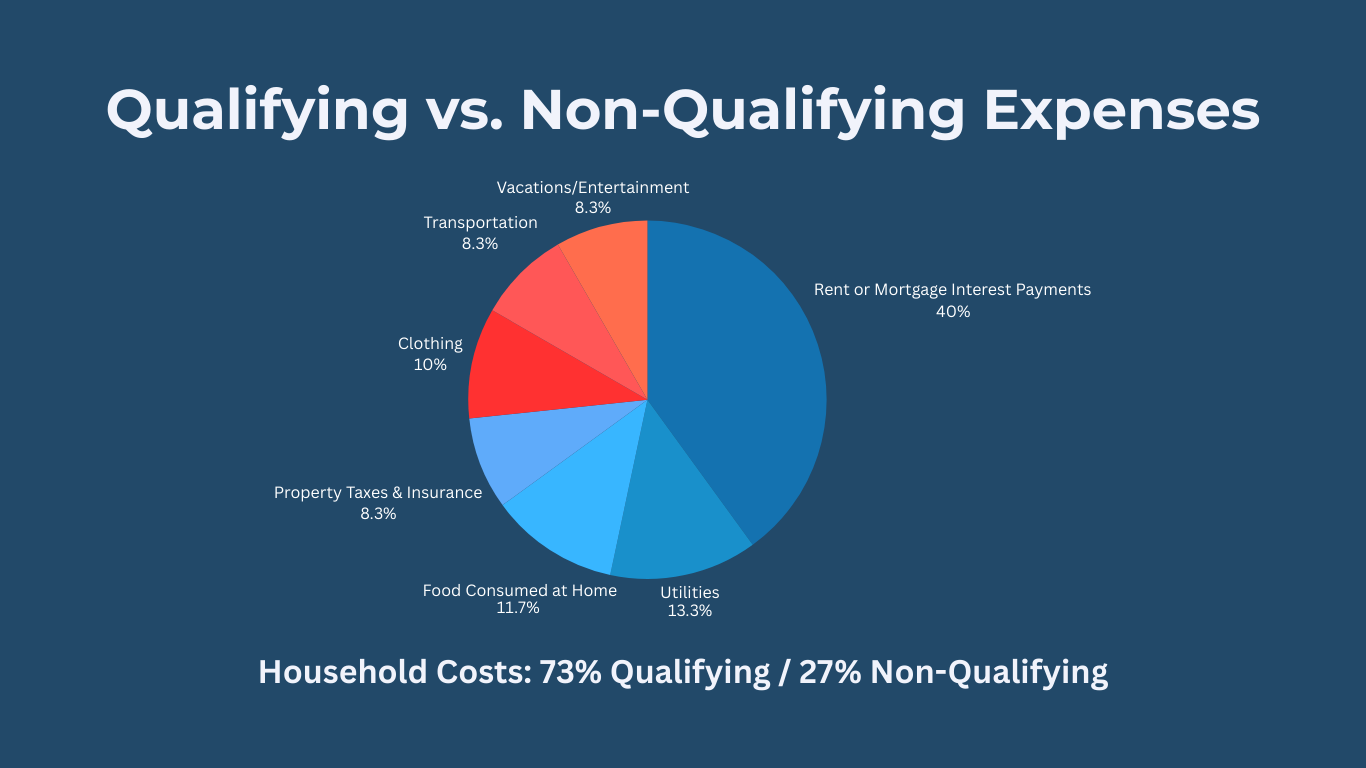
To meet the support test, you must pay more than half of the total household expenses needed to maintain your home for the year. Qualifying household expenses include:
- Rent or mortgage interest payments
- Real estate/property taxes
- Utilities (electricity, gas, water, trash removal)
- Food consumed in the home
- Homeowner’s or renter’s insurance
- Repairs and upkeep to the home
Not included: clothing, education, medical care, vacations, life insurance, or transportation.
3. Qualifying Person Test: Child or Relative
To claim Head of Household status, you must have a qualifying person. The IRS lays out detailed rules in Publication 501. A qualifying person can be a child, parent, or other close relative who meets the IRS relationship, residency, age, and support tests.
Qualifying Child
A qualifying child can be:
- Your biological, adopted, step, or foster child, or a descendant of any of them (such as your grandchild)
- A sibling, half-sibling, step-sibling, or a descendant of one (such as your niece or nephew)
Additional requirements:
- Must live with you for more than half the year (temporary absences for school, medical care, or military service don’t count against this)
- Must be under 19 at year-end, under 24 if a full-time student, or any age if permanently and totally disabled
- Must not provide more than half of their own support
- Must not file a joint return, unless the return is filed only to claim a refund of withheld income tax or estimated tax paid
Example: Jordan is unmarried and cares for a foster child placed through a court order. Because Jordan pays more than half the cost of maintaining the home and the child is an IRS-recognized qualifying child, Jordan may qualify for Head of Household.
Qualifying Relative
You may still qualify through a qualifying relative if you don’t have a qualifying child. This could include:
- A parent, grandparent, or other direct ancestor (but not a foster parent)
- In-laws such as mother-in-law, father-in-law, brother-in-law, sister-in-law, daughter-in-law, or son-in-law
- Other relatives, like a brother, sister, half-sibling, uncle, aunt, niece, or nephew
Requirements for qualifying relatives:
- Must live with you for more than half the year (except for a dependent parent—see below)
- Must have gross income below the IRS exemption threshold
- You must generally provide more than half of their total support
Dependent Parent Exception
A dependent parent is a special case:
- They do not need to live with you
- You qualify if you pay more than half the cost of their main home, whether it’s your home, their home, or a licensed care facility.
Examples:
- You may qualify if your mother lives in her own apartment and you pay more than half of her rent, utilities, and groceries.
- If your daughter, age 20, attends college full-time, lives with you during breaks, and you cover more than half her expenses, you may qualify.
Learn more about qualifying dependents for HOH
How to Check Your HOH Status
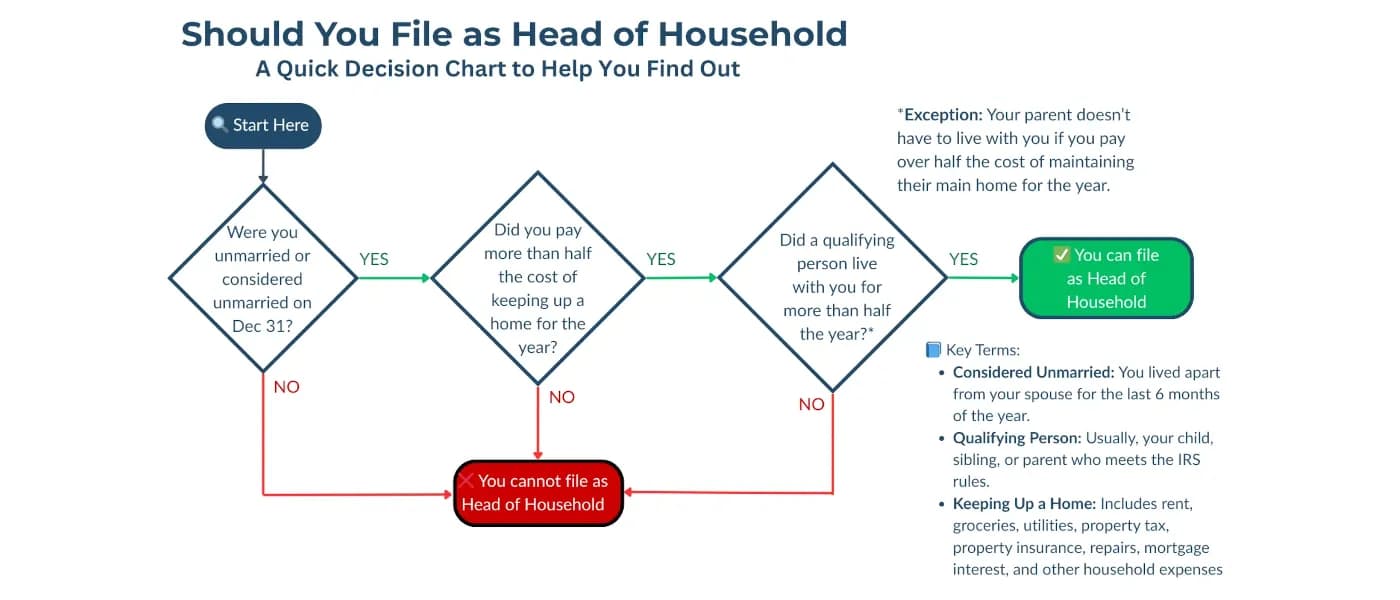
Follow these steps:
- Are you unmarried or considered unmarried?
– If no → you don’t qualify. - Did you pay more than half the cost of keeping up your home?
– If no → you don’t qualify. - Did a qualifying person (child, parent, or other relative meeting IRS rules) live with you more than half the year?
– If no → you generally don’t qualify, unless the qualifying person is your parent and you paid more than half the cost of maintaining their home for the year—in that case, you may still qualify.
👉 Answer yes to all three? You may qualify for HOH, but you must meet all IRS requirements.
Avoid These Common HOH Mistakes and Penalties
Frequent Mistakes
Many taxpayers lose out on HOH savings—or worse, face IRS penalties—because of avoidable errors. Here are the most common missteps:
- Filing while still legally married: Some assume separating or living at different addresses is enough. You can't file as Head of Household unless you meet the IRS's “considered unmarried” qualifications (must file separately, live apart last 6 months, pay more than half the cost of keeping up the home, and have a qualifying child living with you more than half the year).
- Misidentifying dependents: Roommates, unmarried partners, or friends are not qualifying persons. Only children, certain relatives, or dependent parents qualify.
- Misreporting custody arrangements: Your child must live with you for more than half the year to qualify. If custody is exactly 50/50, neither parent automatically qualifies. The IRS tie-breaker rules determine which parent, if any, may claim HOH.
- Both parents claiming HOH: Only one parent can be the household head for a child in a given tax year. The IRS rules give HOH status to the custodial parent (with whom the child lived more than half the year).
- Overlooking dependent parent rules: Some taxpayers miss out on HOH when supporting a parent who doesn’t live with them. Remember, a dependent parent doesn’t need to share your home if you pay more than half their main living costs.
- Not tracking support expenses: Failing to document rent, utilities, and grocery payments can sink your claim during an audit.
- Confusing tax credits with filing status: Claiming the Child Tax Credit doesn’t automatically make you eligible for HOH. They’re separate rules.
IRS Penalties
If you file Head of Household incorrectly, the IRS can impose serious consequences. These may include:
- Audit triggers: HOH claims are a common audit focus, especially when both parents file or income levels don’t align with support claims.
- Repayment of tax savings: If denied, you’ll owe the difference between what you paid and what you would have owed as Single or Married Filing Separately.
- Interest charges: Interest accrues on unpaid amounts from when the tax was originally due.
- Accuracy-related penalty: If you are denied HOH status due to negligence or claiming HOH without meeting the IRS rules, you may be subject to the accuracy-related penalty, which is 20% of the underpaid tax attributable to that error.
- Fraud penalties: If the IRS believes you knowingly misrepresented your filing status, fraud penalties can be as high as 75% of the underpayment.
Example: If you claimed HOH and saved $2,000 in taxes but were later disqualified, you’d owe that $2,000 back, plus interest. You can also possibly face a $400 accuracy-related penalty (20% of $2,000) if the IRS finds out that the error was due to negligence or disregard of tax laws.
Pro Tip: To protect yourself during an IRS review, maintain clear records—lease agreements, utility bills, custody documents, and proof of financial support.
Learn more about HOH penalties and risks
HOH vs Single vs Married Filing Jointly (Comparison)
Filing Status | Standard Deduction (2026) | Tax Brackets Advantage | Who Qualifies |
|---|---|---|---|
Head of Household | $24,150 | Lower rates, wider brackets | Unmarried with a qualifying person |
Single | $16,100 | Higher rates, narrow brackets | Unmarried individuals who do not qualify for another filing status |
Married Filing Jointly | $32,200 | Widest brackets, largest deduction | Married couples who file jointly |
Example: A single parent earning $50,000 may owe less tax filing Head of Household rather than Single because of the higher standard deduction and wider tax brackets.
Compare all filing statuses side-by-side.
Special HOH Situations
Custody & Divorce Rules
Divorce and custody situations can make Head of Household (HOH) filing feel like a tug-of-war—but the IRS has some clear boundaries:
- Custodial parent: The parent with whom the child lives for more than half the year is eligible for Head of Household status if other requirements are met.
- Noncustodial parent: With Form 8332, they may claim the Child Tax Credit or other benefits, but here’s the kicker—they still can’t claim Head of Household.
- Shared custody: Even if you split time 50/50, only one parent may qualify for HOH in a year. (Note: The IRS does not allow both parents to claim HOH for the same child in the same year.)
👉 A mini-comparison table helps:
Parent Type | Can Claim HOH? | Notes |
|---|---|---|
Custodial Parent | ✅ Yes | Must pay >50% of household costs |
Noncustodial Parent | ❌ No | Can claim dependency with Form 8332, but not HOH |
Shared Custody (50/50) | ✅ One parent only | IRS rules decide who qualifies |
Living Situations
Not all living arrangements are straightforward, but HOH can still work in your favor:
- Living alone: Not enough—you also need a qualifying dependent. Learn more →
- Renting a room: Yep, still possible! You may qualify if your dependent lives with you—even in a rented space. Learn more →
- Living with parents: You could still qualify if you pay more than half the cost of keeping up the home. Learn more →
- Temporary absences: Under IRS rules, kids away at college, in the military, or getting medical care can still count as “living with you.”
Multiple Claimants
What if more than one person in the same household tries to claim HOH? If more than one person claims HOH for the same dependent, the IRS applies tie-breaker rules.
🚨 The tie-breaker rules consider:
- Relationship to the dependent
- Support provided
- Residency time
Two taxpayers may both qualify for Head of Household in the same tax year if each maintains a separate household and each has a different qualifying person. However, two taxpayers cannot both claim Head of Household using the same qualifying person.
Learn more about multiple HOH claims
✅ Pro Tip: If you’re in a “gray area” situation (like shared custody or living with parents), keep good records of expenses and living arrangements. Keep thorough records, as the IRS may request documentation to verify HOH status.
How to File as Head of Household (Next Steps)
Filing as Head of Household (HOH) comes with big tax perks—but only if you do it right. Here’s your roadmap:
Forms You’ll Need
- Form 1040: File your return on Form 1040 and check the HOH checkbox at the top of the form.
- Schedule EIC: Must be filed if you claim the Earned Income Credit with a qualifying child. This is where you show your qualifying child's details.
- Documentation (don’t skip this part): Keep proof handy if the IRS asks. Examples include:
- School or medical records showing your dependent’s address.
- Rent or utility bills proving you covered more than half of the household costs.
- Birth certificates or court documents showing the relationship and custody.
👉 Think of this as your records file. The IRS may not ask, but you are required to keep documentation in case of audit, and you’ll be glad you have it if they do.

Best Practices
Want to make filing (and future audits) less painful? Stick to these:
- Keep thorough records: File away receipts, bills, and custody agreements. During tax season, you will thank yourself for being organized.
- Update your W-4: Once you qualify for HOH, be sure to adjust your withholding at work. This can increase your take-home pay throughout the year.
- Check the "Do you Qualify for HOH?" flowchart. Use it as your quick “Am I really HOH?” test before you file. It's a simple visual guide to confirm eligibility before you file.
When to Seek Professional Help
Sometimes preparing your return yourself can be complicated. Bring in the pros if:
- Custody or divorce gets messy: Especially with shared custody or Form 8332 situations.
- Multiple dependents could qualify: Grandma, your child, or your niece—figuring out who qualifies you for the most favorable filing status or credits can be tricky.
- Prior IRS disputes or audits: If you’ve had disputes in the past, avoid round two by getting expert advice.
See Head of Household filing statistics
✅ Pro Tip: FileTax.com's do-it-yourself tax software or a qualified tax professional can help you meet HOH requirements.
Sources
Final Takeaway
The Head of Household filing status reduces taxable income with a higher standard deduction and lower tax brackets. To qualify, you must support at least one dependent and meet all IRS requirements.
👉 Ready to file as Head of Household? Start your tax return today.
Frequently Asked Questions
Yes, if you lived apart from your spouse for the last six months of the year and meet all IRS's ‘considered unmarried’ rules (file separately, pay more than half the cost of the home, and have a qualifying child).


