




Dependents Married Filing Separately: Who Claims the Kids? Dependents & Child Tax Credits
Fact Checked
FileTax.com content is reviewed for accuracy, timeliness, and completeness. It undergoes a structured editorial review process involving writers and expert reviewers.
More on our editorial standards Meet our editorial team Andrew WalshCPA, CFP CTFA & Tax Content Specialist
 Lea Uradu, JDTax Content Reviewer
Your Takeaways:
- Only one parent can claim a child when filing Married Filing Separately.
- The custodial parent usually has priority, based on where the child lived most of the year.
- Form 8332 is required if the custodial parent allows the other parent to claim the child.
- You cannot split a child or split credits between separate returns.
- The Child Tax Credit is allowed under MFS, but only for the parent who claims the child.
Only one parent can claim a child when you file Married Filing Separately. The custodial parent usually has priority unless they release the claim using Form 8332. Some credits, like the Earned Income Tax Credit, aren’t allowed for MFS filers.
This guide breaks it all down in clear, friendly English so you know exactly what to expect.
The Quick Answer: Who Gets to Claim the Kids Under MFS
When you choose the Married Filing Separately (MFS) status, the IRS has strict rules about who claims the child and which credits you can claim. If you need a full breakdown of how MFS works, see our Married Filing Separately Guide.
Before choosing a filing status, review your overall tax situation—including your income, deductions, and personal circumstances—to determine what’s best for you.
Before we dive in, here’s the quick definition:
Married Filing Separately is a filing status where each spouse files their own federal income tax return, reports their own income, tax deductions, and credits, and accepts individual responsibility for their own tax bill. Here’s how married filing separately works: each spouse must file separate returns, following specific IRS rules, and may face different tax rates, deduction limits, and credit restrictions compared to filing jointly.
MFS gives you control, but it also limits access to certain tax benefits. When you file separate returns, you may lose eligibility for some credits and deductions, so it’s important to weigh the pros and cons before deciding. So let’s walk through exactly how dependent rules work in an MFS world.
How Dependent Rules Work When Filing Separately
When you choose the Married Filing Separately status, the Internal Revenue Service has a very specific playbook for deciding who gets to claim the child. Unlike shared parenting plans, the IRS applies strict rules with no flexibility or negotiation.
Here’s the big picture: Only one parent can claim a child on separate returns. The IRS does not allow parents to split or share a dependent; only the qualifying parent can claim the child, unless the custodial parent releases the claim using Form 8332. A single tax return is filed for the dependent, and that parent receives access to the CTC and other eligible tax benefits.
Note: For tax year 2022 and beyond, personal exemptions are no longer available. Instead, taxpayers rely on the standard deduction or itemized deductions.
Check if you are qualified for the Head of Household tax filing status (covered in our HOH guide).
When considering your filing options, remember that filing a joint tax return may offer more tax benefits compared to filing separately, but there are situations where Married Filing Separately is preferred or required.
Another key detail under married filing separately: even if a noncustodial parent qualifies to claim the child using Form 8332, you still lose access to certain tax credits because of your filing status. For example, the Earned Income Credit is completely disallowed under Married Filing Separately, even if you’re the parent who claims the child.
Eligibility for certain credits and deductions can also depend on how you are reporting income on your tax return, which affects which parent can claim specific tax benefits.
IRS Tie-Breaker Rules When Both Parents Qualify
If the child passes the IRS qualifying child tests (relationship, age, residency, support, and joint return) for both of you, the parent the child lived with for more than half the year, counted by nights, usually claims the child. If the nights were exactly equal, the parent with the higher adjusted gross income (AGI) claims the child. For the full tests, the tie-breaker rules, and examples, see our guide on who should claim a child on taxes.
Source: IRS Pub. 501, Qualifying Child Tests
What Happens If Both Parents Try to Claim the Same Child
If you and your spouse both claim the same child on separate tax returns:
- The IRS e-file system rejects one return.
- If both returns are paper-filed, the IRS will apply tie-breaker rules manually.
- The non-qualifying parent may lose credits and could face a tax bill, penalties, or delays.
The easiest fix: decide together before filing. Avoid letting the IRS decide for you. It’s much easier to coordinate ahead of time.
How the Child Tax Credit Works When You File Separately
One of the biggest MFS questions is simple: Who gets the Child Tax Credit? Under MFS, only the parent who claims the child as a dependent can take the credit. Only one parent can claim a child or qualifying relative as a dependent, and generally, the parent who provides the child's housing for most of the tax year gets to claim the child.
Here’s the rule: Only the parent who can claim the qualifying child as a dependent can claim the CTC. The Child Tax Credit is a nonrefundable tax credit (with a refundable portion known as the Additional Child Tax Credit).
That’s usually the custodial parent, unless:
- The custodial parent signs Form 8332, releasing the exemption
- The noncustodial parent attaches Form 8332 to their return
- Both parents agree and follow the IRS dependency release rules
If Form 8332 is used, the noncustodial parent may claim the child, but there’s a twist: if you choose the Married Filing Separately status, you lose several child-related credits even if you claim the child.
How the Child Tax Credit Works Under Married Filing Separately
Married couples filing separately can claim the Child Tax Credit, but with a catch: Married Filing Separately has its own income threshold.
- Credit amounts vary by tax year. For the 2025 filing season, the maximum credit is up to $2,200 per qualifying child, with up to $1,700 potentially refundable.
- Income phase-out for Married Filing Separately: Starts at $200,000 (half of the Married Filing Jointly threshold)
If your spouse claims the child, you cannot, and vice versa. There’s no “split the credit” or “split the child.” If the child lived with both parents equally, the IRS requires the parent with the highest adjusted gross income to claim the child.
Source: Big Beautiful Bill
Credits You Can Claim vs Credits You Lose Under MFS
Here’s your required artifact: a clear comparison table of what’s allowed under Married Filing Separately when claiming a child.
Credit or Deduction | Allowed under MFS? | Notes |
|---|---|---|
Child Tax Credit (CTC) | ✔ Allowed | Only the dependent-claiming parent can take it |
Additional Child Tax Credit | ✔ Allowed | Income limits still apply |
Child and Dependent Care Credit | ✖ Usually Not Allowed | Only allowed if you meet the narrow IRS separation exceptions in Form 2441 instructions. |
Earned Income Tax Credit (EITC) | ✖ Disallowed | Not available unless you qualify for the special “separated spouse” rule. |
Adoption Credit/Adoption Expense Exclusion | ✖ Not allowed | MFS filers cannot claim the adoption tax credit or exclude employer-provided adoption benefits |
American Opportunity Tax Credit | ✖ Not allowed | These credits are not allowed if you file as Married Filing Separately |
Lifetime Learning Credit | ✖ Not allowed | These credits are not allowed if you file as Married Filing Separately |
Recovery Rebate Credit (if applicable) | ✔ Allowed | Eligibility depends on the tax year and phase-out rules |
Kiddie Tax rules | ✔ Apply | The first $1,350 in unearned income is not taxed. Amounts over that are taxed to the parents at varying rates. |
Saver’s Credit | ✔ Allowed | MFS filers can claim the Retirement Savings Contributions Credit (Saver's Credit), but must meet eligibility requirements, including income thresholds and contribution limits. |
Student Loan Interest Deduction | ✖ Mostly Not Allowed | The deduction is disallowed if you file MFS. A very narrow exception exists for certain separated spouses, but most MFS filers cannot take it. |
Tuition and Fees Deduction | ✖ Not allowed | Tuition and fees deduction is not available to MFS filers. |
Why these credits disappear: MFS returns are higher-risk for mismatched residency, income splitting, and education credit abuse, so the IRS restricts many benefits under this filing status.
Other MFS Penalties & Limitations (Not Related to Child Credits)
- Capital Loss Deduction: capped at $1,500 (vs $3,000 for MFJ).
- Standard Deduction: lower than for joint filers.
- Social Security Taxability: You may have to include more benefits in taxable income.
- Itemizing Requirement: If one spouse itemizes, the other must itemize.
- Student Loan Payments: Some income-driven repayment plans require joint filing and may be unavailable under MFS.
Several credits and certain tax deductions disappear entirely when filing taxes under Married Filing Separately, including EITC, education credits, adoption expenses, and the tuition and fees deduction. For the complete list, see our guide on MFS penalties and credits you lose.
Sources:
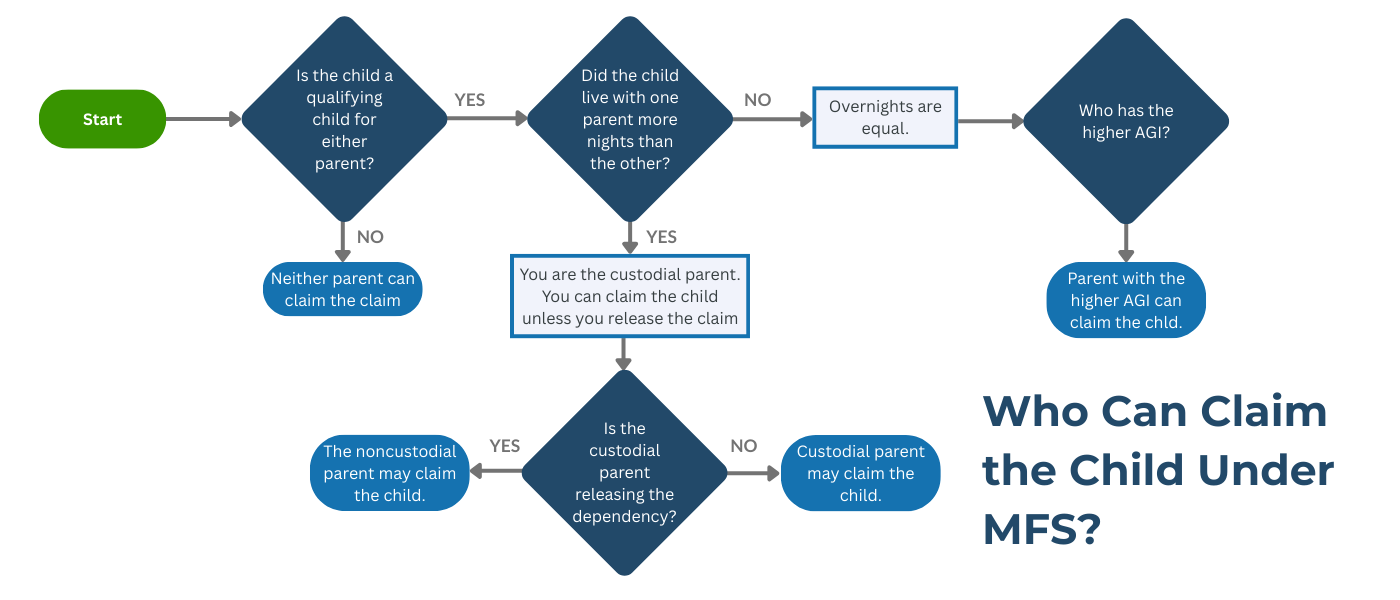
Who Can Claim the Child Under MFS? Decision Chart
Before you decide who gets to claim the kids when using the Married Filing Separately status, it helps to follow the IRS rules step by step. This flowchart walks you through the exact questions the IRS uses to determine which parent can claim the child for tax purposes.
Special Situations That Change Who Can Claim the Child
Parents Living Apart
If you lived apart for the last 6 months of the year, you might qualify for Head of Household filing status instead of MFS. We cover those rules in our HOH guide.
Noncustodial Parent Claiming a Child
This works only if the custodial parent signs Form 8332.
Community Property States
Income, tax deductions, and credits may need to be allocated using Form 8958, but the dependent rule still follows federal regulations on custody and overnights.
Newborns
Even a single night determines the custodial parent. If the child is born on December 31, that day counts as an overnight with the parent the baby went home with.
50/50 Parenting Plans
If overnights are precisely equal, the parent with the higher Adjusted Gross Income claims the child.
Example Scenarios
Scenario 1: Custodial Parent Claims the Child
Jamie and Taylor used the Married Filing Separately status. Their child spends more than half the year with Jamie, making Jamie the custodial parent. Jamie can claim the child as a dependent and take the CTC, unless Jamie chooses to release the claim using Form 8332.
Scenario 2: Noncustodial Parent with Form 8332
Maria is the noncustodial parent. She has Form 8332 from the custodial parent.
Maria can claim the child and the CTC, but not the dependent care credit or EITC.
Scenario 3: Exactly 50/50 Parenting
If both parents have the same number of nights, the IRS uses the higher AGI rule.
Scenario 4: Community Property State
Even if taxable income is split, the dependent rules stay the same: the custodial parent gets priority.

Tax Planning Tips for Parents Filing Separately
Filing separately when you have children adds complexity to your taxes. But here's the good news: the right approach can still get you the tax benefits you deserve. These steps will help you make the most of your situation.
- Choose who claims your child: Only one parent gets the child tax credit. Pick the parent who benefits most—usually whoever has higher income or owes more in taxes. This choice can save you hundreds of dollars.
- Know the dependent care credit rules: This credit is off-limits when filing separately. The exception? You're legally separated or lived apart for six months. If you qualify, keep every receipt for dependent care expenses.
- Check what credits you can claim: Filing separately blocks many credits. You cannot claim the earned income tax credit, retirement savings credit, or education credits. Review this before you file. No surprises.
- Compare both filing options: Calculate your taxes two ways—jointly and separately. Sometimes joint filing saves more money, even when you want separate finances. Run the numbers first.
- Get professional help: Tax rules for separate filers get complicated fast. A tax professional knows the rules around dependents, deductions, and credits. They help you avoid leaving money on the table.
- Handle your FSA correctly: If your employer offers a Dependent Care FSA, understand how it works with the dependent care credit and your filing status. These rules matter.
You can navigate separate filing successfully. Plan ahead. Understand the rules. Make informed choices about your child tax credit and filing status. FileTax.com's platform and expert support guide you through every step.
Common Mistakes to Avoid
- Both parents are claiming the same child
- Assuming you can alternate years without Form 8332
- Forgetting EITC is disallowed under the MFS filing status
- Claiming dependent care expenses when Married Filing Separately disallows the credit
- Attempting to claim unreimbursed childcare expenses under MFS. The IRS generally does not allow you to claim unreimbursed childcare expenses for the Child and Dependent Care Credit if you file as Married Filing Separately, even if the expenses are for children under age 13 or dependents unable to care for themselves.
- Misunderstanding custody vs AGI tie-breakers
Conclusion
When you file married filing separately, the rules around dependents can feel confusing. Still, the core principles stay consistent: only one parent can claim the child, the custodial parent gets priority, and credits like the EITC disappear. Understanding the dependents' Married Filing Separately rules helps you avoid IRS issues and choose the right parent to claim the child.
Ready to see which parent should claim the child and how it affects your refund?
Start your return with FileTax.com and get step-by-step guidance.
Frequently Asked Questions
Yes, but only if you follow IRS rules: the custodial parent must sign Form 8332 in the year the noncustodial parent claims the child.


