



Married Filing Separately Tax Status
This page is your navigation hub for Married Filing Separately, helping you find the right resources without jumping straight to conclusions.
This hub serves as a directory of guides, FAQs, and explanations related to Married Filing Separately, all organized to help you explore the topic from different angles. Instead of giving you a one-size-fits-all answer, it points you to information based on the questions you’re trying to solve.
Quick Link Resources



Married filing separately is a tax filing status that allows spouses to file their own returns instead of filing jointly. It is more restrictive, offers fewer tax benefits, and often results in a higher overall tax bill.
Most couples file jointly. Married filing separately (MFS) is the exception. This guide explains exactly when that exception makes sense and how to decide which filing status saves you the most.
What Married Filing Separately Means
Married Filing Separately (MFS) is a federal tax filing status for couples who are legally married but choose not to file a joint return. Each spouse reports:
- Their own income
- Their own deductions
- Their own credits
- Their own tax liability
In other words, MFS draws a clear financial line between spouses. For couples who prefer to keep their finances separate, face debt risks, or need a lower income to qualify for certain tax benefits, MFS can be a practical choice.
How Filing Separately Works
When you choose MFS:
- You file your own federal return; your spouse files theirs.
- You report only your income.
- You claim only the deductions and credits you qualify for individually.
- You are responsible only for your own tax bill—your spouse’s tax issues cannot affect your refund.
Who Can Use MFS
You can file MFS if:
- You were legally married on December 31.
- You do not qualify for Head of Household.
- Both spouses agree to file separately.
You cannot file MFS if:
- You were legally divorced by year-end.
- One spouse wants to take the standard deduction, and the other wants to itemize (you must choose the same method).
If you live apart and believe you may qualify for Head of Household instead, see our HOH Eligibility Guide—the rules are specific but potentially valuable.
Before you go any further, take two minutes to compare MFS vs MFJ.
This video shows how the two filing statuses differ—and which one could save you more.
How Married Filing Separately Affects Taxes and Benefits
Filing separately changes how the IRS applies deductions, credits, and tax brackets. In general, MFS results in:
- A lower standard deduction
- Narrower income brackets
- Reduced or eliminated credits
- Stricter rules for itemized deductions
- A higher combined tax liability for most couples
These effects are not automatic penalties—they simply remove benefits that joint filers would otherwise receive. The sections below outline what you retain, what you lose, and what becomes limited under married filing separately.
What You Still Get Under MFS
You may still:
- Claim personal deductions you qualify for
- Itemize mortgage interest, property taxes, or charitable contributions
- Claim the Child Tax Credit (if eligible)
- Your refund is separate from your spouse’s tax situation
- Use your own income for medical and casualty loss thresholds
To learn how mortgage interest works under MFS, see Who Claims Mortgage Interest When Filing Separately. Property tax deductions work differently under MFS. Review the MFS property tax rules here.
What You Lose Under MFS
You cannot claim:
- Earned Income Credit
- American Opportunity Tax Credit
- Lifetime Learning Credit
- Adoption Credit
- Saver’s Credit
- Student loan interest deduction
- Savings bond interest exclusion for education
Note: You generally cannot claim the student loan interest deduction if you file MFS. The only exception is when spouses live apart for the entire year. Living separately due to hospitalization or military assignment does not count as living apart. However, having significant medical expenses may be beneficial for MFS.
Source: IRS Pub. 970, Student Loan Interest Deduction
What Becomes Limited
These rules become stricter:
- Child and Dependent Care Credit
- IRA deduction limits
- Capital loss deduction limit (cut in half)
- Standard deduction amount (reduced)
For a comprehensive technical list, refer to our MFS Penalties and Restrictions Guide.
When Married Filing Separately Is Better Than Filing Jointly
Married filing separately is usually the exception, not the rule. But in certain situations, the benefits of separating your tax return can outweigh the disadvantages. When used intentionally, MFS can help you protect your refund, reduce your student loan payments, or increase your tax deductions.
MFS is rarely the default, but in certain situations, it can offer meaningful financial protection or lower your tax burden. Here are the scenarios where filing separately makes sense.
1. Protecting Your Refund From Your Spouse’s Debt
If your spouse owes federal or state debts, filing separately helps protect your refund. Joint returns can be seized to pay your spouse’s debt, but MFS protects your portion entirely.
Debts that can trigger a refund offset include:
- Federal or state back taxes
- Past-due child support
- Defaulted federal student loans
- Unemployment compensation overpayments
- Certain federal agency debts
Your refund is usually protected from your spouse’s federal or state debts when you file MFS because only your income and withholding appear on your return.
Source: Treasury Offset Program
Case Example: Debt Protection
Jamie owes $9,000 in defaulted student loans.
Sam expects a $2,800 refund.
If they file jointly:
→ The entire $2,800 refund can be taken to pay Jamie’s debt.
If they file separately:
→ Jamie’s refund may be taken, but Sam keeps their full refund.
When this strategy helps most
- Your spouse owes back taxes, child support, or student loans
- Your refund would be seized under a joint return
- You want guaranteed separation of refunds
- A spouse has long-term or unresolved debt
If you prefer to stay joint but still want protection, consider whether you may qualify for injured spouse relief. However, when debt is ongoing or substantial, Married Filing Separately (MFS) may be the cleaner option depending on your circumstances.
2. Reducing Your Student Loan Payments Under IDR or SAVE
Under most Income-Driven Repayment (IDR) plans, including Saving on a Valuable Education (SAVE), payments are based on AGI. Filing separately may allow loan servicers to use only your income, depending on the plan rules and whether you live in a community property state.
Filing separately may base your payment on your income alone, resulting in lower monthly payments.
Source: Federal Student Aid, Income-Driven Repayment Plans
How MFS affects student loan plans
Under most IDR plans (SAVE, PAYE, IBR):
MFJ:
→ Monthly payment = based on combined discretionary household income
Note: Discretionary income adjusts gross household income for federal poverty guidelines based on family size.
MFS:
→ Monthly payment uses your individual and discretionary incomes
The difference can be substantial.
Example: Lower IDR Payment
Alex earns $48,000.
Jordan earns $92,000.
Joint filing:
→ IDR payment is based on $140,000 of household income.
Separate filing:
→ Payment is based on Alex’s $48,000 only.
This can reduce Alex’s monthly payment from several hundred dollars to under $100.
Community Property Warning
In community property states, most income earned during marriage is considered community income and must be allocated between spouses according to the procedures outlined in IRS Publication 555 and Form 8958. This can reduce the benefit because:
- Half of your spouse’s income may be allocated to you
- Half of your income may be allocated to them
This does not necessarily eliminate the benefit, but it complicates the calculation.
See our Student Loans and MFS Guide for examples.
When this strategy helps most
- Only one spouse has federal student loans
- Your spouse earns significantly more
- You live in a non–community property state
- Lower IDR payments matter more than lost tax credits
3. Qualifying for Medical Expense Deductions (and Other Itemized Deductions)
Medical expenses are deductible only when they exceed 7.5% of your AGI. Filing separately can lower the AGI used for this calculation, making it easier to claim a larger medical deduction.
Filing separately can lower the AGI used for the calculation, making a significant deduction possible.
Example: Medical Expense Deduction
Maria earns $32,000 and has $10,500 of unreimbursed medical expenses.
Threshold:
$32,000 × 7.5% = $2,400
Deduction:
$10,500 − $2,400 = $8,100
If filing jointly with a $64,000 income:
Threshold rises to $4,800, and the deduction shrinks to $5,700 or may disappear if expenses are lower.
Other itemized deductions where MFS can help
- Casualty and theft losses (based on AGI)
- Miscellaneous itemized deductions (if restored by Congress)
- Certain disaster-related deductions
By lowering the AGI used for percentage-based thresholds, MFS can unlock deductions that joint filers do not qualify for.
For detailed rules, see our MFS itemized deductions guide.
When this strategy helps most
- One spouse has large medical bills
- The lower-income spouse claims the expenses
- You itemize deductions
- Disaster or casualty losses make AGI-based thresholds important
4. Maintaining Financial Boundaries in the Relationship
Some couples prefer separate finances. Filing MFS creates clear tax boundaries, keeping each spouse responsible for their own income, deductions, and potential tax issues.
Some couples use MFS to keep their tax lives separate due to:
- Financial independence
- Trust concerns
- Prenup or postnup agreements
- Different risk tolerances
- Privacy preferences
- Separation without legal divorce
Filing separately creates a formal separation of:
- Tax liability
- Income reporting
- Deductions
- Refund ownership
This is often beneficial when one spouse has:
- Risky business activity
- Audit concerns
- Multiple income streams
- Unpredictable or volatile tax situations
When this strategy helps most
- You want a separate tax liability
- You’re separated but not divorced
- One spouse has a higher financial or legal risk
- Privacy or legal agreements require separate finances
5. Protecting Yourself During a Spouse’s Tax Problems
If your spouse has tax issues such as late filings, audits, or unreported income, filing jointly exposes you to joint liability. MFS shields you from their tax debts, penalties, and audit findings.
MFS shields you from:
- Your spouse’s audit results
- Your spouse’s underreported income
- Unexpected tax assessments
- Penalties tied to your spouse’s actions
Example
If your spouse underreported side income and the IRS adjusts the return, a joint filing makes you responsible for:
- The tax
- Penalties
- Interest
MFS avoids this entirely.
When this strategy helps most
- A spouse is under audit or has unfiled returns
- One spouse has unreported income or foreign accounts
- A spouse is behind on estimated taxes or self-employment taxes
- You want to avoid joint and several liability
For a comprehensive list of scenarios, refer to our guide on when to file as married filing separately.
Summary: When Married Filing Separately Saves You the Most Money
You should strongly consider married filing separately if:
- Your spouse owes certain debts, and you want to protect your refund
- You want lower student loan payments under IDR or SAVE
- Your medical expenses are high relative to your income
- You want financial or legal separation
- Your spouse has tax issues, unreported income, or audit risk
Even with its limitations, MFS can be a strategic filing choice when your financial situation fits one of these scenarios.
If you change your filing status, be sure to update your withholding. See our W-4 updates guide for step-by-step instructions.

Married Filing Jointly vs Separately: Key Differences
Here is the simplified comparison most couples look for:
Feature | Married Filing Jointly | Married Filing Separately |
|---|---|---|
Standard Deduction | Higher | Lower |
Tax brackets | Wider | Narrow |
Credits allowed | Most | Many disallowed |
Refund offset | Refund can be seized for spouse’s debt | Refund protected |
Student loan IDR | Used combined income | Often uses only your income |
Deductions | Standard or itemize | Both spouses must choose the same |
Tax liability | Joint responsibility | Separate responsibility |
Note: If one spouse itemizes deductions, the other spouse must also itemize. Neither spouse may claim the standard deduction if the other spouse itemizes.
Source: IRS Pub. 501, Standard Deduction Rules
For a detailed comparison of every credit and deduction, see Married Filing Jointly vs Separately, or download the Full MFJ vs MFS Table (PDF).
Community Property Rules When Filing MFS
If you live in a community property state, filing separately becomes more complex because income and deductions are usually split 50/50.
These states include:
- Arizona
- California
- Idaho
- Louisiana
- Nevada
- New Mexico
- Texas
- Washington
- Wisconsin
How Community Property Works Under MFS
- Most income earned during marriage is considered community income.
- Each spouse must report half of the community income.
- Many deductions must also be split.
This may reduce or eliminate the benefits of filing separately—especially for student loan repayment or medical deductions.
Form 8958
Form 8958 allocates income and deductions between spouses.
Refer to our Community Property and Form 8958 Guide for a comprehensive example and allocation grid.
Who Claims Dependents When Filing Separately
MFS affects dependents in important ways.
Custodial Parent Rules
The custodial parent usually has priority to claim:
- Child Tax Credit
- Additional Child Tax Credit
- Credit for Other Dependents
You can claim the Child Tax Credit while filing MFS if you meet the custodial parent rules. The credit phases out using the MFS income threshold, which is lower than the MFJ threshold.
Source: IRS Form 1040 Instructions
Noncustodial Parents
They may claim certain benefits only if:
- The custodial parent signs Form 8332, or
- A pre-2009 divorce decree grants the exemption
Credits Never Allowed With MFS
Earned Income Credit is not allowed when filing MFS. The Dependent Care Credit is generally disallowed unless the spouses lived apart for the last six months of the year and meet the requirements for a separated spouse.
Source: IRS Pub. 503, Separated Spouse Rules
For details, see our Dependents and Credits Guide.
How to File Married Filing Separately (Step-by-Step)
Here is your streamlined checklist.
1. Gather your spouse’s information
You need:
- Their legal name
- Social Security Number
- Their filing status (usually MFS as well)
2. Choose your deduction method (standard vs itemized)
Both spouses must either:
- take the standard deduction, or
- itemize deductions
You cannot mix methods.
3. Determine who claims the dependents
Apply custodial parent rules first. If both parents live together and share custody equally, only one can claim the child as a dependent for MFS filings.
For a full breakdown of dependents and credits under MFS, visit MFS dependents and Child Tax Credit rules.
4. Check restricted credits
Most education and low-income credits are not allowed.
5. Complete Form 8958 if required
Only for community property states.
6. File your return
File electronically or by mail.
If your spouse refuses to share information, you may still be able to file. See our guide: How to File Without Your Spouse.
Common mistakes
- Mixing standard and itemized deductions
- Both spouses are claiming the same child
- Claiming student loan interest deduction (not allowed)
- Ignoring community property rules
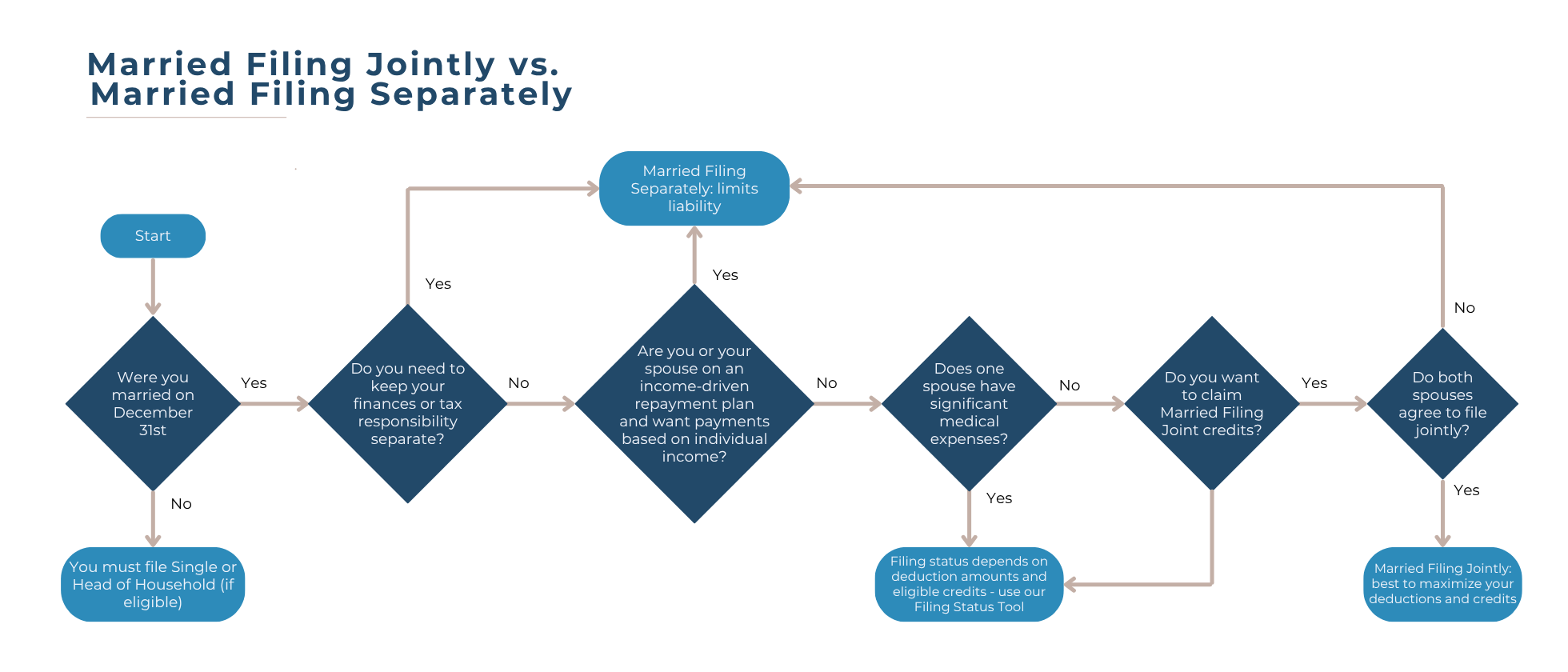
Decision Framework: Should You File Jointly or Separately?
Use this condensed framework to guide your decision.
Step 1: Refund Protection
Does your spouse owe back taxes, child support, or student loan debt?
→ If yes, consider MFS.
Step 2: Student Loans
Would removing your spouse’s income lower your IDR or SAVE payment?
→ If yes, compare both filing statuses.
Step 3: Medical Expenses
Do you have high medical bills and a lower income than your spouse?
→ If yes, MFS may help.
Step 4: Community Property State
Do you live in one?
→ Income splitting may cancel out MFS benefits.
Step 5: Credits Lost
Would you lose more credits than you gain?
→ If yes, MFJ may be better.
See our flowchart: Should You File Jointly or Separately?
Conclusion
Married Filing Separately is one of the most misunderstood filing statuses. It reduces or eliminates many tax benefits, but in the right situations, it can protect your refund, reduce student loan payments, or help you claim key deductions. The best choice depends entirely on your income, debts, and eligibility for specific credits.
Before you decide, compare both filing statuses to see which gives you the lowest tax bill and the most peace of mind. Jump in and file your taxes today.
Frequently Asked Questions
Yes. Many credits are restricted or eliminated, and tax brackets are narrower.


