




Qualifying Surviving Spouse Timeline (Year-by-Year Breakdown)
Fact Checked
FileTax.com content is reviewed for accuracy, timeliness, and completeness. It undergoes a structured editorial review process involving writers and expert reviewers.
More on our editorial standards Meet our editorial team Andrew WalshCPA, CFP CTFA & Tax Content Specialist
 Lea Uradu, JDTax Content Reviewer
Your Takeaways:
- In the year your spouse dies, you can usually file a joint return using Married Filing Jointly.
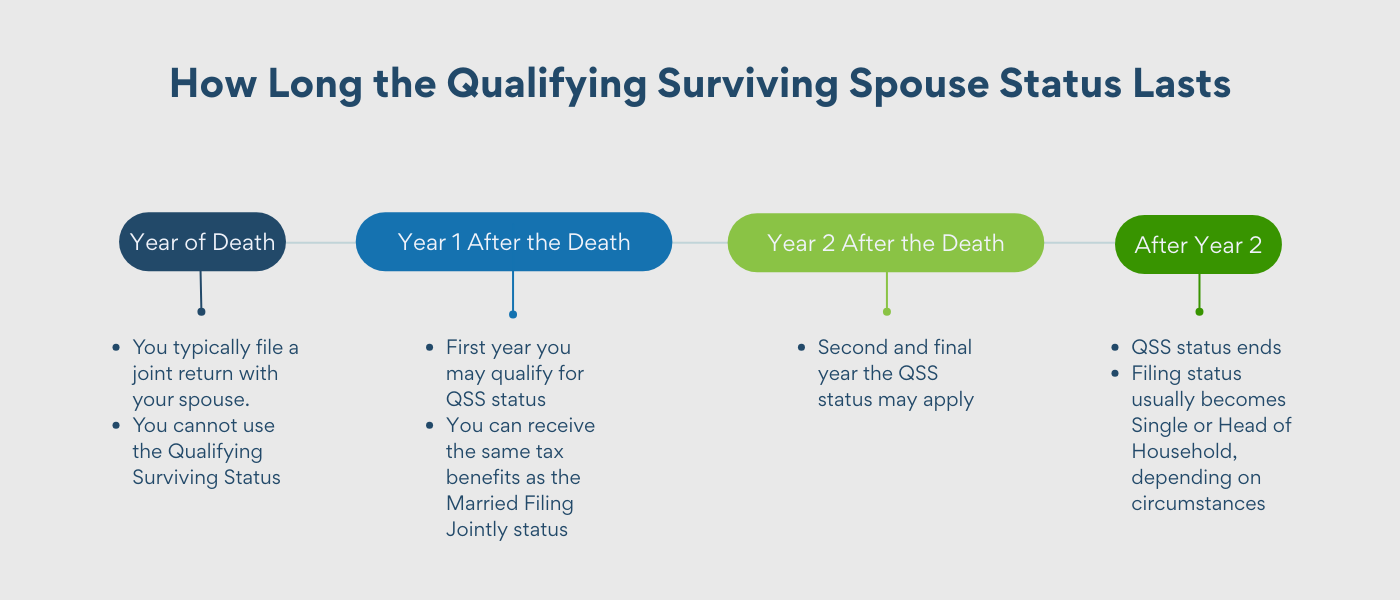
- The Qualifying Surviving Spouse (QSS) status may apply for up to two tax years after the year of death.
- QSS lets you keep Married Filing Jointly tax rates and the higher standard deduction during those two years.
- To qualify, you must have a dependent child, pay more than half of household costs, and not remarry.
- Each year is evaluated separately, so qualifying one year doesn’t guarantee the next.
If your spouse died, you can usually file a joint return for the year of death. For the next two tax years, you may qualify for the Qualifying Surviving Spouse filing status if you have a dependent child and meet IRS support rules.
Losing a spouse is overwhelming enough without trying to decode IRS rules. The Qualifying Surviving Spouse timeline provides crucial financial relief by allowing eligible taxpayers to keep the same tax benefits as married couples filing jointly for a limited time. Understanding this timeline helps you choose the correct filing status, reduce your tax bill, and make informed tax decisions during a difficult transition.
This guide walks through what happens from the tax year your spouse died through the point when the Qualifying Surviving Spouse status ends and what comes next.
How the Qualifying Surviving Spouse Timeline Works
The Qualifying Surviving Spouse status is a temporary filing status designed to ease the financial impact after a spouse’s death. It allows a surviving spouse with a dependent child to receive the same tax rates and standard deduction as Married Filing Jointly.
This favorable tax treatment can apply for up to two years after the year of death, as long as eligibility requirements continue to be met. The timeline matters because each tax year has different filing status options, tax brackets, and tax implications.
For further reading, visit our Qualifying Surviving Spouse guide.
Year of Your Spouse’s Death: What Filing Status Applies
The tax year your spouse died is treated differently from the years that follow. Even though you are now a surviving spouse, the IRS generally allows you to file as if you were still married for this one year. For many households, this creates meaningful tax relief at a time when finances and emotions are already under pressure.
In most cases, you can file a joint return with your deceased spouse for the year of death. This means you use the Married Filing Jointly status, even if your spouse passed away early in the year. The return includes all income, deductions, and credits for both spouses earned before and after the spouse’s death during that tax year.
This distinction often results in lower taxes, depending on your income, deductions, and credits.
Tax Benefits Available in the Year of a Spouse’s Death
Benefit | Why It Matters |
|---|---|
Married Filing Jointly rates | Wider tax brackets |
Higher standard deduction | Reduces taxable income |
Joint credit eligibility | Preserves tax savings |
Filing Married Filing Jointly (MFJ) doesn’t automatically lower your taxes just because you’re married. The biggest advantage shows up when there’s an income imbalance between spouses—for example, one high earner and one lower (or non-) earner.
There are a few important conditions to keep in mind. You generally must not remarry before December 31 of the year of death to file a joint return with your deceased spouse. If you did remarry, your filing status would shift to married filing jointly or married filing separately with your new spouse instead. In addition, you must have been eligible to file jointly with your deceased spouse before their death. This means there was no legal separation or other restriction that would have prevented a joint return.
Source: IRS Pub. 501, Qualifying Surviving Spouse
Filing the Tax Return in the Year of Death
From a paperwork standpoint, you will still file Form 1040 like any other taxpayer. You should keep a copy of your spouse’s death certificate with your tax documents, even though it is not usually mailed with the tax return. Tax software will typically ask for the date of death and guide you through the correct selections, but it is still essential to confirm that Married Filing Jointly is applied correctly.
This year also sets the foundation for what comes next. The year of death is not part of the Qualifying Surviving Spouse period itself. Instead, it serves as the transition point between married filing and the two-year QSS timeline that may follow. Understanding this distinction helps prevent filing errors and ensures you do not inadvertently forfeit valuable tax advantages.
Handled correctly, the year your spouse died often delivers the most favorable tax treatment available during the entire surviving spouse journey.
First Year After Your Spouse’s Death
The first full tax year after your spouse passed is when the Qualifying Surviving Spouse status may begin. This year is a critical point on the QSS timeline because it determines whether you can continue receiving Married Filing Jointly tax benefits.
If you meet the IRS requirements, you can use the Qualifying Surviving Spouse filing status instead of switching immediately to Head of Household or Single filing status. This status exists to provide crucial financial relief during a period when household income, expenses, and emotional stress are often in flux.
This status generally allows you to use the same tax rates and standard deduction as Married Filing Jointly. That includes:
- The same standard deduction used by married couples filing jointly
- The same tax rates and tax brackets
- More favorable tax treatment than head of household or single filing status in most cases
These benefits can lead to significant tax savings, especially if your taxable income remains similar to what it was when your spouse was alive.
A key requirement during this year is having a dependent child living with you for more than half of the tax year. The child must qualify as your dependent and can be a biological child, stepchild, or adopted child. Temporary absences, such as college, medical care, or military service, generally do not break this requirement as long as the child is expected to return home.
You must also continue to pay more than half of your household expenses, including items like rent or mortgage payments, property taxes, utilities, food, and other necessary costs of maintaining the home. Meeting this support threshold helps establish your household status and preserves access to this filing status.
Tax Planning in the First QSS Year
From a tax planning perspective, this first year is often when surviving spouses notice the biggest difference compared to filing as Head of Household. The more favorable tax brackets and significantly lower effective tax rates can reduce your tax liability and keep your tax bill manageable while you adjust to a new financial reality.
It is also the year when careful tax filing matters most. Errors in filing status selection can cause you to lose joint filing benefits you are entitled to. Tax software can help guide the process, but it is still important to confirm that the Qualifying Surviving Spouse status is selected correctly on your tax return and that your dependent and household information is accurate.
Handled properly, the first year after your spouse passed can provide stability, tax relief, and breathing room as you begin planning for the years ahead.

Second Year After Your Spouse’s Death
The second year after your spouse’s death is the final year of Qualifying Surviving Spouse status.
All QSS tax benefits continue for this final year:
- Same tax rates
- Same standard deduction
- Same favorable tax treatment as married filing jointly
This is often the last chance for substantial tax savings under the Qualifying Surviving Spouse status. Smart tax planning during this year can reduce future tax liability and protect your financial future.
This is also the year to begin planning for what comes next, especially if your taxable income, household expenses, or tax withholding will change.
What Happens After Qualifying Surviving Spouse Status Ends
After the two-year period ends, Qualifying Surviving Spouse filers receive no further access to this filing status.
At this point:
- You must choose a new filing status
- Tax rates and household tax brackets often become less favorable
- The standard deduction may decrease
- Your overall tax bill may increase
Common transitions include moving to Head of Household or Single filing status, depending on whether you still have a qualifying dependent. This shift can create a noticeable change in tax obligations, so preparation matters.
How Life Events Can Change the Timeline
Certain events can shorten or alter the timeline for the Qualifying Surviving Spouse.
Remarriage
If you remarry at any point before the end of the tax year, you cannot use Qualifying Surviving Spouse status for that year. Your tax filing options shift immediately to Married Filing Jointly or Married Filing Separately. To see how the timing of a new marriage affects each tax year, read what happens if you remarry after your spouse dies.
Dependent Changes
If your dependent child no longer qualifies or stops living with you for more than half the year, the Qualifying Surviving Spouse status ends early.
Temporary Absences
Temporary absences like college, illness, or military service usually do not disrupt eligibility as long as the child is expected to return.
Adoption or Foster Care
An adopted child may preserve eligibility if all dependency rules are met. Foster children do not qualify for the Qualifying Surviving Spouse filing status under IRS rules.
Source: IRS Pub. 501, Qualifying Surviving Spouse
Common Timeline Mistakes to Avoid
Mistakes during this period can be costly.
- Miscounting the two-year window
- Assuming the Qualifying Surviving Status lasts indefinitely
- Selecting the Head of Household status too early
- Overlooking tax credits tied to dependent status
- Using tax software without confirming the correct filing status
If the wrong filing status is chosen, such as Head of Household or Single instead of Qualifying Surviving Spouse, the error can generally be corrected by filing an amended return (Form 1040-X) within three years of the original filing.
These errors can increase your tax liability and reduce available tax relief.
For more information on the topic, visit our Guide on Common Qualifying Surviving Spouse mistakes.
Final Thoughts on the Qualifying Surviving Spouse Timeline
The Qualifying Surviving Spouse timeline is designed to provide meaningful tax savings and stability during a difficult period. By understanding when each filing status applies and how long favorable tax treatment lasts, you can minimize your tax bill, avoid mistakes, and make confident, informed tax decisions.
If you are unsure how this timeline applies to your tax situation, the right guidance or tax software can help ensure you choose the correct filing status and protect your financial future while navigating the Qualifying Surviving Spouse timeline.
Take control of your taxes. File on your own with expert support today.
FAQs About the Qualifying Surviving Spouse Timeline
It lasts for up to two tax years after the year your spouse died, provided you meet all requirements.


