




Don't Lose Your Tax Benefits: 8 Common Mistakes That Disqualify You from Qualifying Surviving Spouse
Fact Checked
FileTax.com content is reviewed for accuracy, timeliness, and completeness. It undergoes a structured editorial review process involving writers and expert reviewers.
More on our editorial standards Meet our editorial team Andrew WalshCPA, CFP CTFA & Tax Content Specialist
 Lea Uradu, JDTax Content Reviewer
Your Takeaways:
- Qualifying Surviving Spouse (QSS) is not automatic—you must requalify every tax year.
- Remarrying at any point during the tax year immediately disqualifies you from QSS for that year.
- A qualifying child is mandatory; simply claiming a dependent is not enough.
- Losing your qualifying child—even temporarily—can cause you to lose QSS.
Qualifying Surviving Spouse status can reduce your taxes after a spouse’s death, but it’s easy to lose if IRS rules aren’t met each year. Common mistakes include remarrying too soon, lacking a qualifying child, or assuming eligibility is automatic.
Losing a spouse is hard enough. Dealing with taxes afterward can feel overwhelming, confusing, and unfair. Yet every tax season, thousands of taxpayers lose valuable benefits because of common mistakes they did not even realize they were making. The IRS rules are strict, and good intentions do not protect you from costly filing errors.
This guide breaks down the most common mistakes surviving spouses make, why they happen, and how to avoid losing tax benefits you may still qualify for during this difficult time.
Quick Reference: The Four Non-Negotiable QSS Requirements
To qualify for QSS in the two years after the year your spouse died, you must meet all four of these requirements:
- You did not remarry during the tax year.
- You were eligible to file jointly in the year your spouse died.
- You paid over half the cost of keeping up your home.
- You have a qualifying child (or dependent) who lived with you for more than half the year.
Why So Many Surviving Spouses Get This Wrong With Taxes
When a spouse dies, taxes usually fall low on the priority list. Between grief, estate matters, children, income changes, and paperwork, it is easy to assume things will “work themselves out.”
Unfortunately, the IRS does not work that way, even during a difficult time.
Most qualifying surviving spouse errors happen because people assume:
- The status applies automatically
- The rules are flexible
- Last year’s filing status still applies
- State law and federal tax law are the same
None of those assumptions is safe. And the vast majority of disqualifications happen unintentionally.
Mistake #1: Assuming You Automatically Qualify for Two Years
This is one of the most common and most expensive mistakes surviving spouses make.
Many people hear that you can keep married filing benefits for “two years after your spouse dies” and stop there. That half-truth leads to incorrect tax filing, IRS notices, and lost tax benefits.
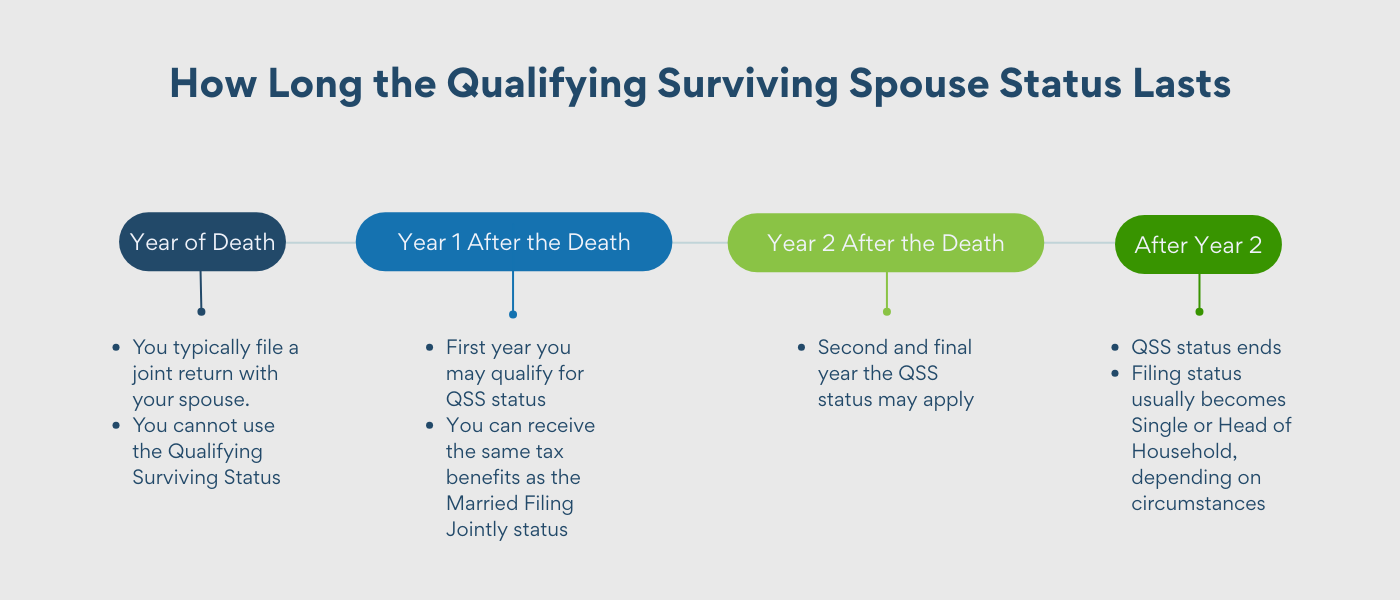
Here is the reality: Qualifying Surviving Spouse status is never automatic. It must be earned and re-earned each tax year.
Why This Assumption Happens
After a spouse passes away, surviving spouses are often told things like:
- “You still file like you’re married for two years.”
- “Nothing really changes right away.”
- “The IRS gives you a grace period.”
While well-meaning, these statements gloss over critical details. During a difficult time, it is easy to assume the IRS will apply flexibility or leniency. Unfortunately, federal tax laws do not work on assumptions or intent.
What the Two-Year Qualifying Surviving Spouse Period Actually Means
The two-year period refers to the maximum amount of time you may be eligible for qualifying surviving spouse status after the year of your spouse’s death. It does not guarantee eligibility.
Each tax year stands on its own. To qualify for each year, you must:
- Meet all IRS eligibility criteria for that tax year
- Have a qualifying child who lives with you for most of the year
- Not remarry before the end of the tax year
- Be eligible to file a joint return in the year your spouse died
If any one of these conditions is not met in a given tax year, the status is lost for that year.
A Common Real-World Example
IRS guidance makes clear that Qualifying Surviving Spouse status must be requalified each year. Losing a qualifying child or remarrying ends eligibility, even within the two-year window.
Source: IRS Pub. 501, Qualifying Surviving Spouse
Why the IRS Catches This Quickly
Filing status affects:
- Your standard deduction
- Your tax rate
- Certain credits and deductions
Because of this, the IRS closely reviews filing status claims. When your return shows a Qualifying Surviving Spouse but your dependent information no longer supports it, the mismatch is flagged.
The result may include:
- A revised tax bill
- Back taxes owed
- Interest and penalties
All because of an assumption made during an already stressful time.
How to Avoid This Mistake
Before filing each tax return, pause and ask:
- Do I still meet every eligibility requirement this year?
- Does my dependent child still qualify under IRS rules?
- Has anything changed since last year?
If the answer is “I’m not sure,” that is your cue to slow down and double-check. Taking advantage of the qualifying surviving spouse status is valuable, but only when it is claimed correctly.
The two-year window is an opportunity, not a guarantee.
Mistake #2: Claiming QSS Without a Qualifying Child
A qualifying child is not optional. It is required.
Many surviving spouses believe that having children in general is enough. Unfortunately, the IRS definition of a qualifying child is very specific.
Common errors include:
- Claiming QSS with adult children who no longer qualify as dependents
- Claiming QSS when a child lives elsewhere most of the year
- Assuming financial support alone is enough
To qualify, the child must meet dependency rules and live with you for most of the tax year, with limited exceptions such as temporary absences for school.
Without a qualifying child, the Qualifying Surviving Spouse status is not available.
Mistake #3: Remarrying Too Soon and Still Claiming QSS
This mistake is simple but costly.
If you remarry at any point before the end of the tax year, you cannot claim qualifying surviving spouse status for that year. It does not matter if:
- The remarriage happens in December
- You did not live together long
- You supported a dependent child
Remarriage changes your tax filing status immediately. At that point, you generally file jointly with your new spouse or choose another applicable status. Our guide on what happens to your taxes if you remarry explains how the timing of the wedding affects your return.
This is one of the fastest ways the IRS disqualifies QSS claims.

Mistake #4: Choosing the Wrong Filing Status
Filing status errors are among the most common IRS red flags.
Surviving spouses often choose the wrong status because:
- Tax software defaults to single
- They assume Head of Household applies
- They avoid claiming QSS due to uncertainty
Choosing the wrong filing status can mean:
- Losing the higher standard deduction
- Paying a higher tax rate
- Missing credits tied to Married Filing Jointly status
Your tax filing status directly affects how much tax you pay. Guessing is expensive, especially when filing status is involved.
Mistake #5: Confusing a "Tax Dependent" with a "Qualifying Child" for QSS
Many surviving spouses assume that if they claim someone as a dependent on their tax return, they automatically meet the child requirement for Qualifying Surviving Spouse status. This is a frequent and costly misunderstanding.
While all children used for QSS must be your dependents, not all dependents allow you to claim QSS.
The Strict Residency Requirement
The biggest difference lies in where the child lives. For general dependency, some relatives don't have to live with you at all if they meet income tests. However, for QSS status, the child must live in your home for more than half the year.
Common scenarios that lead to disqualification include:
- The "Non-Child" Dependent: You provide total financial support for a parent, sibling, or other relative who lives with you. While they are your dependents, they are not your "qualifying child" for QSS purposes.
- The Foster Child or Grandchild: While these relationships can sometimes qualify, the rules are stricter regarding legal placement and residency than standard dependency rules.
- The Away-at-School Rule: While "temporary absences" for school generally count as living at home, if a child has permanently moved out or established a different primary residence, you can no longer claim QSS, even if you still pay their tuition and claim them as a dependent.
Why This Triggers IRS Notices
When you file your return, the IRS computer systems look for a specific relationship code and residency match. If you select "Qualifying Surviving Spouse" but the dependent listed is a "Parent" or a child who does not meet the half-year residency test, the system may automatically flag the return for a filing status adjustment.
How to Verify
To avoid this mistake, check IRS Publication 501. You must be able to answer "Yes" to two distinct questions:
- Is this person my legal son, daughter, stepchild, or eligible foster child?
- Did this child live with me for more than half of the tax year?
If the answer to either is "No," you may still be able to claim them as a dependent, but you must likely file as Head of Household or Single instead of Qualifying Surviving Spouse.
Mistake #6: Ignoring Estate Tax and Portability Deadlines
Many people believe the federal estate tax only affects the ultra-wealthy. That belief causes major problems later.
Even when no estate tax is due, filing Form 706 on time preserves unused estate tax exemption portability for the surviving spouse. For deaths in 2025, this filing is required to elect portability.
Common errors include:
- Not filing Form 706 because no estate tax was due
- Missing the nine-month deadline
- Losing unused estate tax exemption portability
Even if no estate tax is owed, filing the estate tax return on time preserves future tax benefits for the surviving spouse.
Source: IRS Form 706 Instructions
The Portability Election and Form 706
Remember that the decision to file Form 706 for portability is often separate from whether any estate tax is actually due. The election to preserve unused estate tax exemption portability is crucial, regardless of the size of the estate, for the surviving spouse's future tax planning.
Mistake #7: Overlooking Medical Expenses and Other Final-Year Deductions
Medical expenses are frequently mishandled after a spouse’s death.
Surviving spouses often assume:
- Expenses paid after death are not deductible
- Medical bills belong only on the estate tax return
- Deductions were already “used up” last year
Medical expenses paid within one year after death may be deducted on the final joint return if they otherwise qualify. Missing these deductions means paying more taxes than necessary.
Timing matters, and documentation matters even more.
Source: IRS Pub. 502, Medical and Dental Expenses
Mistake #8: Assuming State Law and Federal Rules Are the Same
This mistake confuses estate planning, probate, and tax filing.
State law governs:
- Probate
- Estate administration
- Property ownership
Federal tax laws govern:
- Filing status
- Deductions
- Estate tax rules
Surviving spouses often assume that because something was handled one way under state law, it carries over to federal taxes. That assumption is frequently wrong and leads to filing errors.
How to Avoid These Common Mistakes Moving Forward
You do not need to become a tax expert overnight. But you do need to slow down and verify before you file.
Smart next steps include:
- Reviewing eligibility criteria every tax year
- Confirming your filing status before submitting your tax return
- Keeping clear records of income, assets, and expenses
- Asking tax professionals when something feels unclear
Taking advantage of available tax benefits requires accuracy, not speed.
Beyond QSS: The Biggest Financial Traps for Surviving Spouses
While securing the Qualifying Surviving Spouse status is essential, the financial journey for a surviving spouse involves pitfalls far beyond filing status—especially concerning Social Security and the often-misunderstood Widow's Tax Trap.
The Widow's Tax Trap Explained
The Widow's Tax Trap refers to the painful financial reality where a surviving spouse pays more in taxes on less overall income. This occurs because once the two-year QSS period ends, the spouse must shift to the Single filing status. The Single status features narrower income tax brackets and a lower standard deduction compared to the Married Filing Jointly or QSS statuses. This change often pushes a significant portion of the survivor's remaining income into a higher tax bracket, increasing their effective tax rate.
Critical Social Security Mistakes to Avoid
Mistakes in claiming Social Security survivor benefits can lead to permanent loss of income. Unlike the QSS filing status, which lasts a maximum of two years, these decisions affect you for life.
- Claiming Too Early Permanently Reduces Benefits: Claiming Social Security survivor benefits as early as age 60 (or age 50 if disabled) results in a permanent reduction in the monthly benefit amount.
- Waiting Maximizes Benefits: Waiting until your full retirement age (FRA) for survivor benefits ensures you receive 100% of your late spouse's benefit amount.
- Failing to File for the Lump-Sum Payment: You must file promptly for the one-time, lump-sum death payment of $255 within two years of the spouse's death to avoid losing that benefit.
- Meeting the Marriage Length Requirement: Social Security survivor benefits typically require a minimum length of marriage, often nine months, unless certain exceptions apply.
Final Takeaway for Surviving Spouses
The qualifying surviving spouse status offers meaningful tax benefits, including a higher standard deduction and lower tax rates. However, those benefits disappear quickly when common mistakes go unnoticed.
Understanding qualifying surviving spouse common mistakes is the first step toward protecting your money, your future, and your peace of mind during an already difficult time.
When in doubt, pause before you file. The right choice today can protect your benefits for years to come.
FAQs About Qualifying Surviving Spouse Common Mistakes
Assuming eligibility applies automatically without meeting the dependent child requirement.


