


Qualifying Surviving Spouse
This page serves as a starting point for understanding Qualifying Surviving Spouse filing status, with pathways to deeper guidance you can explore when ready.
A collection of guides, FAQs, and plain-English explanations focused on Qualifying Surviving Spouse filing status, organized to help you navigate the topic step by step. The goal isn’t to give a single answer, but to connect you with the information that matches your situation and questions.
Quick Link Resources


Learn How This Filing Status Works

Qualifying Surviving Spouse (QSS) status maintains joint filing benefits for up to two years after your spouse’s death if you have a qualifying child, cover more than half of the household expenses, and didn't remarry. It provides essential financial relief during a tough time.
Navigating Your Taxes After Losing a Spouse
Losing a spouse is difficult, and the last thing you need is confusion about your tax filing status. The Qualifying Surviving Spouse filing status exists to give you breathing room by preserving the tax benefits you had as a married couple while you adjust. This guide walks you through the rules in clear, approachable language so you can make informed tax decisions with confidence.
What the Qualifying Surviving Spouse Filing Status Is and How It Works
The Qualifying Surviving Spouse filing status is a temporary but meaningful filing status designed to support you after your spouse's death. You get the same standard deduction and tax brackets as Married Filing Jointly. In addition, QSS is eligible for the same credit as MFJ.
Without QSS, many surviving taxpayers immediately shift to Head of Household or Single filing status, which often results in higher taxable income and fewer deductions. By allowing you to file as a qualifying widow(er) for a limited period, the IRS gives you a smoother transition instead of a sudden jump in tax liability.
To use the Qualifying Surviving Spouse status, you must meet specific IRS criteria, including having a qualifying dependent child, paying more than half of your household expenses, meeting year-of-death rules, and not remarrying during the two-year period. These rules ensure that the surviving spouse's tax status is reserved for taxpayers who remain financially responsible for a home and a dependent child after their spouse's death.
Here’s a simple example:
If your spouse died in 2024 and you have a dependent child who lived with you all year (except for temporary absences like school or medical treatment), you may be able to claim this filing status on your 2025 and 2026 tax returns. This gives you access to significant tax savings, favorable tax treatment, and more stability during a challenging season.
In short, the Qualifying Surviving Spouse filing status offers crucial financial relief, helps keep your taxable income lower, and ensures you maintain access to all the deductions and credits you were entitled to as a married couple, at least for a bit longer. If you meet the qualifying surviving spouse IRS rules, this filing status can provide the breathing room you need.
Source: IRS Pub. 501, Qualifying Surviving Spouse
Prefer a quick explanation? This short video explains who qualifies, how long the status lasts, and why it matters.
IRS Rules for Qualifying Surviving Spouse Status
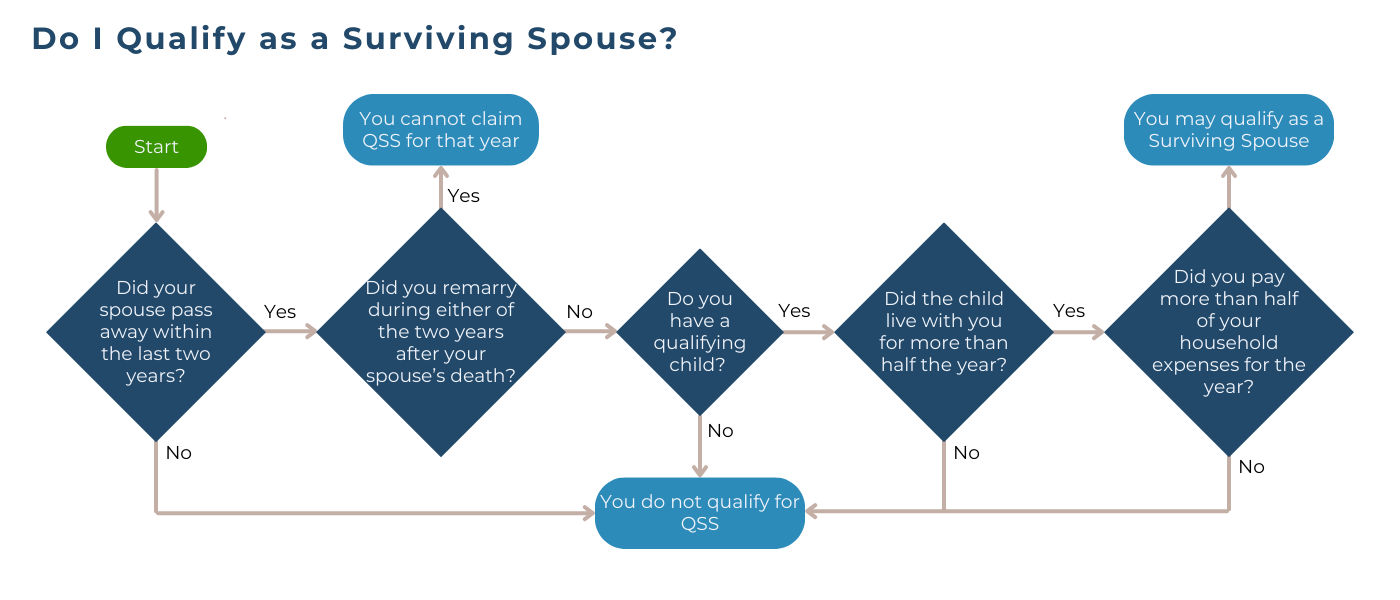
To use Qualifying Surviving Spouse status, you must meet all of the IRS requirements. You can claim it for the two tax years after the year your spouse died, as long as you did not remarry, you have a qualifying dependent child, and you paid more than half the cost of keeping up your home. Our guide to Qualifying Surviving Spouse requirements explains each test, including which children qualify, with examples.
This flowchart breaks down the IRS rules into simple yes-or-no steps so you can easily see whether you qualify for the Qualifying Surviving Spouse status.
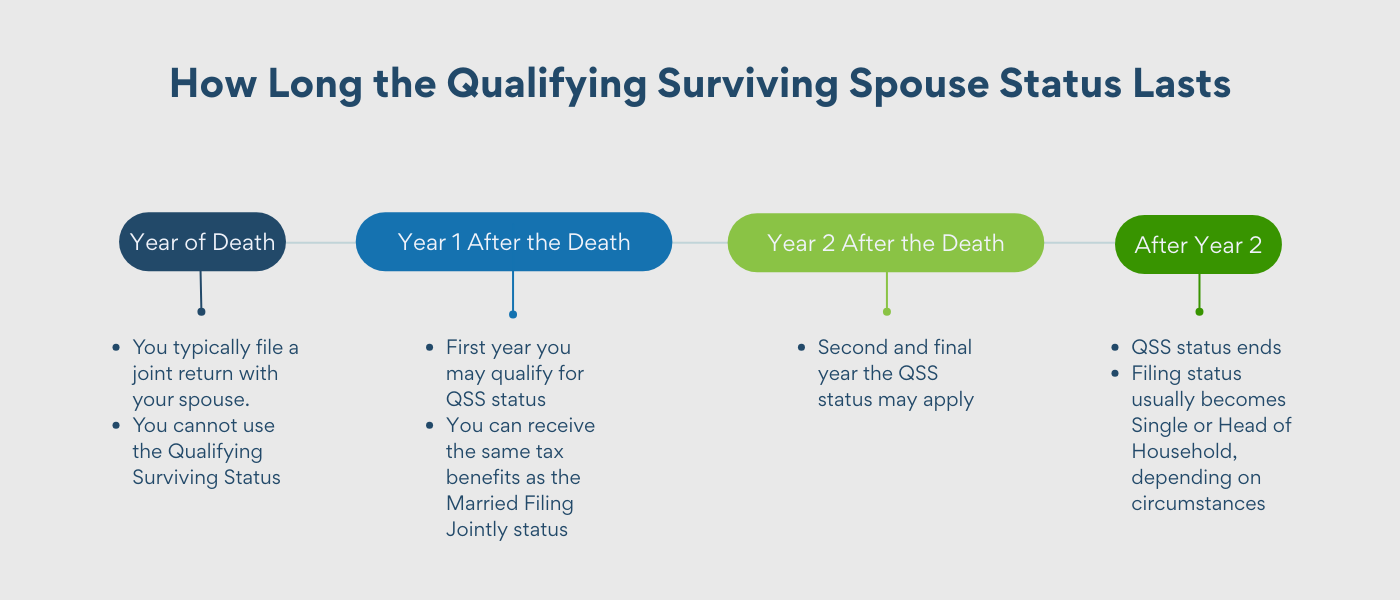
Your Filing Status Timeline After a Spouse’s Death (Year-by-Year Guide)
Understanding your tax filing status after your spouse dies can feel overwhelming, especially when the rules seem to change every year. The IRS has a definite timeline you must follow, and choosing the correct filing status each year ensures you get the tax benefits you’re entitled to. Here’s the year-by-year breakdown so you know exactly what happens from the year of death through the end of qualifying surviving spouse eligibility.
Source: IRS Pub. 501, Qualifying Surviving Spouse
For more information, visit our Qualifying Surviving Spouse Timeline
QSS vs Married Filing Jointly (MFJ)
The QSS filing status entitles you to nearly the same tax benefits as married filing jointly, including:
- The same standard deduction
- The same tax brackets
- Eligibility for the child tax credit and other deductions
Key Difference
Married Filing Jointly is only available for the year your spouse died. QSS applies for the two years after that if you qualify.
Example:
Spouse died in 2023 → You can file MFJ for 2023, then possibly QSS for 2024 and 2025.
Comparing QSS, MFJ, HOH, and Single Filing Statuses
Filing Status | Standard Deduction (2026 Amount) | Tax Brackets | Who Qualifies? | Key Notes |
|---|---|---|---|---|
Married Filing Jointly (MFJ) | $32,200 | Most favorable brackets | Married couples filing together for the year your spouse died (unless you remarry). | Typically results in the lowest taxable income. You may file jointly even if your spouse passed mid-year. |
Qualifying Surviving Spouse (QSS) | $32,200 (same as MFJ) | Same as MFJ | Your spouse died within the last two tax years, you did not remarry, you have a qualifying dependent child, and you paid more than half of the household expenses. | Available for two tax years after the year of death. Often provides significant tax savings and a smoother transition after loss. |
Head of Household (HOH) | $24,150 | Usually more advantageous than filing Single, but less favorable than MFJ/QSS | You have a qualifying dependent, paid more than half of the household expenses, and the dependent lived with you more than half the year. | Common status after QSS eligibility ends, if you still have a qualifying child. |
Single | $16,100 | Least favorable brackets | Unmarried (or considered unmarried) without a qualifying dependent. | Often applies after QSS ends if you no longer have a qualifying child. |
Qualifying Surviving Spouse vs Head of Household
This is one of the most common points of confusion, especially when transitioning out of QSS.
Key Differences
Rule | Qualifying Surviving Spouse | Head of Household |
|---|---|---|
Requires deceased spouse | Yes | No |
Requires a dependent child | Yes | Yes |
Residency rules | The child must live with you | Same, but broader scenarios apply |
Timeline | Only up to two years | Can be indefinite |
Tax brackets | Same as MFJ | Less favorable |
Examples
Shared custody:
You may qualify for HOH after QSS ends if your child lives with you the majority of the year.
New spouse:
If you remarry, you cannot use QSS even if your new spouse does not live with you.
Learn more about Qualifying Surviving Spouse vs Head of Household

How to File as a Qualifying Surviving Spouse (Step-by-Step)
Your tax benefits depend on choosing the correct filing status, so make sure you’re eligible before you file.
1. Confirm you meet all IRS criteria
Check the QSS eligibility requirements, including the two-year limit.
2. Gather documentation
- Your spouse’s death certificate
- Proof of residency for your child
- Financial records showing household expenses
- Dependent’s Social Security Number
3. Complete Form 1040
According to Form 1040 instructions, select Qualifying Surviving Spouse as your filing status.
4. Claim your dependent child
Ensure the child meets IRS rules.
5. Attach required documentation
In most cases, you do not need to attach a death certificate when filing. You typically only need to include your spouse’s name, Social Security number, and date of death on the tax return.
6. File federal and state taxes
Some states follow federal rules; others differ.
7. Update your W-4 for the next tax year
Life changes can affect withholding. Update your W-4 after a life event.
Source: IRS Pub. 501, General Filing Requirements
Check out our guide on how to file taxes as a Qualifying Surviving Spouse for more information.
What Changes After QSS Ends?
When the two-year eligibility window ends, you must switch to HOH or Single based on whether you still have a qualifying child.
- If you do, Head of Household may apply.
- If not, you must use Single filing status, which generally results in less favorable tax treatment.
Common Mistakes to Avoid
These mistakes can cause delays, incorrect refunds, or IRS notices.
- Claiming QSS without a qualifying child.
- Forgetting the two-year limit.
- Using QSS after remarriage.
- Confusing MFJ, QSS, and HOH requirements.
- Assuming college students do not count. (They often do if they are under age 24 and studying full-time).
For a deep dive into the topic, visit our Guide on Common Mistakes that can Disqualify You from QSS.
Final Note
The Qualifying Surviving Spouse status offers more favorable tax treatment and meaningful financial relief after a spouse’s death. Understanding the rules helps you make informed tax decisions and claim every deduction and credit available to you.
Ready to file your taxes? Start your tax return today.
Frequently Asked Questions
Two years after the year your spouse died, as long as you meet all IRS rules.


