




Property Tax Laws and Assessment Basics: How Your Home’s Value Determines Your Bill
Fact Checked
FileTax.com content is reviewed for accuracy, timeliness, and completeness. It undergoes a structured editorial review process involving writers and expert reviewers.
More on our editorial standards Meet our editorial team Todd MonahanTax Content Specialist
 Lea Uradu, JDTax Content Reviewer
Your Takeaways:
- Property tax laws are set by states and enforced locally.
- Your tax bill is based on assessed value—not market value.
- Assessments use ratios and local mill rates to calculate taxes.
- Renovations, market changes, and exemptions can affect your bill.
- You can appeal an assessment if your home is overvalued.
Property taxes are governed by state and local laws that set how your home is valued, taxed, and billed. Knowing how assessments work, how to appeal an incorrect value, and which limits or caps may apply can help you lower your bill and file your taxes correctly.
Pulling that property tax bill out of your mailbox can be a nerve-wracking moment. When you open it, it might feel as though the numbers are being pulled out of thin air, but it’s actually the result of a detailed process dictated by local property tax laws.
These rules determine everything from how much your home is worth in the eyes of the tax man to the final amount you owe for public services like schools, roads, and first responders.
As you make your way deep into this world of assessments, mill rates, and appeals, it can all feel a little overwhelming. But when you understand the basics, you gain the power to spot errors, challenge unfair valuations, and make sure you’re not paying a penny more than you should.
Here’s how your home’s value translates into your tax bill, and more importantly, what you can do about it.
What Are Property Tax Laws?
Definition: Property tax laws are state and local rules that determine how properties are assessed, taxed, and billed by cities or counties. They are not federal laws, although certain payments may be deductible on your federal return.
Property tax laws are the local and state rules that give your city or county the authority to assess, levy, and collect taxes on real estate. These are not federal laws; the IRS doesn’t set your property tax rate or tell your local government how to value your home.
Instead, the federal government’s role really only comes into play when you file your federal return, as you may be able to deduct the taxes you’ve paid.
You can learn more about this in IRS Pub. 530, but for now, know that your state creates the big-picture framework, and your county or municipality handles the on-the-ground work of valuing your property and sending the bill. This is why tax rates and rules can vary dramatically, even between neighboring towns.
For more information, you can explore our resources on property taxes.
How Property Tax Assessments Work
The journey from your home’s market value to your final tax bill involves a few key steps, but it all starts with the assessment.
A local official, usually a property assessor or appraiser, is responsible for determining the value of your property for tax purposes. They typically estimate its market value, which is the price it would likely sell for in an open market. To do this, they analyze recent sales of similar homes in your area, consider your property’s specific features, and use standard methods.
Your home’s assessed value is not its full market value (this is a common misconception). Many jurisdictions use an “assessment ratio,” meaning they only tax a certain percentage of the market value. For example, if your county has an 80% assessment ratio, only 80% of your home’s estimated market value is taxable.
Once the assessed value is set, the local government applies its tax rate, often called a “mill levy” or mill rate. A mill is one-tenth of one cent ($0.001). A rate of 25 mills means you pay $25 for every $1,000 of assessed value.
Example: Your home is estimated to be worth $400,000, and your county assesses properties at 75% of market value. You’d multiply $400,000 (the market value) by 0.75 (the assessment ratio) to arrive at an assessed value of $300,000. Since the local tax rate is 30 mills, or 3%, you can calculate your annual property tax bill by multiplying the assessed value ($300,000) by the tax rate (0.030) to arrive at $9,000, which is the amount you’ll owe in property taxes. |
|---|
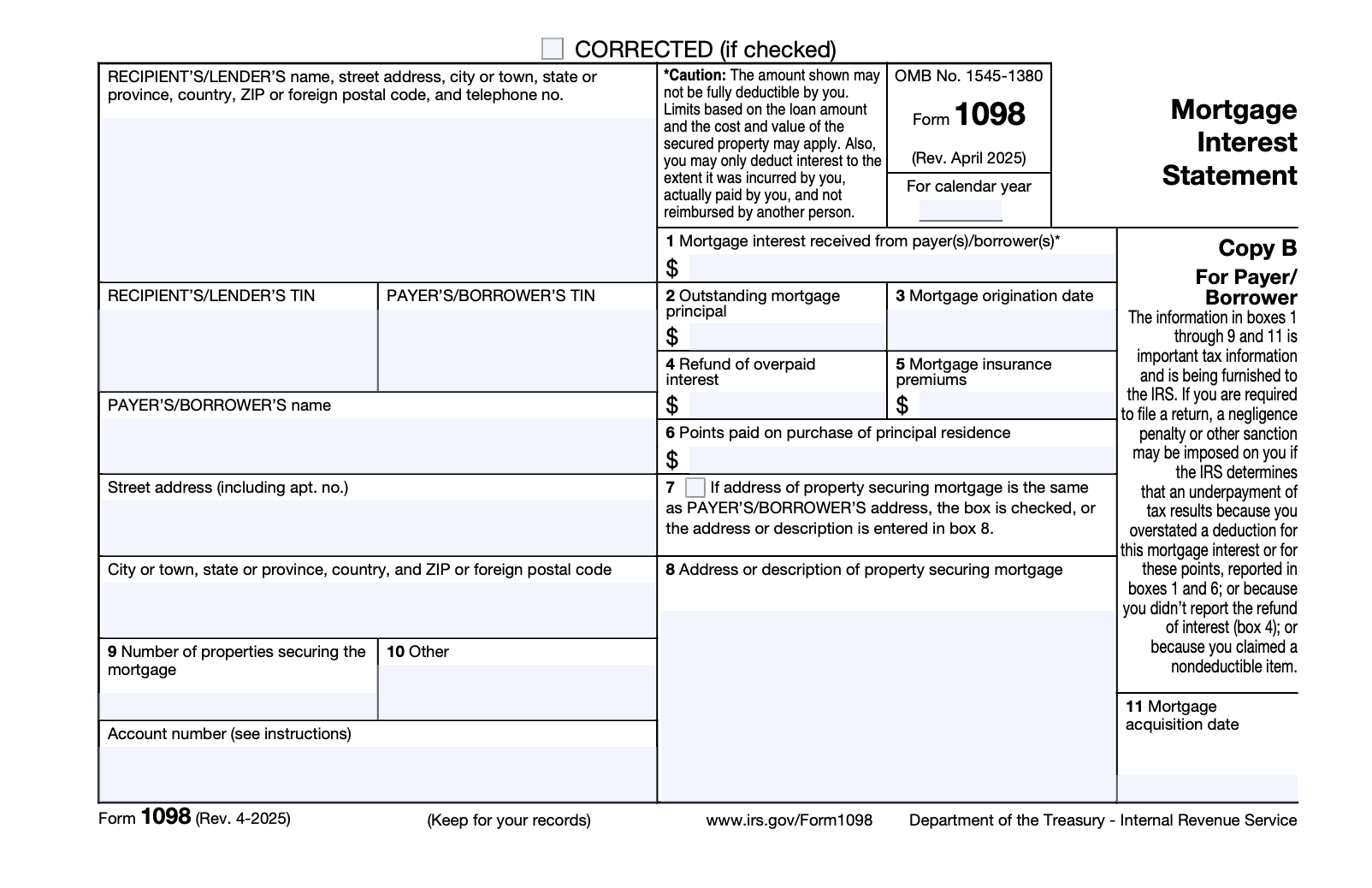
Your lender might report the taxes you paid through your escrow account in Box 10, "Other," on Form 1098, your Mortgage Interest Statement. Just remember, this form shows what you paid, not your home’s assessed value. It’s also important to note that the frequency of these assessments can vary, too. You can learn more about this in our article on how often you pay property taxes.
Factors That Affect Your Property Tax Bill
There are several factors that may cause your property tax bill to rise or fall. Some are within your control, while others are tied to the broader market.
Here are some of the most common factors:
Factor | Impact on Taxes | Example |
|---|---|---|
Home Addition or Renovation | Increases assessed value | Building a new primary suite adds square footage and value, leading to a higher tax bill. |
Rising Market Values | Raises assessed value | A hot real estate market with rising home prices can trigger a higher reassessment for your entire neighborhood. |
Damage or Disaster | If a hurricane damages your roof or a fire destroys part of your home, your assessment may be temporarily reduced. | May lower assessed value |
Property Tax Exemptions | Lowers your taxable value | A homestead exemption for your primary residence or a senior citizen exemption reduces the assessed value. |
Assessment Caps | Limits annual increases in value | Your state may have a law preventing your assessed value from increasing more than a certain percentage each year. |
If you’re worried that your taxes might be too high, know that exemptions can be a powerful tool for lowering your bill. Many states offer property tax exemptions for primary residences (referred to as homesteads), as well as for seniors, veterans, or individuals with disabilities. Be sure to check with your local assessor’s office to see what property tax exemptions you might qualify for.
How to Appeal Your Property Assessment
What if you open your assessment notice and the value seems way too high? You have the right to challenge it through a property tax appeal. If you believe the assessor made a mistake, you can present evidence to make your case.
The process follows these steps in general:
- Review Your Assessment Notice: The moment you receive your notice, check the new value and, most importantly, the deadline for filing an appeal. These deadlines are strict, often giving you only 30 to 90 days.
- Gather Your Evidence: This is the most important step, as you need to prove that your home is worth less than the assessed value. So what might constitute “good evidence?” Generally, you’ll want to look at recent sales data for comparable homes (comps) in your neighborhood, a private appraisal, photos of your property’s condition (especially if it needs repairs), and records of any issues that reduce its value.
- File the Appeal: You’ll need to submit a formal appeal to your county’s assessment review board. The paperwork will ask for your reasoning and supporting documents.
- Attend a Hearing: In many cases, you’ll present your case at an informal or formal hearing. You’ll explain why you believe the value is incorrect and answer questions from the board.
A successful appeal can lead to significant savings, so don’t be afraid to do your due diligence.
Example: If your home was assessed at $500,000, but comps showed its value is closer to $450,000, an appeal could save you hundreds or even thousands of dollars depending on your local tax rate. |
|---|
Local Caps and Limitations on Property Taxes

To protect homeowners from sudden, dramatic tax hikes, some states have put laws in place that limit how much property values or taxes can increase each year. These caps and limitations can be game-changers for long-term homeowners. For example:
- California's Proposition 13: This famous law limits annual increases in a property’s assessed value to 2% or the rate of inflation, whichever is lower. The value is only reassessed to full market value when the property is sold.
- Florida's Save Our Homes: This amendment caps the annual increase in the assessed value of a homestead property at 3% or the rate of inflation, whichever is less.
- Oregon's Measure 50: This measure limits the annual growth of a property's maximum assessed value to 3%.
Again, these laws provide a great deal of predictability, but they can also create large disparities between what longtime owners and new buyers pay in taxes for otherwise similar homes.
How State and Local Systems Differ
In the United States, there’s no one-size-fits-all system for taxes; again, each state has its own approach, which leads to a patchwork of rules and procedures. Some states have a centralized system, while others give almost all authority to local county assessors. Reassessments can happen once every year, every two years, or even less frequently.
Here’s a look at how a few states stack up in comparison to each other:
State | Assessment Frequency | Oversight Level | Notable Limit |
|---|---|---|---|
Upon change of ownership; limited annual adjustments | County Assessor | Prop 13 cap on annual increases | |
Annual | County Appraisal District | Homestead cap rules and exemptions | |
Every 2 years (odd-numbered years) | Local Assessor | No statewide assessment cap | |
Annual (in most localities) | Municipal Assessor | Varies by local discretion | |
Annual | County Property Appraiser | Save Our Homes cap for homesteads |
You can learn more in our Tax Filing resources.
Filing and Deductibility Basics
After you’ve paid your taxes for the year, you may be able to get some of that money back in the form of a federal tax deduction. If you itemize deductions on your federal income tax return, you can deduct the state and local taxes (SALT) you paid.
You’ll report these deductions on Schedule A (Form 1040). But there’s a catch: the SALT deduction is currently capped at $40,000 per household per year starting in 2025. This cap includes property taxes plus state and local income or sales taxes.
To claim the deduction, make sure you’re keeping meticulous records, including your property tax bills, canceled checks or bank statements as proof of payment, and the Form 1098 from your mortgage lender, as you’ll likely be asked to provide these when you file.
Take Control of Your Tax Bill
Your property tax bill is far from just a random number pulled out of thin air. Instead, you receive it as the direct result of local property tax laws and statutes, assessment rules, and your home’s perceived value.
It’s wise to take the time to understand how the process works and to check your assessment for accuracy. And when needed, make sure you exercise your right to appeal.
All of these steps take some effort, but the potential savings can make it well worth your time.
💡 File your taxes with confidence. FileTax.com automatically applies property tax deductions, SALT credits, and renter relief programs when you file online.
Frequently Asked Questions
Your home’s assessed value is calculated by a local assessor who estimates its market value based on comparable sales, location, and condition. That value is then multiplied by your county’s assessment ratio to determine the final taxable amount.


