



How to File an Alabama Tax Extension and Meet the Filing Deadlines
All you need to know about filing a tax extension in Alabama.
Fact Checked
FileTax.com content is reviewed for accuracy, timeliness, and completeness. It undergoes a structured editorial review process involving writers and expert reviewers.
More on our editorial standards Meet our editorial team Andrew WalshCPA, CFP CTFA & Tax Content Specialist
 Lea Uradu, JDTax Content Reviewer
Your Takeaways:
- Original filing and payment deadline: April 15, 2026
- Extension request: None required. The extension is automatic
- Extended filing deadline: October 15, 2026
- Payment still due: April 15, 2026
- Minimum to pay by April 15: The full balance you expect to owe
- Extension payment form: Form 40V payment voucher, "Automatic Extension Payment" box checked
Alabama has no percentage safe harbor for extension payments, meaning no partial payment that avoids charges. The tax “must be paid on or before the due date of the return without regard to the extension,” under the Alabama Administrative Code. If you expect a refund, there is nothing to do before October 15. If you expect to owe, send the whole estimated balance by April 15, 2026.
How Does an Alabama Tax Extension Work?
Alabama grants every individual filer an automatic six-month extension of time to file. The Alabama Administrative Code holds the regulations ALDOR issues under state law. Rule 810-3-27-.03 of that code sets the extension. “An individual will be granted an automatic six-month extension of time for filing an individual income tax return,” its first line reads.
The 2025 Form 40 booklet gives the date. “You will automatically be granted an extension until October 15, 2026.” You send nothing, and ALDOR sends nothing back.
The Alabama extension moves your filing date only. An extension “means only that you will not be assessed a penalty for filing your return after the due date,” according to ALDOR. Any Alabama tax you owe is due April 15, 2026, and interest on an unpaid amount runs from that day.
Who This Guidance Covers
Any individual living in Alabama during 2025 and wanting to file an extension for 2026.
- An Alabama resident
- A part-year resident filing Form 40
- A nonresident with Alabama income filing Form 40NR.
Business filers have their own section below.
Form 40V Is a Payment Voucher Only
Form 40V, the Individual Income Tax Payment Voucher, is the only form in Alabama’s extension process. It carries a check or money order to ALDOR and requests nothing.
You use it only when you mail a payment. The voucher itself says “DO NOT SUBMIT FORM 40V IF PAYMENT WAS MADE BY E-CHECK, CREDIT CARD, OR ACH DEBIT.”
Missing Last Year’s October Deadline Can Cost You the Automatic Extension
Yes, Alabama can take the automatic extension away. A filer who misses the extended due date “may not be granted an automatic extension the following (ensuing) year,” under rule 810-3-27-.03(3).
That filer “may be required to request the extension in writing,” according to the same rule. The request goes to the Commissioner of Revenue or a designee. It must explain why you need the extension and why last year’s return was late. It must also state that you owe no outstanding debts to ALDOR.
If you filed your 2024 return after its extended deadline, treat the 2025 extension as uncertain. Contact ALDOR before April 15, 2026 to confirm whether you need a written request.
How Do You File an Alabama Tax Extension?
Filing an Alabama tax extension comes down to paying what you owe on time.
Step 1: Estimate your Alabama tax
Gather your W-2 and 1099 forms, records of any self-employment income, and last year’s return. Work out your expected 2025 Alabama tax liability. Then subtract your Alabama withholding and any 2025 estimated tax payments you made on Form 40ES. What remains is your balance due.
Step 2: Pay the balance by April 15, 2026
Pay the full balance due by April 15, 2026. An Alabama tax extension payment can go online or by mail.
Online. ALDOR accepts payment online through My Alabama Taxes at myalabamataxes.alabama.gov. According to the Form 40V instructions, paying by e-check is free and a convenience fee applies to debit and credit cards.
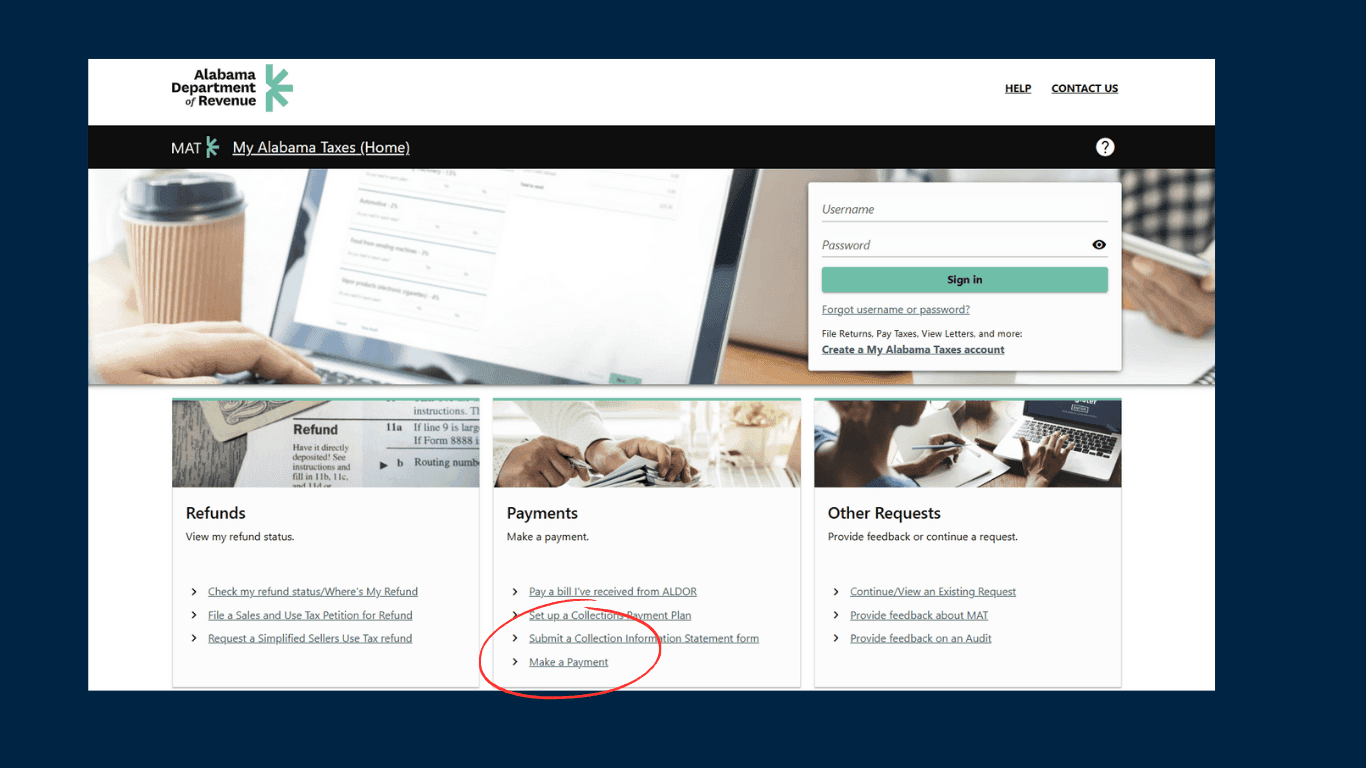
By mail. Complete Form 40V and check the “Automatic Extension Payment” box. Make the check payable to Alabama Department of Revenue and write your Social Security number on it. Mail it, without your return, to the address printed on the voucher:
Alabama Department of Revenue
P.O. Box 327467
Montgomery, AL 36132-7467
“DO NOT staple or attach your payment or Form 40V to your return or to each other,” the voucher adds.
Over $25,000. The mail option closes above this amount, and the payment section below explains the electronic payment rule.
Step 3: Keep a record of your payment method
Keep a record of your payment method just in case (e-check, credit card receipt, check stub). Place your payment amount on Form 40, line 23, labeled "2025 Estimated Tax Payments/Automatic Extension Payment".
Step 4: File your return by October 15, 2026
Your return is due October 15, 2026. If you’re mailing a paper return, don’t send it to the P.O. box above. That address only takes extension payments, so a return sent there can sit in the wrong pile. The booklet’s "Where To File" page has the right address for your return.
What Are the Alabama Tax Extension Deadlines for 2026?
Deadline | Date | Day |
|---|---|---|
Original due date for 2025 returns | April 15, 2026 | Wednesday |
Extension payment due | April 15, 2026 | Wednesday |
Alabama extended filing deadline | October 15, 2026 | Thursday |
Longest extension, unless you are abroad | Six months | n/a |
Alabama accepts the federal extension. No additional forms are needed, but you must still make payment by the due date.
The six-month limit has one exception, for taxpayers abroad. Otherwise, ALDOR says, “no extension will be granted for more than 6 months.” ALDOR does not publish a set length for that longer period.
Is There Any 2026 Disaster Relief for Alabama Income Tax?
ALDOR had announced none for individual income tax as of September 2026. It announces disaster relief event by event. After Hurricane Helene in 2024, it offered relief “on a case-by-case basis” to taxpayers in federally declared disaster areas. If a disaster affects you, confirm any later date on ALDOR’s news page before you rely on it.
How Much Should You Pay With an Extension?
Pay 100 percent of the tax you expect to owe. Alabama has no partial-payment threshold, so any shortfall draws a charge from April 15.
Take a worked example with $6,000 of 2025 Alabama tax and $4,500 withheld by your employer. Your balance due is $1,500, and all of it is due April 15, 2026.
Now suppose you send the $1,500 on August 10. ALDOR’s late payment charge is “1% of the unpaid amount for each month or fraction of a month.” That is four months, or $60. Interest adds roughly $31 more, for a total of about $91. Our penalty and interest calculator can help you estimate a federal balance the same way.
An April 15 Balance Accrues Interest at Two Different Rates in 2026
Yes, in 2026 an unpaid balance picks up interest at 6 percent and then 7 percent. Alabama uses the IRS underpayment rate under Section 40-1-44 of the Code of Alabama 1975, the state’s law code.
ALDOR’s quarterly interest rate table lists 2026 rates of 7 percent for January to March, 6 percent for April to June, and 7 percent for July to December. In the example above, April 15 to June 30 runs at 6 percent. From July 1 the rate is 7 percent.
Payments Over $25,000 Must Go by Electronic Funds Transfer
Yes, a large extension payment has to be electronic. Under rule 810-3-27-.03(4)(b), a payment over $25,000 “must be made via EFT,” meaning electronic funds transfer. A check with Form 40V is not an option at that amount.
What Alabama Charges If You File or Pay Late
The Alabama late filing penalty is 10 percent of the tax due or $50, whichever is greater. ALDOR says the penalty does not apply to a return showing no tax due or a refund.
The late payment charge is 1 percent per month or fraction of a month, capped at 25 percent. Interest runs on top of both.
Alabama Business Tax Extension Basics
Businesses follow separate Alabama rules. S corporations get their extra Alabama time through the federal extension. When the IRS grants one, it “is also granted for Alabama purposes,” according to ALDOR. Submit the federal Form 7004, the IRS business extension request, with Alabama Form 20S, the S corporation return. Pass-through payments go with Form PTE-V, the pass-through entity payment voucher.
The payment rule matches the individual one described above. Other entity types should check the ALDOR rules for their own return.
Do Military Servicemembers Get More Time to File in Alabama?
Possibly, if you are stationed overseas. Alabama allows an extension beyond six months only for taxpayers abroad, which covers a servicemember stationed outside the United States. Contact ALDOR to confirm the date that applies to you.
Federal law separately gives servicemembers in a combat zone extra time on their federal return. The combat zone tax extension page explains what that relief covers. The 2025 Alabama booklet covers two other military topics, how military pay is taxed and where a servicemember is a resident.
Combat Zone Pay Is Exempt From Alabama Income Tax
Yes. The booklet lists “compensation received from the United States for active service as a member of the Armed Forces” in a designated combat zone as income you do not report. The exemption also covers National Guard and Reserve members deployed outside the United States, and members activated for certain emergencies.
Residency follows the servicemember. Under the federal Soldiers’ and Sailors’ Civil Relief Act, now the Servicemembers Civil Relief Act, you do not lose your Alabama residence by being away on military orders. A nonresident servicemember with only a duty station in Alabama files Form 40NR only when there is Alabama income other than military pay.
Common Alabama Extension Mistakes to Avoid
- Assuming the extension is automatic after a late year. If you missed last year’s October 15 deadline, ALDOR may require a written request this year.
- Paying part of the balance and calling it enough. Alabama has no 90 percent rule. The full amount is due April 15.
- Mailing a check for more than $25,000. Payments above that amount must go by EFT.
- Sending the voucher to a return address. An extension payment mailed without a return goes to P.O. Box 327467.
- Using last year’s voucher. Download the 2025 Form 40V, which reads “Your 2025 return,” from ALDOR.
- Mailing Form 40V after paying online. The voucher is for mailed payments only.
- Leaving the extension payment off line 23. Enter it on Form 40, line 23. That line credits the amount you already paid.
Compare Alabama’s Extension Rules with Other States
State tax extension rules vary across the country.
Some states automatically accept the federal tax extension, while others require taxpayers to submit a separate state extension form.
Filing Your Alabama Extension
Alabama asks for very little here. Your Alabama return can wait until October 15, 2026, but any Alabama tax you owe is due April 15, 2026.
File your federal extension with FileTax.com for the IRS side, and let Alabama’s automatic six months cover your state return.
Frequently Asked Questions
You don’t need it. Alabama’s individual extension is automatic with or without federal Form 4868, and ALDOR asks for no copy of it. Our federal extension accepted page compares how other states handle this. Our guide to the federal extension process covers the IRS side.


