



What Qualifies as Head of Household on Taxes?
Fact Checked
FileTax.com content is reviewed for accuracy, timeliness, and completeness. It undergoes a structured editorial review process involving writers and expert reviewers.
More on our editorial standards Meet our editorial team Karen Van ThournoutTax & Financial Content Specialist
 Lea Uradu, JDTax Content Reviewer
Your Takeaways:
- You must be unmarried or considered unmarried, pay over half of household expenses, and have a qualifying person to file as Head of Household.
- A qualifying person can be a child, certain relatives, or a dependent parent, and parents don’t need to live with you to count.
- Temporary absences like school, medical care, or military service still count as living with you for HOH purposes.
- Filing as HOH provides a higher standard deduction and wider tax brackets than Single status, which can lower your tax bill.
Filing as Head of Household may reduce your tax bill because it offers a higher standard deduction and wider tax brackets than the Single filing status. However, you must meet IRS tests to qualify for your marital status, household support, and having a qualifying person.
Quick Answer: Who Can File as Head of Household?
The head of household filing status depends on three Internal Revenue Service tests: being unmarried (or considered unmarried), paying more than half the cost of keeping up your home, and having a qualifying person such as a child or dependent parent. In practical terms, single parents, certain separated spouses, and adults supporting a dependent relative may qualify if they meet all IRS requirements.
IRS Rules for Head of Household Filing Status
The IRS uses three main tests to determine if you qualify for head of household filing. Let’s walk through them step by step.
Step 1: Marital Status Test
You must be unmarried or considered unmarried on the last day of the tax year. The IRS allows you to be considered unmarried if:
- You lived apart from your spouse for more than the last six months of the year, and you meet all the IRS requirements, including filing separately, paying more than half the cost of keeping up the home, and having a qualifying person.
- You are legally separated or divorced under a final decree.
- Special rules apply if your spouse is a nonresident alien. You generally cannot claim HOH unless you meet the ‘considered unmarried’ tests and have a qualifying person.
👉 Related reading: Can You File Head of Household If You’re Married?
Getting married before the year ends disqualifies you from the Head of Household filing status. When that time comes, your options are Married Filing Jointly or Married Filing Separately.
Step 2: Support Test
You must pay more than half the cost of keeping up your home for the year. Qualifying costs include:
- Rent or mortgage interest payments
- Property taxes
- Utilities (gas, electricity, water, trash removal)
- Food consumed at home
- Household repairs and insurance
Clothing, vacations, life insurance, child care, education, medical expenses, and transportation are not included.
Step 3: Qualifying Person Test
The final test requires that you have a qualifying person who lived with you for more than half the year. The key exception is for parents: they don’t need to live with you if you pay more than half the cost of keeping up their main home for the year. This rule still applies if your parent lives in a nursing home, care facility, or their own residence, as long as you cover more than half of the household costs.
This may include:
- A qualifying child: your biological, adopted, step, or foster child, or a descendant of any of them (such as your grandchild), or a sibling, half-sibling, step-sibling, or a descendant of one (such as your niece or nephew). The child must also meet IRS age, residency, and support tests.
- A qualifying relative: such as a grandparent, in-law, uncle, or aunt, who meets the IRS relationship, residency, gross income, and support tests.
- A dependent parent supported by you, even if not living in your home
Temporary absences (such as school, medical treatment, or military service) still count as the child living with you.
👉 Related reading: Who Is a Qualifying Dependent for Head of Household?
Eligibility Checklist for Head of Household
Here’s a quick way to check if you qualify:
Requirement | Do you Qualify? |
|---|---|
Unmarried or considered unmarried at year-end | Yes / No |
Paid more than half the cost of keeping up your home | Yes / No |
Had a qualifying person live with you more than half the year (or supported a dependent parent) | Yes / No |
You may qualify for Head of Household filing status if you answered “Yes” to all three.
If you answered ‘No’ to any question, you generally must file as a Single, Married Filing Jointly, or Married Filing Separately, depending on your situation.
Want a faster way to decide?
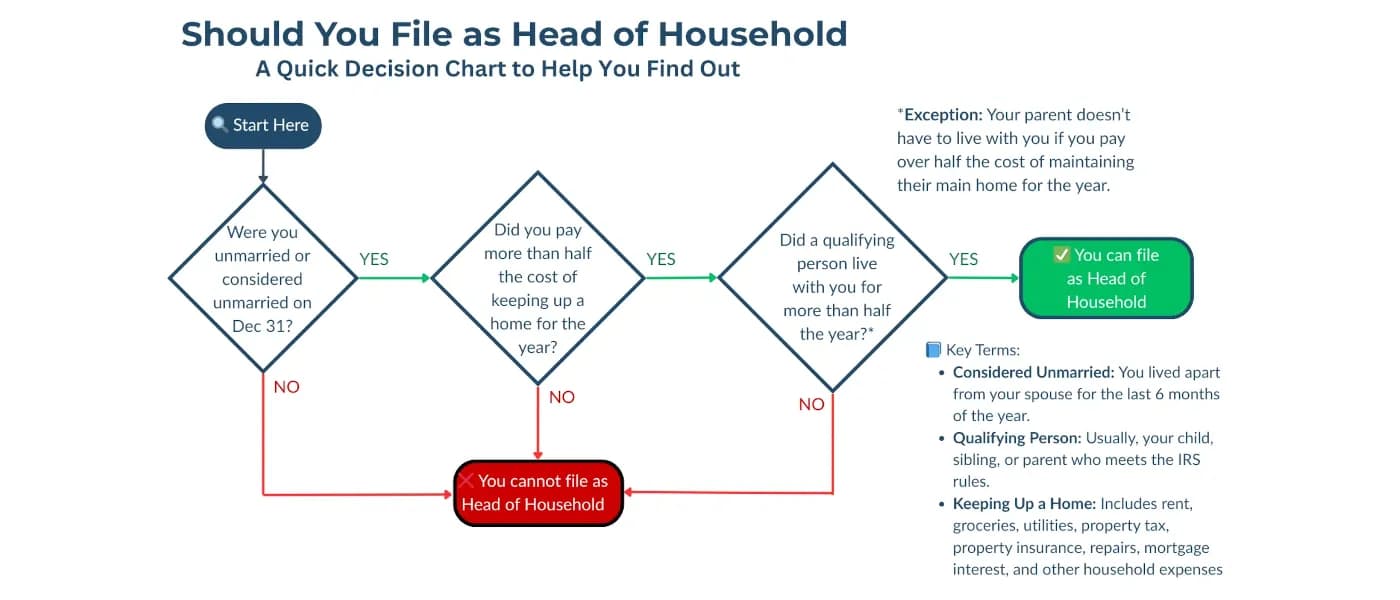
Use this simple flowchart to see if you meet the IRS rules for head of household. Follow the arrows to check whether you're married or unmarried, whether you paid more than half of the household expenses, and whether you had a qualifying person. If you answered Yes to all three, you may qualify.
Examples of Head of Household Situations
Let’s bring the rules to life with some everyday scenarios.
Example 1: Single parent with a child
Jane is unmarried, pays more than half the cost of keeping up the home, and has lived with her child for the entire year. Thus, she qualifies as head of household.
Example 2: Divorced or separated parents
Chris and Pat are divorced. Their child lived with Chris for seven months and Pat for five. Chris is the custodial parent and can qualify for Head of Household. Although Pat is the noncustodial parent, with Form 8332, she may be able to claim the Child Tax Credit but cannot claim HOH.
Example 3: Supporting a parent
Taylor pays more than half of her mother’s nursing home costs, which is the same as paying more than half the cost of her mother’s main home for tax purposes. Even though her mother doesn’t live with Taylor, she is considered a qualifying person, making Taylor eligible for the HOH tax filing status.
Example 4: Foster child case
Jordan, unmarried, takes care of a foster child placed by a court order. Since Jordan pays more than half the cost of keeping up the home, he qualifies as the head of household.
Head of Household vs. Single Filing Status (2026)
Filing Status | Standard Deduction (2026) | Tax Brackets (2026) - 12% Bracket | Notes |
|---|---|---|---|
Head of Household | $24,150 | $17,701 to $67,450 taxable income | Larger deduction + wider brackets = lower tax bill |
Single | $16,100 | $12,401 to $50,400 taxable income | Smaller deduction + narrower brackets = higher taxable income |
Why It Matters
- A Head of Household filer saves $8,050 more in standard deductions than someone filing Single.
- The wider 12% tax bracket also delays when income is taxed at the higher 22% rate.
- Combined, these rules often mean hundreds or even thousands in tax savings compared to the Single tax status.
What to Do Next
Still unsure? Try these resources:
- IRS “What’s My Filing Status” Tool
- IRS Publication 501
- Our guide: Head of Household Filing Status: Rules, Requirements, and How to Qualify

Wrap-Up
If you’ve wondered what qualifies a person as Head of Household, the answer depends on three tests: civil status, household support, and a qualifying person. Meeting these eligibility criteria often leads to a higher standard deduction and wider brackets than other filing statuses.
Need help filing your return? Consider using FileTax.com to simplify the process.
Other Categories
Why Trust FileTax.com
• Written and reviewed by qualified tax professionals, including CPAs and tax law reviewers
• Reviewer and contributor profiles include credentials, expertise, and verification information
• Content is reviewed for tax accuracy, compliance, and clarity before publication
• Based on IRS guidance, state tax agencies, and current tax law updates
• Editorial standards and review processes are publicly documented
Links
FAQs About Head of Household
Yes, but only if each has their own qualifying person and pays more than half the cost of maintaining their part of the household. For example, two roommates who each support a child can both qualify. But if two taxpayers claim the same qualifying person or share expenses for the same household, only one can file as Head of Household.


