




My Spouse Died — How Do I File My Taxes?
Fact Checked
FileTax.com content is reviewed for accuracy, timeliness, and completeness. It undergoes a structured editorial review process involving writers and expert reviewers.
More on our editorial standards Meet our editorial team Karen Van ThournoutTax & Financial Content Specialist
 Lea Uradu, JDTax Content Reviewer
Your Takeaways:
- You can still file Married Filing Jointly for the tax year in which your spouse died.
- In the two years after the death, you may qualify as a Qualifying Surviving Spouse if you have a dependent child and do not remarry.
- Qualifying Surviving Spouse status allows you to use MFJ tax brackets and the highest standard deduction for up to two years.
- Without a qualifying child, most surviving spouses must file as Single starting the year after the death.
- Filing status changes alone can significantly affect your tax rates, deductions, and credits, even if income stays the same.
If your spouse died during the tax year, you can still file Married Filing Jointly for that year. In the next two years, you may qualify as a Qualifying Surviving Spouse if you have a dependent child and do not remarry.
Losing a spouse is devastating, and trying to deal with taxes on top of that can feel overwhelming. Many people search online for guidance using phrases like ‘my spouse died, how do I file taxes,’ so if you’re unsure where to start, you’re not alone. The IRS gives surviving spouses several filing status options, but choosing the right one depends on the year the death occurred, your household situation, and whether you have a qualifying dependent.
This guide walks you through the big picture, skipping unnecessary jargon and focusing on what actually changes when a spouse passes away. We also show you where the Qualifying Surviving Spouse status fits into the pathway for future years.
Introduction to Filing Taxes After a Spouse’s Death
When a spouse dies, the tax rules shift in ways that can be confusing. Your filing status affects your standard deduction, your tax brackets, and the total income tax you may owe. It also determines whether you can file a joint return, qualify as a surviving spouse, or need a different filing status in future years.
This article focuses on the decisions you must make, without retelling the full MFJ, MFS, HOH, or year-of-death rules that appear in other sections of the Tax Help Center. You will learn the essential steps for filing the final tax return, choosing the correct status, and understanding how your spouse’s death impacts your federal income taxes going forward.
How Your Filing Status Changes After a Spouse’s Death
Your filing status is not just a label. It affects everything from the standard deduction to tax credits to which income gets included on the return. After a spouse dies, the law treats you as considered married for the entire tax year in which the death occurred. This means you may still be able to use the married filing options for that year.
Here is the general filing pathway survivors follow:
- Year of death
You choose between married filing jointly or married filing separately, depending on your situation. - Years 1 and 2 after the death
If you meet the IRS requirements, you may qualify for qualifying surviving spouse status, which offers the same tax brackets as married filing jointly. - After the surviving spouse eligibility ends
You transition to either Head of Household (if eligible) or Single.
Year | Possible Filing Status | Notes |
|---|---|---|
Year of death | MFJ or MFS | You’re considered married the entire year |
Year 1 | QSS (if eligible) | Same brackets as MFJ |
Year 2 | QSS (if eligible) | Must still meet requirements |
Year 3+ | HOH or Single | Depends on dependent + household rules |
Step 1: File the Final Tax Return for the Deceased Spouse
The final tax return reports all income earned by your spouse from January 1 through the date of death. This includes wages, self-employment income, interest earned, mutual fund distributions, and any other taxable amounts tied to your spouse.
Who signs the final return
A surviving spouse usually signs the income tax return on behalf of the deceased taxpayer. If a personal representative or court-appointed representative is managing the estate, that person signs instead.
You usually sign the final return as the surviving spouse. If you’re claiming a refund and no court-appointed representative exists, the IRS may require Form 1310 and supporting documents, such as proof of death. These documents confirm who is legally authorized to act on behalf of the deceased person or their estate.
When the final return is due
The deadline is the regular tax deadline. Most years, that is April 15. If you need more time, you can file an extension.
Step 2: Choose the Correct Filing Status for the Year of Death
You generally have two filing status options for the year your spouse passed:
Married Filing Jointly
Many survivors use Married Filing Jointly because it tends to produce the lowest tax bill and allows access to the married tax rates. A joint return may also simplify reporting, since you can file jointly even if your spouse passed away at any point during the year.
Married Filing Separately
Some survivors must use the Married Filing Separately status because of legal, financial, or personal reasons. However, this choice often reduces the standard deduction and may limit certain tax credits.
Working with an expert allows you to run the numbers both ways. It’s the best way to ensure you aren't leaving money on the table or paying more than you strictly owe.
What If I Don’t Have a Dependent Child?
If you do not have a qualifying dependent child, your filing pathway is different and often results in a higher tax bill starting the year after your spouse's death.
- The Year of Death: You can still file Married Filing Jointly.
- The Following Years: Without a qualifying child, you typically cannot use the Qualifying Surviving Spouse status. Instead, you must file as Single starting the very next year.
The Impact of Filing "Single"
Switching to the Single filing status can cause a substantial shift in your tax return because:
- Smaller Standard Deduction: The standard deduction for Single filers is half of the amount for Joint or QSS filers (e.g., $16,100 vs. $32,200 in 2026).
- Higher Tax Rates: Single tax brackets are narrower, meaning you reach higher tax percentages (like the 22% or 24% bracket) at much lower income levels than you did when filing jointly.
- The "Widow's Penalty": Many taxpayers refer to this sudden jump in tax liability as the widow's penalty, as you are essentially taxed more on the same amount of income.
Step 3: See If You Qualify as a Surviving Spouse in Future Years
After the year of death, some taxpayers qualify for the Qualifying Surviving Spouse filing status for up to two years. This status is also known as:
- Qualifying Widow
- Qualifying Widower
Qualifying Surviving Spouse status gives you the same tax brackets and standard deduction as Married Filing Jointly for up to two years after your spouse’s death, as long as you meet all eligibility rules. It can significantly reduce your income tax for the next two years.
Qualifying Surviving Spouse requirement
You must have a qualifying child, such as a biological child, adopted child, or stepchild. Foster children do not qualify for QSS unless they were legally adopted. The child must live with you all year, and you cannot remarry during the QSS period. Check out our full eligibility rules.
Source: IRS Pub. 501, Qualifying Surviving Spouse
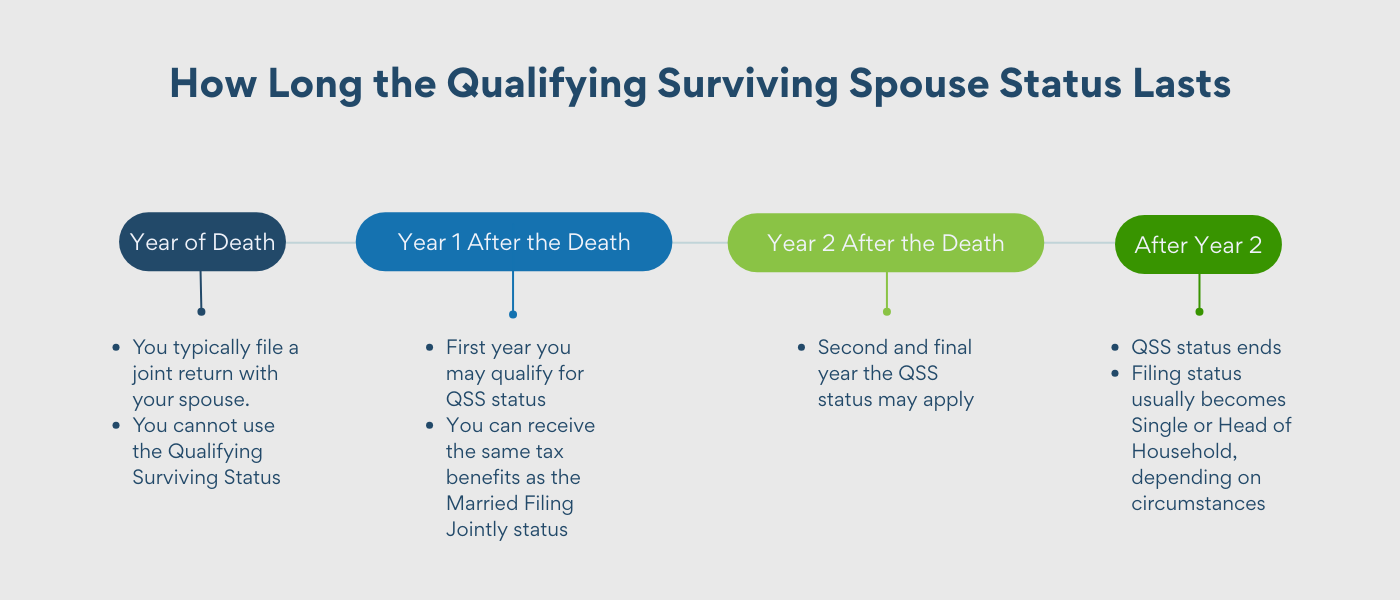
How QSS fits your filing pathway
Year of death → Possible QSS Year 1 → Possible QSS Year 2 → HOH or Single afterward.
Step 4: How Income, Deductions, and Credits Work After a Spouse Dies
When a spouse passes away, your tax return often becomes a blend of:
- Income that belonged to your spouse before death
- Income you earned during the year
- Income the estate earns after death
Estate income, like interest, dividends, or business income, may require a separate estate return (Form 1041) if gross income exceeds the filing threshold.
Deductions and credits
Your ability to itemize deductions, use certain tax credits, or access specific benefits depends heavily on your filing status. For many survivors, Married Filing Jointly or Qualifying Surviving Spouse status provides access to the most favorable lower tax bracket.
Related Topic: Standard Deduction and Tax Benefits for Qualified Surviving Spouse
Step 5: Refunds and Taxes Owed After a Spouse’s Death
A surviving spouse may receive a refund if the deceased spouse had too much withholding or estimated tax payments. If no appointed representative exists and you are the person claiming a refund, the IRS may require additional documentation.
If taxes are due, either the estate or the surviving spouse may be responsible. This depends on the type of return filed and whether a joint return was used.
The IRS offers payment plans if paying the balance immediately is not possible.
Step 6: Signing and Submitting Your Return
In most cases, the surviving spouse signs the tax return on behalf of both parties. If a representative handles the estate, that person signs instead. Write ‘Deceased’ and the date of death above your spouse’s name on the return. You sign as the surviving spouse unless a court-appointed representative is administering the estate.
When required, Form 1310 identifies who is authorized to claim a refund for the deceased individual.
A correctly signed return helps you avoid processing delays with the IRS.
Source: IRS Pub. 559
Step 7: Filing Pathway Summary
Here is the big picture of how taxes work after a spouse passes away:
- Complete the final return for the spouse who passed.
- Choose your filing status for the year of death.
- Evaluate next year’s status, including eligibility for filing as a surviving spouse.
- Plan ahead for when QSS ends, which may shift you to HOH or Single, depending on your household status.
- Ask a tax professional or certified public accountant if your situation involves multiple dependents, complex assets, or income from the spouse’s estate.
By following these steps, you can answer the question so many people have during this difficult time: My spouse died, how do I file taxes.

You Don’t Have To Navigate This Alone
Filing taxes after losing a spouse is one of those life tasks no one prepares you for. The rules get complicated, the paperwork feels endless, and choosing the right filing status can impact your finances for years. Whether you end up filing jointly for the year of death, using surviving spouse status, or transitioning to another category later, the goal is simple. Make choices that protect your income, minimize stress, and support your family’s future.
If things still feel confusing, that is normal. A tax professional or certified public accountant can help you sort through your options, especially when estates, dependents, or multiple returns are involved. You deserve clarity at tax time, and you deserve support while adjusting to life after your spouse’s death.
Whenever you’re ready to file or want a second pair of eyes on your return, FileTax.com is here to help you feel confident at tax time. Jump in and file your taxes today.
FAQs About Filing After a Spouse’s Death
If you file a joint return, you may be responsible for any balance due. Otherwise, the estate typically pays.


