




How to Fill Out a W-4 If Married and Both Work
Fact Checked
FileTax.com content is reviewed for accuracy, timeliness, and completeness. It undergoes a structured editorial review process involving writers and expert reviewers.
More on our editorial standards Meet our editorial team Andrew WalshCPA, CFP CTFA & Tax Content Specialist
 Lea Uradu, JDTax Content Reviewer
Your Takeaways:
- Withholding matters: The W-4 controls how much tax is taken from each paycheck—get it wrong, and April could sting.
- Dual-income couples need coordination: If both spouses work, you must plan together to avoid underwithholding or overwithholding.
- Know the W-4 steps: From personal info to dependents to other income—each section affects your bottom line.
When you both work, each employer figures your withholding from its own paycheck. Neither W-4 knows about the other job, so the two paychecks together can come up short, and that gap shows up as a tax bill in April. Learning how to fill out a W-4 if married, with both of you working, is how you close it.
How to Fill Out W-4 If Married, in Five Steps
Step 1: Enter Personal Information and select “Married filing jointly"
Step 2: Multiple Jobs or Spouse Works if both spouses work.
Step 3: Claim Dependent and Other Credits on only one W-4, if applicable.
Step 4: Other Adjustments for other income, deductions, or extra withholding when needed.
Step 5: Sign Here on each W-4 before giving the forms to your employers.
If either of you has self-employment income, use the IRS Tax Withholding Estimator instead of the Step 2 checkbox.
Exempt From Withholding
The 2026 Form W-4 includes a separate checkbox for employees who qualify for exemption from federal income tax withholding. To qualify, you must have had no federal income tax liability in 2025 and expect to have none in 2026. If you claim exemption, complete only Steps 1(a), 1(b), and 5, and check the exemption box. To continue claiming exemption for 2027, you must submit a new Form W-4 by February 16, 2027.
Why Married Couples With Two Jobs Often Owe Taxes
Each employer only sees its own paycheck, not your combined income. If you want the full reason two incomes come out under-withheld, read why two incomes can get under-withheld.
How to Fill Out the W-4 Form Step-by-Step
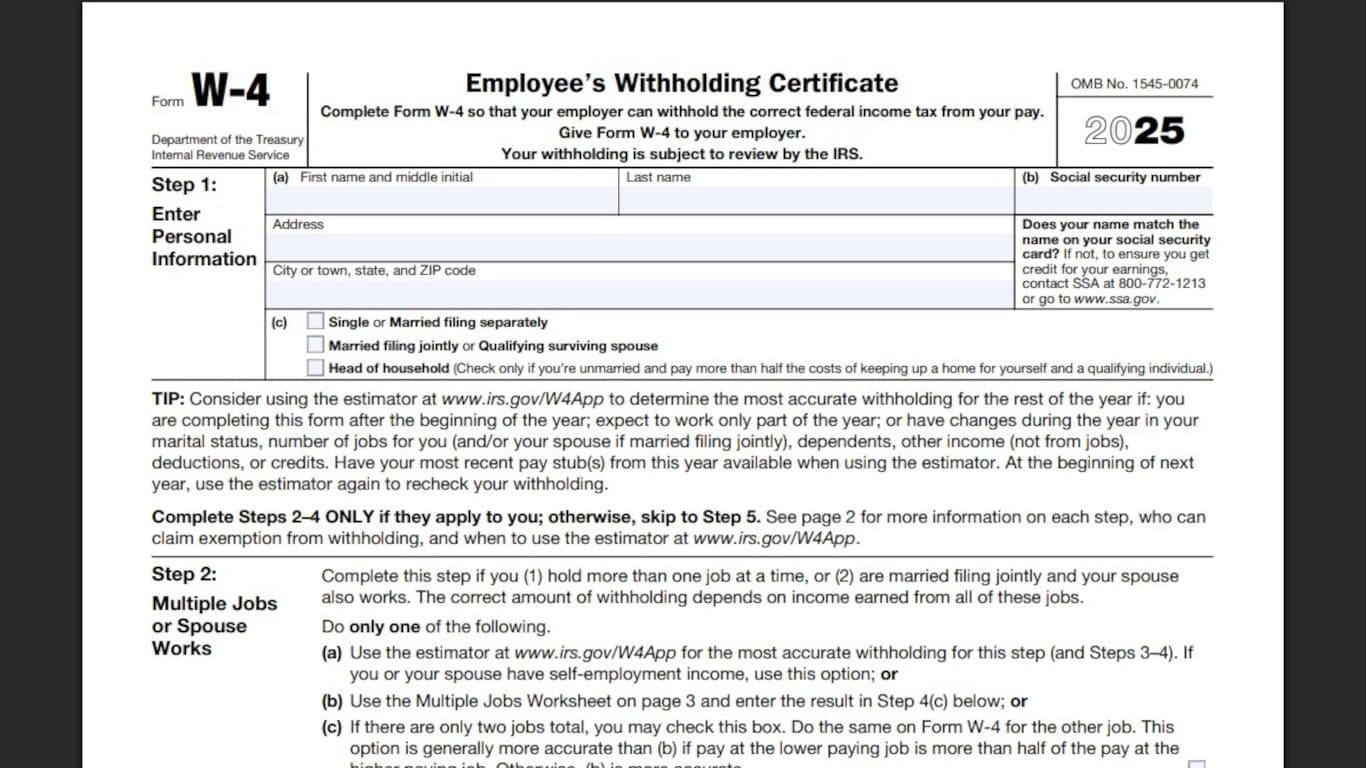
If you need the basics of the form first, start with our Form W-4 guide.
Step 1: Enter Personal Information
Enter your name, address, and Social Security number. Then select the filing status that matches your expected tax return.
For a married couple filing jointly, select “Married filing jointly or Qualifying surviving spouse.” The form also asks whether your name matches the name on your Social Security card. If it does not, the IRS directs you to contact SSA.
Not sure you’ll file jointly? Settle that first, because the W-4 should match the return you expect to file. Our guide to filing jointly vs. separately walks through the choice.
Step 2: Multiple Jobs or Spouse Works
Complete Step 2: Multiple Jobs or Spouse Works if you have more than one job at the same time or you are married filing jointly and your spouse also works. The IRS provides three options.
Option (a) is to use the IRS Tax Withholding Estimator. The IRS specifically says to use this option if you or your spouse have self-employment income.
Option (b) is to use the Multiple Jobs Worksheet on page 3 and enter the result in Step 4(c).
Option (c) is available when there are only two jobs total. You can check the box on both Forms W-4. This option is usually more accurate than the worksheet when the lower-paying job pays more than half of the higher-paying job.
Steps 3 through 4(b) go on only one of the two W-4s. Use the one for the higher-paying job, because the IRS says that’s where your withholding comes out most accurate.
Step 3: Claim Dependent and Other Credits
If you have qualifying children or other dependents and expect to claim applicable credits, enter the appropriate amount in Step 3: Claim Dependent and Other Credits.
For 2026, the form uses $2,200 for each qualifying child under 17 and $500 for each other dependent, as long as your total income is $400,000 or less if you file jointly. Put your dependents on the higher-paying job’s W-4 only. If you both list the same children, your employers may withhold too little.
Step 4: Other Adjustments
This step has three parts:
- Step 4(a): Other income (not from jobs) includes income you expect to receive that will not have withholding. The 2026 form gives interest, dividends, and retirement income as examples.
- Step 4(b): Deductions lets you account for deductions that may reduce your withholding. The form directs you to the Deductions Worksheet on page 4. This can include deductions beyond the standard deduction, depending on your situation.
- Step 4(c): Extra withholding lets you request an additional amount of federal income tax to be withheld from each paycheck.
Not every dollar of other income or every deduction belongs here. Follow the form’s instructions for each one, or let the estimator do the math.
Step 5: Sign Here
Sign and date each W-4 before you hand it in. The form says it is not valid unless you sign it.
Common W-4 Mistakes to Avoid
Married couples who both work should watch for these common mistakes:
- Failing to account for both spouses' income
- Completing Step 3 on both W-4 forms
- Ignoring self-employment income
- Forgetting about other income such as dividends or retirement income
- Using the wrong filing status
- Failing to update a W-4 after a major change
- Forgetting to sign Step 5
How to Update Your Form W-4 After the Wedding
After getting married, each spouse should complete a new Form W-4 for their own job, reflecting their updated filing status and household income. If you married late in the year, rerun the withholding estimator to see whether your withholding needs adjustment.
Real-Life Example: Meet Sarah and James
Sarah and James are married and both work. James earns $70,000 a year, and Sarah earns $60,000. They have one qualifying child and plan to file a joint return.
They have two jobs between them, so each of them checks the box in Step 2(c) on their own Form W-4. The 2026 form says to do it on both: "If there are only two jobs total, you may check this box. Do the same on Form W-4 for the other job."
James holds the higher-paying job, so his W-4 carries the dependent information. He enters their child in Step 3: Claim Dependent and Other Credits. Sarah leaves Step 3 blank on hers.
James, $70,000 (higher-paying job) | Sarah, $60,000 | |
|---|---|---|
Step 1(c) filing status | Married Filing Jointly | Married Filing Jointly |
Step 2(c) box | Checked | Checked |
Step 3 dependents | Their Child | Blank |
Step 4(c) extra withholding | Only if the estimator calls for it | Blank |
Step 5 | Signs and dates | Signs and dates |
If either of them picks up a third job, the two-job checkbox no longer applies. They use the IRS estimator or the Multiple Jobs Worksheet on page 3 instead.
Check Both W-4s Before You Hand Them In
Sarah and James got three things right: the Step 2(c) box checked on both forms, their child listed only on James’s W-4, and both forms signed. Pull out your own two W-4s and look for those same three things. If one is missing, hand in a corrected form now, while there are still paychecks left in the year to fix the gap. Wait until after December, and that gap shows up on your tax return instead.
Newly Married?
If you recently got married, our Newlywed Tax Starter Kit can help you review your filing status, update your W-4, and prepare for common tax changes after marriage.
Frequently Asked Questions
If you plan to file a joint tax return, select “Married Filing Jointly” in Step 1(c) of Form W-4.


