




Pennsylvania Tax Extension Rules and Filing Deadlines
Everything you need to know about extending your Pennsylvania state tax deadline.
Fact Checked
FileTax.com content is reviewed for accuracy, timeliness, and completeness. It undergoes a structured editorial review process involving writers and expert reviewers.
More on our editorial standards Meet our editorial team Andrew WalshCPA, CFP CTFA & Tax Content Specialist
 Lea Uradu, JDTax Content Reviewer
Your Takeaways:
Original filing and payment deadline: April 15, 2026
Extended filing deadline: October 15, 2026
Extension length: 6 months
Payment still due: April 15, 2026
Extension form, if you need one: REV-276
A Pennsylvania tax filing extension buys six more months, and plenty of filers get them without sending anything at all. Whether you are one of them comes down to a single question: do you owe Pennsylvania anything?
That answer drives everything else here. Pennsylvania passes your federal extension through only when you expect to owe the state nothing further. Anyone carrying a balance has to ask separately.
This page covers individual filers submitting a Pennsylvania Personal Income Tax return on Form PA-40 for tax year 2025, whether you are a resident taxpayer, a nonresident taxpayer or a part-year resident. For the federal side of the process, see our guide to filing a tax extension, and for everything else Pennsylvania, see the Pennsylvania state tax guide. For other states, start at the state tax extension hub.
How Does a Pennsylvania Tax Extension Work?
Pennsylvania grants a six-month extension of time to file a PA-40, moving you from an original filing deadline of April 15, 2026 to an extended filing deadline of October 15, 2026. How you get those months depends on your federal extension and on your balance.
Your Federal Extension Carries Over Only If You Owe Nothing
The Department of Revenue states the condition directly: “If a taxpayer has been approved an extension of time to file his/her federal income tax return and does not owe PA income tax with the state return, the Department will grant the same extension for filing the PA tax return.”
Read both halves. You need an approved federal extension from IRS Form 4868, and you need to expect no Pennsylvania tax due with the return. Filers who clear both send nothing to Harrisburg, not the state form and not a copy of the federal one.
Owe anything at all and the exemption stops applying. Filers who never obtained a federal extension never had it to begin with. Either situation puts you on Form REV-276 or an online extension payment.
Six Months Is the Individual Figure
Other Pennsylvania returns run shorter on the same form. Partnerships and S corporations filing a PA-20S or PA-65 get five months. Estates and trusts filing a PA-41 get five and a half.
Filers living abroad go the other way. Anyone who qualifies for the IRS automatic two-month extension receives two months on the PA-40, not six.
Pennsylvania also declines to handle these in bulk. A preparer cannot request extensions for a group of clients in one go, and the Department says blanket requests will not be considered.

How Do You File a Pennsylvania Tax Extension?
Step 1: Work out what you owe Pennsylvania
Pennsylvania taxes personal income at a flat 3.07 percent and has since 2004. No brackets, no standard deduction, no personal exemption. Gather your tax documents first. Multiply your expected Pennsylvania taxable income by 3.07 percent, then subtract the tax withholding shown on your W-2 and 1099 forms, any estimated payments already made, and any tax credits you expect to claim. A self-employed taxpayer or small business owner paying quarterly estimated tax payments rather than having tax withheld runs the same arithmetic from those payment records.
What remains is your balance, and it decides whether you need the form at all.
Step 2: Pay at least 90 percent by April 15, 2026
If there is a balance, clear it. If you cannot clear all of it, get 90 percent of your total tax liability paid by April 15. That figure is what stands between you and the underpayment penalty, and the section below explains the condition attached to it.
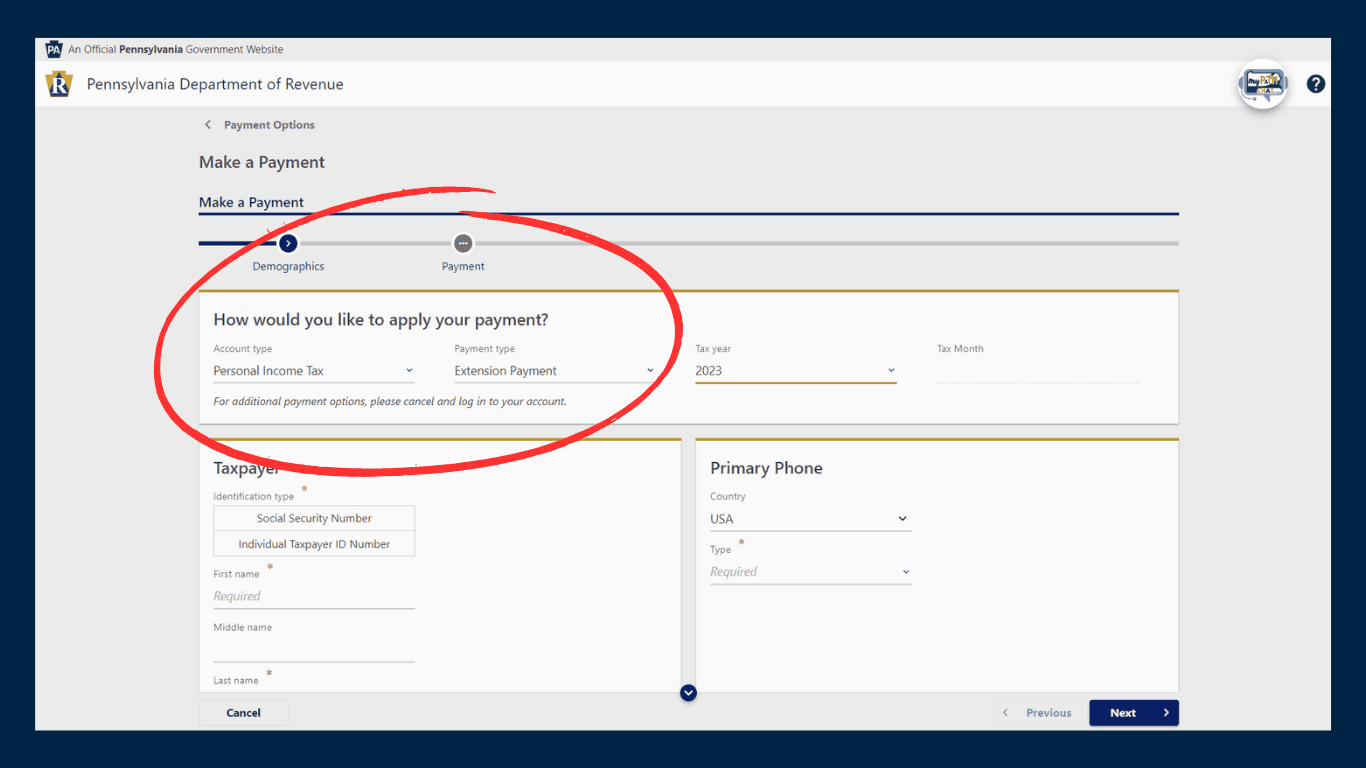
Step 3: Request the extension the way your payment dictates
Paying online covers both steps. The Department’s myPATH portal handles the payment and submits the extension request in the same transaction, and no paper follows. Pennsylvania notes that electronic processing may not be open to first-time PA filers.
Paying by check is what puts you on the form. REV-276 doubles as the payment voucher, so mail payment and form together to:
PA Department of Revenue
Bureau of Individual Taxes
PO Box 280504
Harrisburg PA 17128-0504
That address applies whether or not a payment is enclosed, so there is no second box to choose between.
Watch one threshold. Payments of $15,000 or more have to be made by electronic funds transfer, and paying a sum that size by check carries a charge of 3 percent of the payment, capped at $500.
Step 4: Keep the confirmation and file by October 15
Keep your payment confirmation and your filing record together, along with your copy of REV-276 if you filed one. Then file the completed PA-40 by October 15, 2026.
How Much Should You Pay With an Extension?
Pay the full balance where you can. Pennsylvania’s 90 percent threshold shields you from one charge and leaves a second one running.
The 90 Percent Rule Has a Second Half
Pennsylvania attaches two conditions to that threshold, and the second lands six months after the first.
From the Personal Income Tax Guide: “No underpayment of tax penalty will be charged if at least 90 percent of the total tax liability was paid by the original due date and all additional tax is paid with the extension on or before the extended due date. However, interest will be imposed on the amount that was not paid by the original due date of the return.”
Three things sit in that passage. Ninety percent by April 15 is the first condition. Clearing the rest by October 15 is the second, and missing it forfeits the waiver even if you met the first. And the waiver covers the penalty alone. Interest runs on every dollar you carried past April regardless of how well you did on the threshold.
Say your Pennsylvania liability comes to $4,000 and your employer withheld $3,400. You are $600 short, which is 15 percent of the total, so reaching the 90 percent mark means sending at least $200 by April 15. Interest starts on the remaining $400 that day, and that $400 has to reach the Department by October 15 for the penalty waiver to hold.
Our penalty and interest calculator can help you estimate what a shortfall would cost.
Filing Late Compounds. Paying Late Does Not.
Pennsylvania charges these separately and only one of them grows.
Late filing costs 5 percent of the unpaid tax for every month or fraction of a month the return is late, up to 25 percent, with a $5 floor. The Department will waive it for reasonable cause. Underpayment costs a single 5 percent of the balance still owed after the original due date.
On that $600 shortfall, the underpayment penalty is $30 and stops. The filing charge opens at $30 and climbs each month toward a $150 ceiling.
Pennsylvania Sets Its Interest Rate Once a Year
Interest accrues on top of either charge. Pennsylvania fixes one rate per calendar year, taking whatever the U.S. Secretary of the Treasury has in effect on January 1 and holding it through December 31. For both 2025 and 2026 that rate is 7 percent, which works out to a daily factor of 0.000192.
The IRS resets its own rate quarterly, so a figure you looked up for a federal balance will not match what Pennsylvania charges you.
Your State Extension Does Not Cover the Local Earned Income Tax
Pennsylvania layers a second income tax underneath the state one, and the extension you just filed leaves it untouched.
Municipalities and school districts levy a local earned income tax, collected by a local tax collector for each tax collection district rather than by Harrisburg. The local tax return falls due April 15, the same day as the state one, moving to the next business day when the 15th lands on a Saturday or Sunday.
Form CLGS-32-1 is specific about what to do. If you have filed a federal or state application for extension, check the extension box on the front of the local form and send it in with your estimated payment by April 15. The local deadline holds on its own schedule.
So the local return still needs action in April even when your PA-40 does not. If you moved during the tax year, you file with the collector for each district you lived in.
Pennsylvania Business Tax Extension Basics
Corporations, partnerships and multi-member LLCs extend federally on Form 7004. On the Pennsylvania side, PA-20S and PA-65 filers get five months and PA-41 filers five and a half, both requested on the same REV-276 that individuals use.
The payment rule above applies here too. How Form 7004 works and which deadline attaches to which entity are covered on the business extension guide.
Do Military Servicemembers Get More Time to File in Pennsylvania?
Yes, and Pennsylvania asks for a specific step to claim it.
You Claim Combat Zone Relief by Labeling the Return
Pennsylvanians serving in a combat zone or a qualified hazardous duty area get the same additional time the federal rules allow. The deadline moves to 180 days from the last day of that service, or from the last day of continuous hospitalization for an injury incurred there.
The claiming step is manual and easy to miss. Print COMBAT ZONE at the top of your return and include a copy of your military orders. Pennsylvania routes these away from its usual mail. Paper returns go to PO Box 280600 in Harrisburg. If you e-file, send the orders separately by email or fax, labelled the same way.
The combat zone tax extension page covers the federal rules this sits on.
Common Pennsylvania Extension Mistakes to Avoid
- Assuming Form 4868 covers you. It carries over only when you also expect to owe Pennsylvania nothing. A balance puts you on REV-276 or an online extension payment.
- Treating 90 percent as the finish line. The waiver also needs the remainder paid by October 15, and it covers the penalty only. Interest runs on anything left unpaid after April 15 either way.
- Mailing a check for $15,000 or more. Payments at or above that figure must be electronic, and a paper one costs 3 percent of the payment up to $500.
- Using the federal interest rate. Pennsylvania sets one rate a year. The IRS resets quarterly.
- Asking for a group at once. The Department does not consider blanket extension requests.
- Sending a combat zone return to the standard address. Paper goes to PO Box 280600 with the orders attached.
- Forgetting the local return. Your state extension does not extend the local earned income tax return. Check the extension box on the local form and send your estimated payment to the tax collector by April 15.
Compare Pennsylvania Tax Extension Rules to Nearby States
If you live or work across state lines, you may also need to understand how nearby states handle tax extensions:
- New York tax extension
- New Jersey state tax extension
- Ohio tax extension rules
- Maryland tax extension
- West Virginia extension deadline
Each state has different requirements for payments and whether a separate extension form is required.
Filing Your Pennsylvania Extension
Everything here turns on one number. Work out your balance at 3.07 percent, and if it lands at zero your federal extension has already done the job. If you owe, pay at least 90 percent by April 15, request the extension through myPATH or on REV-276, and clear the remainder by October 15 so the waiver holds.
File your federal extension with FileTax.com and we will walk you through the federal side, which is what determines whether Pennsylvania needs anything from you at all.
Frequently Asked Questions
Only when you expect no Pennsylvania tax due with your return. Clear that and an approved federal extension carries over with nothing to file. Expect a balance and you need REV-276 or an online extension payment. Our federal extension accepted page covers how other states handle the same question.


